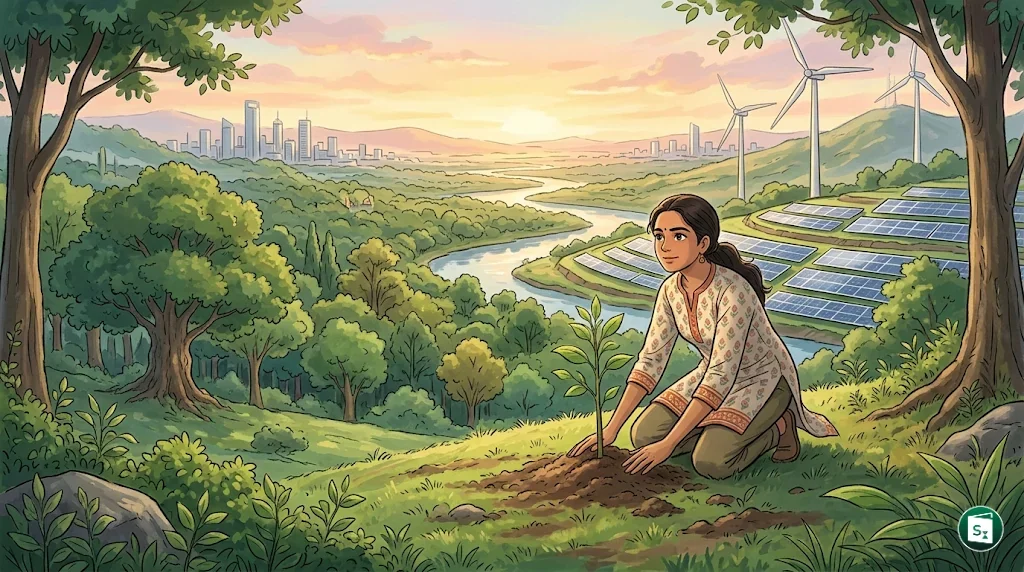
India formally submitted its third Nationally Determined Contribution (NDC) for the 2031-2035 period to the United Nations Framework Convention on Climate Change (UNFCCC) in April 2026. The new climate roadmap commits the country to a 47% reduction in the emission intensity of its GDP and a 60% share of non-fossil fuel energy capacity by 2035. This submission marks an escalation in India’s climate ambition as it aligns its developmental goals with the global effort to limit global warming under the Paris Agreement.
The Purpose of Nationally Determined Contributions
Under the Paris Agreement of 2015, nearly every country agreed to limit global temperature rise to well below 2 degrees Celsius, ideally 1.5 degrees. To achieve this, each nation must outline and communicate its climate actions through a document known as a Nationally Determined Contribution (NDC). These documents are updated and submitted every five years to the UNFCCC Secretariat, which is headquartered in Bonn, Germany.
The United Nations Framework Convention on Climate Change (UNFCCC) was established in 1992 at the Earth Summit in Rio de Janeiro to coordinate global efforts against climate change. Each successive NDC is expected to represent a progression beyond the previous targets, reflecting the highest possible ambition of the submitting country. India’s latest submission for the 2031-2035 period follows its previous commitments made in 2015 and the updated version submitted in 2022.
Key Targets for the 2031-2035 Period
India’s third NDC centers on three major quantitative targets that build upon the progress made under previous cycles. These targets are measured against a 2005 baseline and are designed to be achieved by the year 2035.
Decoupling Emissions from Economic Growth
The primary goal is to reduce the emission intensity of the Gross Domestic Product (GDP) by at least 47% by 2035. Emission intensity is a measure of the amount of greenhouse gases emitted for every unit of economic value generated. By targeting intensity rather than absolute emissions, India ensures that its economy can continue to grow while becoming progressively cleaner and more efficient. This target represents a step up from the 2030 goal of 45%, which India is already on track to surpass.
Accelerating the Transition to Non-Fossil Energy
India has pledged that about 60% of its cumulative electric power installed capacity will come from non-fossil fuel-based energy resources by 2035. This includes solar, wind, biomass, large hydro, and nuclear energy. This commitment reflects India’s rapid expansion of its renewable energy infrastructure. As of early 2026, the country has already achieved more than 52% of its capacity from non-fossil sources, demonstrating its role as a global leader in the energy transition.
Strengthening the National Carbon Sink
To combat residual emissions, the government aims to create an additional carbon sink of 3.5 to 4 billion tonnes of CO2 equivalent through expanded forest and tree cover. A carbon sink is a natural or artificial reservoir that absorbs more carbon than it releases. India plans to achieve this through massive afforestation drives, restoration of degraded lands, and ecological conservation programs. This target is a significant increase from the previous goal of 2.5 to 3 billion tonnes.
The Strategic Role of LiFE and Viksit Bharat 2047
Beyond quantitative metrics, India’s submission integrates the Lifestyle for Environment (LiFE) movement as a fundamental pillar of its climate strategy. The LiFE movement encourages a global shift from mindless consumption to mindful utilization, rooting climate action in India’s traditional values of sustainability. This behavioral approach aims to mobilize citizens as active participants in the green transition by promoting circular economy principles in everyday life.
The NDC is closely aligned with the national vision of Viksit Bharat (Developed India) by 2047. It emphasizes that India’s low-carbon development path will be pursued in a manner that does not compromise energy security, food security, or poverty eradication. The submission also highlights the importance of nature-based solutions, such as the Green Credit Program and the MISHTI (Mangrove Initiative for Shoreline Habitats and Tangible Incomes) scheme, in meeting the country’s expanded ecological and carbon sink targets.
Evolution of India’s Climate Commitments (2015 to 2035)
India’s climate journey since the Paris Agreement has been marked by a consistent over-performance in meeting its targets. In its first NDC in 2015, the country committed to a 33-35% reduction in emission intensity by 2030, a goal it reached nearly eight years early. Similarly, the initial target of 40% non-fossil fuel capacity was met in 2021, nine years ahead of the 2030 schedule. This track record of reliability has allowed the government to progressively raise its ambition in the latest submission.
| Feature | 2015 NDC (for 2030) | 2022 Update (for 2030) | 2026 NDC (for 2035) |
|---|---|---|---|
| Emission Intensity | 33-35% reduction | 45% reduction | 47% reduction |
| Non-Fossil Capacity | 40% share | 50% share | 60% share |
| Carbon Sink (Additional) | 2.5 to 3 billion tonnes | 2.5 to 3 billion tonnes | 3.5 to 4 billion tonnes |
All these targets are calculated from a 2005 baseline and demonstrate India’s long-term commitment to reaching Net Zero emissions by the year 2070.
Global Climate Action and the Funding Challenge
While India has significantly raised its climate ambition, the latest submission underscores that these goals are not unconditional. The achievement of the targets for the 2031 to 2035 period is contingent upon the availability of adequate climate finance, low-cost technology transfer, and capacity-building support from developed nations. India has consistently called for an end to the mitigation ambition gap from wealthier countries, which bear a historical responsibility for global greenhouse gas emissions.
The document also points out that India’s per capita emissions remain far below the global average, even as it takes on massive infrastructure and developmental projects. By integrating climate goals with its national development agenda, the country aims to demonstrate that economic prosperity and environmental sustainability can be achieved simultaneously. This balanced approach is essential for maintaining global climate momentum while ensuring equitable growth for the developing world.
Key Takeaways
- India submitted its third Nationally Determined Contribution (NDC) to the UNFCCC in April 2026, covering the targets for the 2031 to 2035 period.
- The country has committed to reducing the emission intensity of its GDP by at least 47% from the 2005 baseline by 2035.
- India aims to achieve 60% cumulative electric power installed capacity from non-fossil fuel-based energy resources by the year 2035.
- The government has pledged to create an additional carbon sink of 3.5 to 4 billion tonnes of CO2 equivalent through expanded forest and tree cover by 2035.
- These climate goals are formally integrated with the Lifestyle for Environment (LiFE) movement and the national vision of Viksit Bharat 2047.
- The UNFCCC, established in 1992 and headquartered in Bonn, Germany, coordinates global efforts to limit warming under the Paris Agreement.