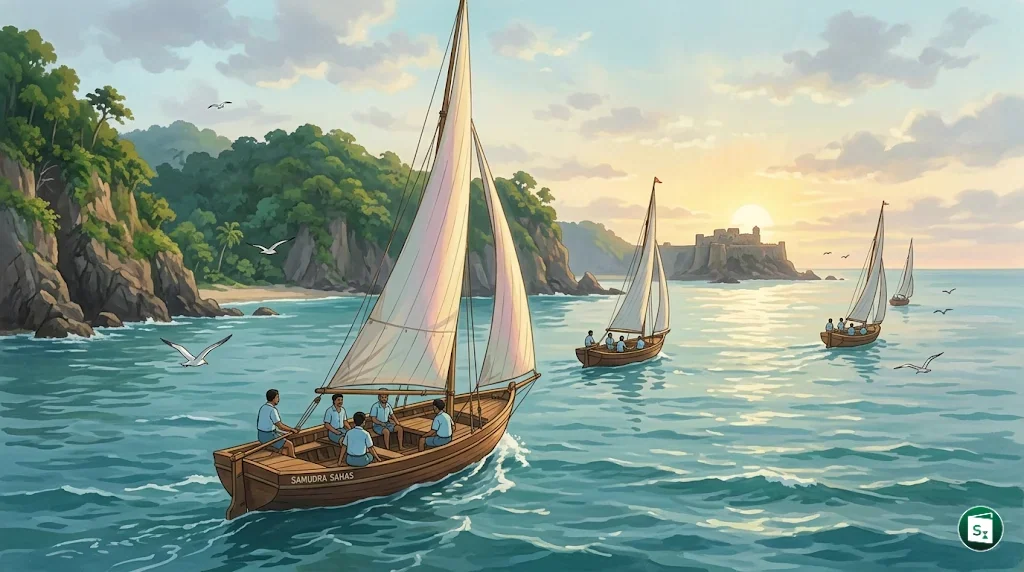
The Regiment of Artillery of the Indian Army achieved a historic milestone by launching its first blue water sailing expedition, ‘Samudra Sahas’, from Marve in Mumbai. Flagged off on April 20, 2026, the expedition commemorates the 200th anniversary of the Regiment’s raising and honours the maritime legacy of Chhatrapati Shivaji Maharaj. The team of ‘Gunners’ will navigate 520 nautical miles along the treacherous Konkan Coast, testing their endurance and seamanship in Seabird class boats.
Celebrating Two Centuries of Valour: The Samudra Sahas Expedition
The expedition was ceremonially flagged off by Lieutenant General NS Sarna, who serves as the Commandant of the School of Artillery and the Senior Colonel Commandant of the Regiment. This venture is unique as it represents the first instance of an artillery unit undertaking a “blue water” sailing mission, moving beyond traditional land-based operations into the challenging maritime domain.
The mission is led by Captain Kshitij Nair and Subedar Prakash Funde, with ground support managed by Major Vardhan Shidhye. The primary goal of Samudra Sahas is to foster essential military qualities such as leadership, resilience, and collaborative teamwork among the participants. By venturing into the open sea, the Regiment aims to demonstrate that the spirit of a “Gunner” is not confined to the battlefield but extends to conquering new frontiers of adventure.
Strategic Route and Maritime Legacy
The expedition follows a demanding path of approximately 520 nautical miles along the Konkan Coast, a region known for its historical and strategic maritime significance. The voyage is divided into four distinct legs, connecting Mumbai to the historic sea fort of Vijaydurg and further down to Goa, before retracing the path back to the starting point.
The Konkan Coast and Shivaji Maharaj’s Naval Vision
By choosing this route, the Regiment of Artillery pays homage to the visionary leadership of Chhatrapati Shivaji Maharaj, often regarded as the Father of the Indian Navy. Shivaji Maharaj famously proclaimed, “Jalameva yasya, balameva tasya” (He who rules the seas is all-powerful), recognizing that a strong naval presence was vital to defending India’s western shores from foreign powers.
The Konkan coastline is dotted with majestic sea forts like Sindhudurg and Vijaydurg, which served as the naval bastions of the Maratha Empire. These forts were designed to protect trade routes and provide strategic depth, much like how modern coastal defense remains a priority for the nation. The Indian Navy and the Indian Coast Guard are providing administrative and operational support to the army team as they navigate this historically rich corridor.
Technical Aspects and the Seabird Class Challenge
The team is utilizing 21-foot Seabird class sailing boats for this arduous journey. Designed by Morgan Giles in 1920 for the Royal Bombay Yacht Club, these boats are a classic fixture in Indian coastal sailing. Despite their small size, they are remarkably versatile and capable of handling varying sea states, though they offer no protection from the elements.
Sailing in a Seabird class boat is primarily a test of physical and mental endurance. These vessels lack on-board facilities such as cabins or toilets, meaning the crew is constantly exposed to the sun, wind, and sea spray. The team maintains a path roughly 7 nautical miles away from the shoreline, where they must constantly adjust to wind speeds ranging from 2 to 15 knots. Such conditions require precise navigation and quick decision-making to maintain the vessel’s stability and speed.
The Regiment of Artillery: A Legacy of Honour and Glory
Tracing its origins back to September 28, 1827, the Regiment of Artillery was first established as the 8th Company of the Golandaz Battalion (Bombay Foot Artillery). This foundation date is observed annually as Gunner’s Day across the Indian Army. Over nearly two centuries, the Regiment has evolved into one of the most formidable arms of the military, playing a decisive role in every major conflict India has faced since independence.
The regimental motto, ‘Sarvatra Izzat-o-Iqbal’, which translates to ‘Everywhere with Honour and Glory’, reflects the widespread deployment and consistent excellence of the artillery batteries. Based at the School of Artillery in Devlali, Nashik, the Regiment continues to prioritize both technological modernization and the holistic training of its personnel. Initiatives like the Samudra Sahas expedition serve to broaden the horizons of its officers and soldiers, ensuring they are prepared for the multi-dimensional challenges of modern warfare.
Key Takeaways
- Samudra Sahas is the first blue water sailing expedition ever conducted by the Regiment of Artillery of the Indian Army.
- The expedition covers a distance of 520 nautical miles along the Konkan Coast, charting a course from Mumbai to Goa and back.
- The event commemorates the bicentenary (200 years) of the Regiment, which traces its official origin to the year 1827.
- The crew navigates using 21-foot Seabird class gaff-rigged boats, which are designed for coastal endurance but lack onboard facilities.
- The Regiment of Artillery is headquartered at Devlali, Nashik, and operates under the motto ‘Sarvatra Izzat-o-Iqbal’.
- The expedition serves as a tribute to Chhatrapati Shivaji Maharaj, recognizing his strategic vision as the Father of the Indian Navy.