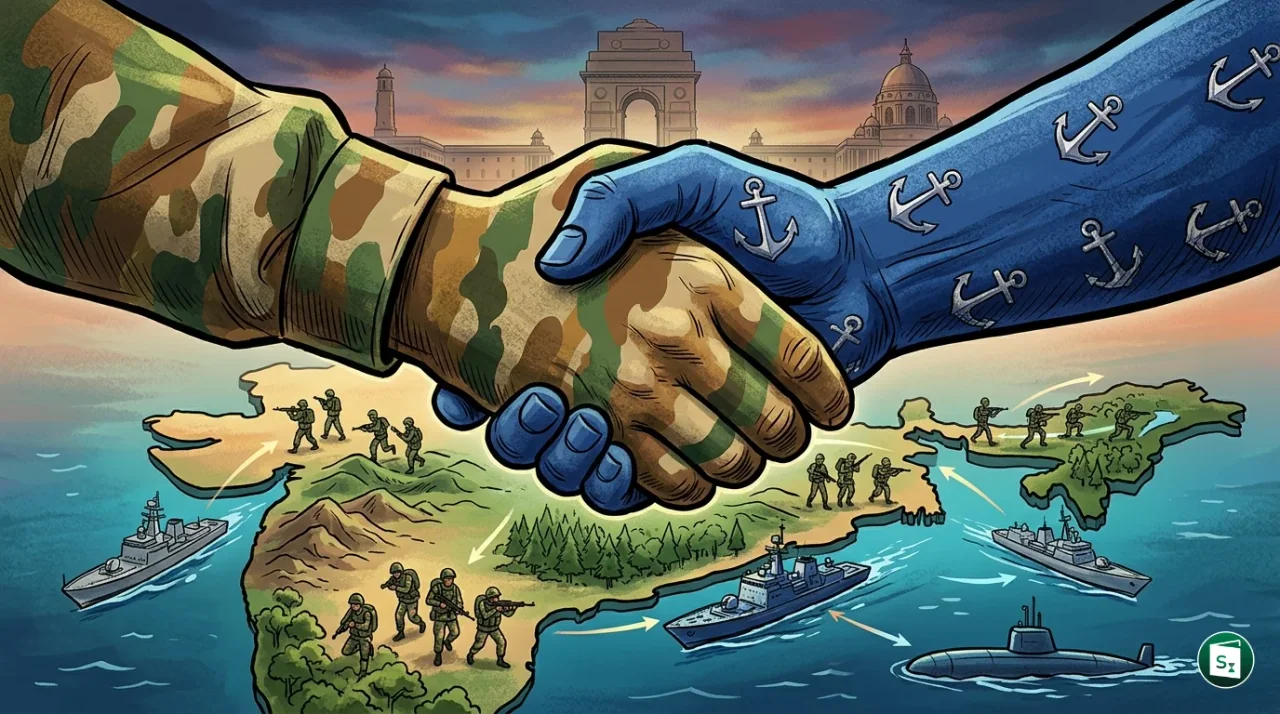
The Indian Army and the Indian Navy signed a Memorandum of Association on Affiliation in New Delhi to strengthen inter-service cooperation, operational cohesion, and jointness. Signed by the Adjutant General of the Army and the Chief of Personnel of the Navy, the agreement provides a structured framework for professional exchanges, joint training, and operational familiarisation. This formalisation represents a critical step in India’s ongoing efforts to build integrated warfighting capabilities and prepare for multi-domain combat.
What is the MoA on Affiliation?
The Memorandum of Association (MoA) on Affiliation establishes a formal, service-wide framework to institutionalise ties between the Indian Army and the Indian Navy. The agreement was signed by Lieutenant General VPS Kaushik, Adjutant General of the Indian Army, and Vice Admiral Gurcharan Singh, Chief of Personnel of the Indian Navy, in New Delhi. While informal and unit-specific affiliations have existed for decades, this MoA marks a transition toward a structured, service-level partnership.
Key Signatories and Context of the Signing
The signatories represent the principal administrative authorities of their respective services. The Adjutant General is a senior officer holding the rank of Lieutenant General who acts as the primary authority for personnel administration, welfare, and discipline in the Indian Army. Lieutenant General VPS Kaushik assumed this appointment on August 3, 2024. The Chief of Personnel is a senior naval appointment in the rank of Vice Admiral responsible for human resource policies and career management at Naval Headquarters. Vice Admiral Gurcharan Singh took charge of this office on November 1, 2025. Their coordination highlights the focus on administrative alignment to support operational integration.
Strategic Intent and Core Objectives
The MoA outlines broad guidelines to systematically enhance cooperation between army formations, regiments, and training centers, and naval commands and ships. Rather than focusing solely on ceremonial ties, the agreement targets several concrete operational and professional objectives:
| Objective | Focus Area and Description |
|---|---|
| Structured Professional Exchanges | Organizing regular interactions to share best practices, administrative procedures, and tactical methodologies. |
| Operational Familiarisation | Providing mutual exposure to help personnel understand the roles, capabilities, and equipment of both services. |
| Joint Activities and Training | Conducting combined training exercises, sports meets, and adventure expeditions to foster camaraderie. |
| Coordinated Multi-Domain Operations | Improving inter-service interoperability for joint warfare scenarios involving land and maritime assets. |
The Concept and History of Military Affiliations in India
The concept of military affiliation involves establishing a formal, symbolic, and professional bond between units of different services or branches. In the Indian Armed Forces, the affiliation programme was formally institutionalised around 1990 to foster jointmanship and inter-service camaraderie. This system serves as a force multiplier by encouraging personnel from different operating environments to understand each other’s operational doctrines, combat potential, and traditions.
Evolution of Inter-Service Affiliations
Historically, affiliations were primarily signed at the unit level, linking a specific naval ship with a distinguished army regiment. During these ceremonies, units exchange charters of affiliation and official mementos, which are then displayed at regimental centers and on ships. Over the years, these pairings have facilitated mutual training visits, where sailors spend time in army barracks to understand land combat, and soldiers embark on naval vessels to experience maritime operations.
Examples of Past Army-Navy Affiliations
Several prominent naval vessels have been affiliated with celebrated regiments of the Indian Army over the last few decades. The table below lists some of these notable affiliations:
| Naval Ship | Affiliated Army Unit | Affiliation Year |
|---|---|---|
| INS Kolkata | Mahar Regiment | 2022 |
| INS Sahyadri | Poona Horse | 2016 |
| INS Teg | Sikh Light Infantry Regiment | 2013 |
| INS Shivalik and INS Satpura | Scinde Horse and 7th Cavalry | 2012 |
Operational Catalysts: Lessons from Operation Sindoor
The signing of the MoA on Affiliation comes in the wake of key operational lessons learned during recent joint activities. A prominent example is Operation Sindoor, which was executed in May 2025. The operation was launched in response to a terrorist attack on civilians in Pahalgam, Jammu and Kashmir, on April 22, 2025. The retaliatory mission targeted cross-border terrorist infrastructure and was characterized by a highly coordinated, multi-domain response.
For the first time in recent years, the Indian Army, the Indian Navy, and the Indian Air Force operated in close synchronization to execute precision strikes. The navy provided critical maritime surveillance and security, while the army and air force conducted strikes and secured border positions. The tactical success of the operation demonstrated the value of integrated warfare, but also highlighted the need for formalized, long-term frameworks to build inter-service cohesion before conflicts arise.
Path to Integrated Theatre Commands
The formalisation of the affiliation agreement aligns with the Indian Armed Forces’ broader transition toward Integrated Theatre Commands (ITCs). Currently, India’s military operates with 17 single-service commands, consisting of seven commands for the Indian Army, seven for the Indian Air Force, and three for the Indian Navy. This fragmented structure often leads to overlapping jurisdictions and administrative duplication during joint operations.
To resolve these redundancies, the office of the Chief of Defence Staff (CDS) is spearheading a transition toward theatreisation, which will reorganise the armed forces into geographical theatre commands under single operational commanders. Historically, India has operated only two joint commands: the Andaman and Nicobar Command (ANC) established in 2001 as the first tri-service command, and the Strategic Forces Command (SFC) created in 2003 to manage the nation’s nuclear assets. The inter-service MoA on Affiliation serves as a crucial bottom-up initiative, fostering cultural and professional alignment among personnel to prepare them for the structural integration of theatre commands.
Key Takeaways
- The Indian Army and the Indian Navy signed a Memorandum of Association on Affiliation in New Delhi to establish a structured framework for inter-service cooperation.
- The agreement was signed by Adjutant General of the Army Lieutenant General VPS Kaushik and Chief of Personnel of the Navy Vice Admiral Gurcharan Singh.
- The inter-service affiliation programme was formally institutionalised within the Indian Armed Forces in 1990 to build inter-service camaraderie.
- The formalisation of inter-service coordination was driven by lessons from Operation Sindoor in May 2025, which was launched following a terrorist attack in Pahalgam.
- The MoA aligns with the military’s broader plans to transition from 17 single-service commands to unified Integrated Theatre Commands.
- India’s existing joint commands are the Andaman and Nicobar Command established in 2001 and the Strategic Forces Command established in 2003.