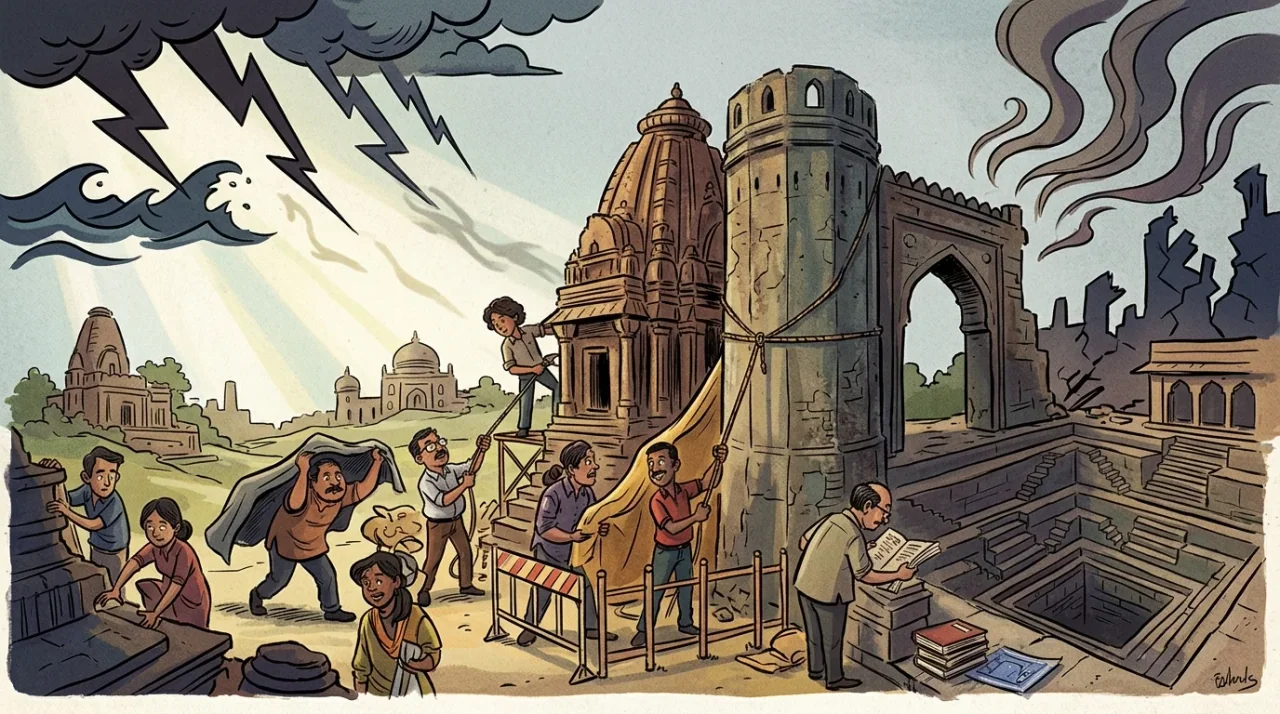
The world observed the International Day for Monuments and Sites, also known as World Heritage Day, on April 18, 2026. This year’s theme, focusing on heritage under threat from disasters and conflicts, underscores the critical role of preparedness and learning from 60 years of ICOMOS actions. The day serves as a global call to action to protect diverse cultural and natural sites from modern vulnerabilities.
Understanding World Heritage Day 2026
The International Day for Monuments and Sites was first proposed by ICOMOS in 1982 and subsequently approved by the UNESCO General Conference in 1983. Since then, it has been celebrated annually on April 18 to promote awareness about the diversity of cultural heritage and the efforts required to protect and conserve it. The day is widely known as World Heritage Day, reflecting its broad focus on sites of universal value.
Every year, ICOMOS selects a specific theme to guide international discourse and local activities. These celebrations often involve free access to heritage sites, community workshops, and expert lectures aimed at fostering a sense of shared responsibility. In 2026, the focus has shifted towards the resilience of these sites in an era of increasing global instability.
The 2026 Theme: Addressing Modern Threats
The theme for 2026, “Heritage under Threat from Disasters and Conflicts: Preparedness and Learning from 60 years of ICOMOS Actions,” addresses two of the most pressing challenges of the 21st century. Rapid climate change has led to an increase in natural disasters such as flash floods, wildfires, and rising sea levels, all of which pose a direct threat to ancient structures and natural landscapes. Simultaneously, ongoing armed conflicts in various parts of the world have resulted in the deliberate or collateral destruction of irreplaceable cultural symbols.
The concept of preparedness is central to this year’s message. It emphasizes that conservation is not just about restoring what is lost, but about creating robust systems to prevent damage before it occurs. This includes digitizing heritage records, training local communities in emergency response, and integrating heritage protection into national disaster management plans.
Analogy · Heritage Preparedness Expand analogy
Protecting a monument from a disaster is like earthquake-proofing a house before the tremors start. It is far more effective and less costly to strengthen the foundation today than to try and piece together the ruins tomorrow.
Furthermore, the theme highlights living heritage, which includes the traditional knowledge and craftsmanship passed down through generations. When a conflict or disaster strikes, it is not just buildings that are at risk, but also the social practices and skills that define a community’s identity.
60 Years of ICOMOS: A Legacy of Conservation
The International Council on Monuments and Sites (ICOMOS) was established in 1965 in Warsaw, Poland. Its creation was a direct outcome of the 1964 Venice Charter, officially known as the International Charter for the Conservation and Restoration of Monuments and Sites. This charter provided the first international framework for the scientific conservation of heritage, moving away from purely aesthetic restoration towards a more rigorous, evidence-based approach.
Over the last 60 years, ICOMOS has grown into a global network of thousands of professionals, including architects, archaeologists, and historians. It serves as one of the three formal Advisory Bodies to the UNESCO World Heritage Committee. Its primary role is to evaluate nominations for cultural and mixed sites and to monitor the state of conservation of properties already on the World Heritage List.
| Aspect | Details |
|---|---|
| Founded | 1965 |
| Headquarters | Charenton-le-Pont, France |
| Founding Document | Venice Charter (1964) |
| Role | UNESCO Advisory Body |
| Focus | Cultural and Mixed Heritage Sites |
The organization’s work has been instrumental in the implementation of the 1972 World Heritage Convention. Through its international scientific committees, ICOMOS develops doctrinal texts and guidelines that have become the gold standard for heritage management worldwide. The 2026 anniversary serves as a moment to reflect on these decades of scientific progress and to adapt them for a more volatile future.
India’s Rich Heritage and Global Standing
India holds a prominent position on the global heritage map, with a total of 44 UNESCO World Heritage Sites as of April 2026. This impressive list includes 36 cultural sites, 7 natural sites, and 1 mixed site (the Khangchendzonga National Park in Sikkim). The sheer variety of India’s heritage—from ancient stupas and medieval forts to colonial-era railways and modern architectural marvels—reflects the subcontinent’s complex history and cultural depth.
Recent years have seen significant additions to this list. In 2025, the Maratha Military Landscapes of India, a network of 12 forts across Maharashtra and Tamil Nadu, was inscribed for its unique military architecture. Prior to that, in 2024, the Moidams, the royal mound-burial system of the Ahom dynasty in Assam, became the first site from the North East to be recognized under the cultural category.
The Archaeological Survey of India (ASI), established in 1861 and headquartered in New Delhi, serves as the nodal agency for the protection and maintenance of centrally protected monuments. India also maintains a robust Tentative List of 69 sites, indicating a strong commitment to expanding its international heritage footprint in the coming years.
The Role of ICOMOS as a UNESCO Advisory Body
To effectively manage the World Heritage Convention, the UNESCO World Heritage Committee relies on three specialized Advisory Bodies. Each body brings a unique set of expertise to the table, ensuring that the World Heritage List remains a credible and balanced collection of the world’s most significant sites.
| Advisory Body | Specialization | Focus |
|---|---|---|
| ICOMOS | Monuments and Sites | Cultural and Mixed Sites |
| IUCN | Nature Conservation | Natural and Mixed Sites |
| ICCROM | Restoration and Training | Conservation Science and Training |
ICOMOS is specifically responsible for evaluating the “Outstanding Universal Value” of cultural properties nominated for the list. It also provides technical support through missions to sites that are facing threats from development, disasters, or neglect. By collaborating with national governments and local experts, ICOMOS ensures that conservation standards are maintained across diverse geographical and political contexts.
Key Takeaways
- The International Day for Monuments and Sites, also known as World Heritage Day, is celebrated globally on April 18.
- The theme for 2026 is “Heritage under Threat from Disasters and Conflicts: Preparedness and Learning from 60 years of ICOMOS Actions.”
- ICOMOS was established in 1965 following the 1964 Venice Charter and is headquartered in Charenton-le-Pont, France.
- India currently has 44 UNESCO World Heritage Sites, comprising 36 cultural, 7 natural, and 1 mixed site.
- The Maratha Military Landscapes of India (2025) and the Moidams (2024) are the most recent cultural additions to India’s World Heritage List.
- ICOMOS serves as one of the three official Advisory Bodies to the UNESCO World Heritage Committee, specifically focusing on cultural heritage.