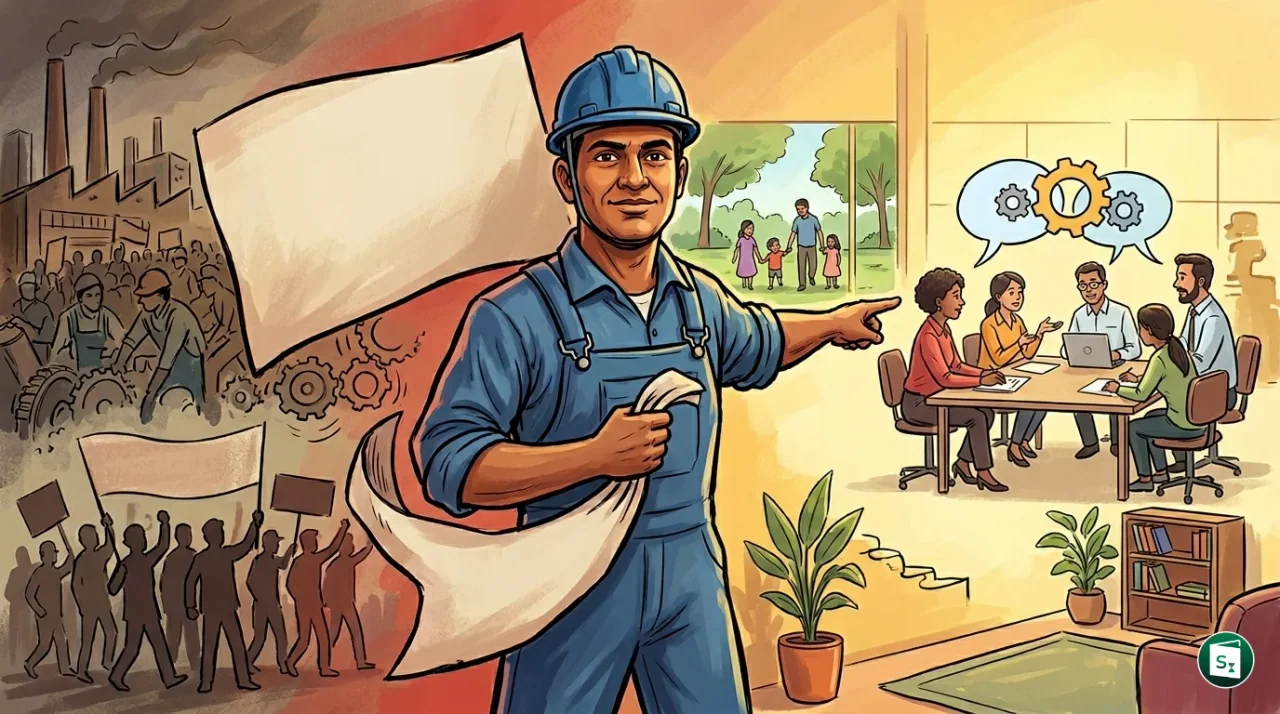
International Labour Day was observed on May 1, 2026, across the globe to honour the historic contributions of workers and advocate for their rights in an evolving global economy. The theme for 2026, “Ensuring a Healthy Psychosocial Working Environment,” emphasizes the growing necessity of addressing mental health and workplace stress as core components of occupational safety. In India, the day is also celebrated as Antar Rashtriya Shramik Divas and Kamgar Din, marking over a century of formal labour movement history in the country.
The Historical Origins of International Labour Day
The roots of International Labour Day trace back to the late 19th century in the United States, during a period of intense industrialization and worker mobilization. In 1886, a general strike was organized in Chicago and other industrial hubs to demand an eight-hour workday, a major shift from the prevailing twelve to fourteen-hour shifts. This movement culminated in the Haymarket Affair, a tragic confrontation between workers and police that became a global symbol of the struggle for labour rights.
In 1889, the Second International, an organization of socialist and labour parties, met in Paris and designated May 1 as a day for international demonstrations. The first formal celebrations were held in 1890, establishing May Day as an annual event to commemorate the Chicago workers and advocate for social and economic justice. Since then, the day has evolved from a protest-driven event into a globally recognized holiday celebrating the achievements of the working class.
The 2026 Theme: Psychosocial Well-being at Work
The theme for 2026, “Ensuring a Healthy Psychosocial Working Environment,” highlights a critical shift in the global understanding of occupational health. While traditional workplace safety focused primarily on physical hazards, the International Labour Organization (ILO) now emphasizes the importance of managing psychosocial risks. These risks include excessive workloads, lack of role clarity, workplace bullying, and poor social support, all of which can lead to severe mental health issues and reduced productivity.
A healthy psychosocial environment is defined by how work is organized and managed. The ILO advocates for a preventive approach, where organizations proactively design work systems to protect the emotional and social well-being of employees. This focus is particularly relevant in the post-pandemic era and the burgeoning digital economy, where the boundaries between professional and personal life have become increasingly blurred.
Evolution of the Labour Movement in India
India’s formal association with International Labour Day began in 1923, marking a significant milestone in the country’s struggle for workers’ rights. The first May Day celebration was organized in Madras (now Chennai) by the Labour Kisan Party of Hindustan, led by the pioneering labour leader Malayapuram Singaravelu Chettiar. This historic event saw the first unfurling of the red flag in India, symbolizing the solidarity of the working class against colonial and industrial exploitation.
During this inaugural meet, resolutions were passed demanding that the government declare May 1 as a public holiday and safeguard the rights of labourers and farmers. Singaravelu Chettiar, often remembered as the ‘First Communist of South India’, was instrumental in bridging the gap between the national freedom struggle and the grassroots labour movement. His efforts laid the foundation for the establishment of numerous trade unions and the eventual integration of labour welfare into India’s constitutional and legal framework.
Statutory Framework and Modern Reforms in India
In recent years, India has undertaken a massive overhaul of its labour laws to adapt to the 21st-century economy. The government has consolidated 29 central labour laws into four comprehensive Labour Codes: the Code on Wages, the Industrial Relations Code, the Social Security Code, and the Occupational Safety, Health and Working Conditions Code. These reforms aim to simplify compliance, extend social security to unorganized workers, and ensure a safer working environment.
A key pillar of these modern reforms is the e-Shram portal, a national database for unorganized workers launched to facilitate the delivery of social security benefits. Furthermore, the Ministry of Labour and Employment has been working toward integrating mental health support into the workplace through various initiatives. By aligning with international standards set by the ILO, India seeks to balance the ease of doing business with the fundamental rights and well-being of its diverse workforce.
Key Takeaways
- International Labour Day is celebrated annually on May 1 to commemorate the 1886 Chicago strike for an eight-hour workday.
- The theme for 2026 is “Ensuring a Healthy Psychosocial Working Environment,” focusing on mental health and stress management at work.
- The first May Day in India was observed on May 1, 1923, in Madras (now Chennai) by the Labour Kisan Party of Hindustan.
- Malayapuram Singaravelu Chettiar led the 1923 celebrations and is credited with unfurling the first red flag in India.
- India has consolidated its labour regulations into four Labour Codes, including those on wages, social security, and occupational safety.
- The e-Shram portal serves as a national database to extend social security benefits to the unorganized sector in India.