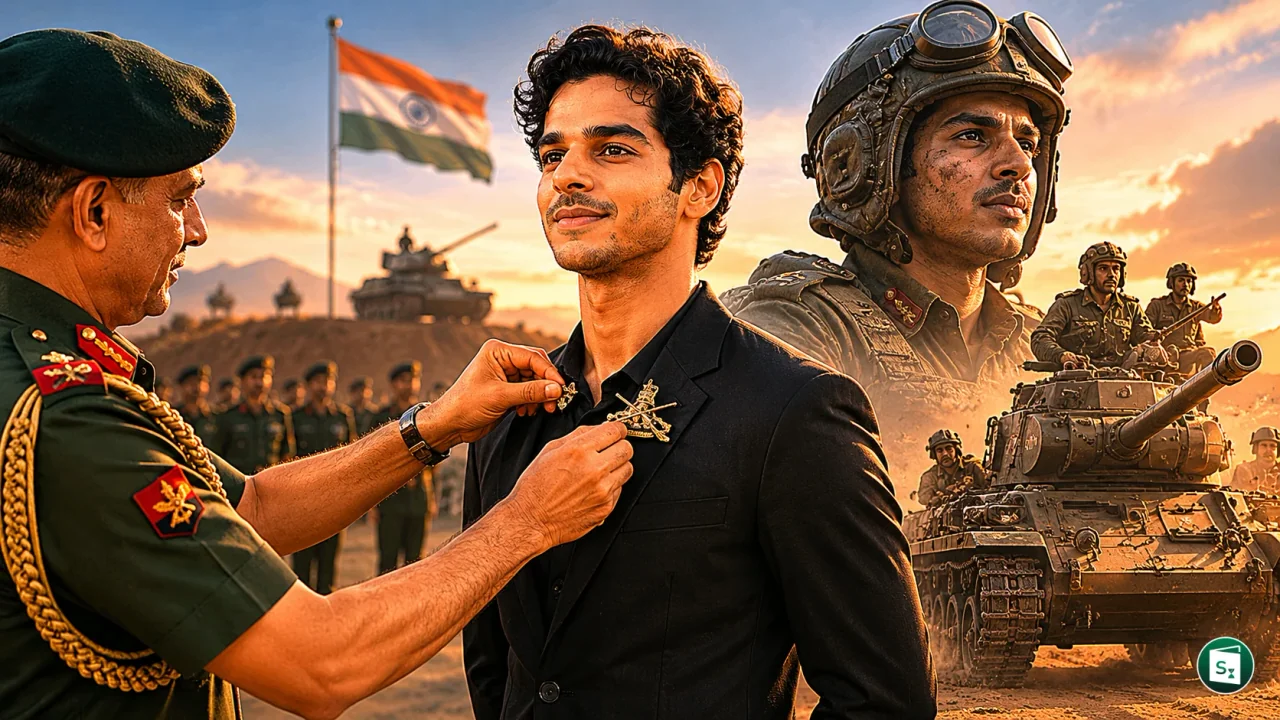
Actor Ishaan Khatter was conferred with an honorary membership of the 45 Cavalry Regiment of the Indian Armoured Corps during a ceremony in May 2026. The rare honour recognises his authentic portrayal of Captain Balram Singh Mehta in the 2023 war drama Pippa and his respect for the regiment’s ethos and legacy. The film itself is based on Brigadier Mehta’s war memoir, The Burning Chaffees, which details the regiment’s pivotal role in the historic Battle of Garibpur during the 1971 Indo-Pakistani War.
Recognition of Pippa and Regimental Ethos
The honorary membership was presented to actor Ishaan Khatter at a ceremony held at the XLV Officers Mess. The regiment recognized the actor for his dedicated and realistic portrayal of Captain Balram Singh Mehta in the 2023 film Pippa. This gesture highlights the strong bond between the armed forces and creative representations of their history, marking a rare instance where a civilian artist is formally inducted into a regiment’s close-knit circle.
During the event, military officers commended the actor’s efforts to understand and respect the traditions, discipline, and core values of the Indian Armoured Corps. In his acceptance speech, Khatter described the honorary membership as the most significant recognition of his career. He emphasized that portraying a real-life war hero from a decorated regiment was a profound responsibility and expressed his commitment to upholding the regiment’s name.
Profile of the 45 Cavalry Regiment
The 45 Cavalry is a distinguished armoured regiment of the Indian Army. Famously known as the Paintalis Risala, the regiment has built a formidable reputation for its operational readiness and gallantry in various conflicts.
History of Raising and Re-Establishment
The history of the 45 Cavalry is divided into two distinct periods. The regiment was originally raised in 1941 during World War II to meet the growing need for armoured units in the British Indian Army. Following the end of the war, the unit was disbanded in 1946 as part of demobilisation.
To strengthen the country’s armoured capabilities, the Indian Army re-raised the regiment on May 16, 1965, at the Delhi Cantonment. Under the initial command of Lieutenant Colonel S. K. Candade, the regiment was equipped with light amphibious tanks, preparing it for specialised operations in marshy and riverine terrains.
Regimental Symbolism and Motto
The values of the 45 Cavalry are reflected in its official motto and insignia. The regiment’s motto is Veer Bhogya Vasundhara, which translates from Sanskrit to “The World is for the Brave.”
Its current insignia features a representation of the PT-76 amphibious light tank with a scroll bearing the motto underneath. This tank design commemorates the unit’s historic achievements in riverine battles. Over the years, the regiment has upgraded its equipment, transitioning from PT-76 light tanks to T-55 tanks, and eventually to modern T-90 Main Battle Tanks.
The Battle of Garibpur: A Pivotal 1971 Engagement
The Battle of Garibpur was fought on November 20 to 21, 1971, representing one of the earliest and most critical tank battles of the Indo-Pakistani War. Crucially, this battle occurred before the official declaration of war on December 3, 1971.
Strategic Objective and Terrain
Indian forces crossed the international border into East Pakistan (now Bangladesh) to secure a defensive position around the village of Garibpur. Capturing this area was strategic as it allowed Indian troops to block the Chaugacha to Jessore highway, which served as a major supply line for the Pakistani forces stationed in the Jessore sector. The marshy, riverine terrain of the region made conventional tank movement difficult, creating a challenging environment for armoured operations.
Armoured Confrontation and Results
On the morning of November 21, the Pakistani Army launched a counter-offensive backed by their 3rd Independent Armoured Squadron, which was equipped with American-built M-24 Chaffee light tanks. The Indian defence was led by the 14th Battalion of the Punjab Regiment and C Squadron of the 45 Cavalry, which operated Soviet-made PT-76 amphibious light tanks.
Despite being outnumbered, the Indian tank crews utilized the foggy morning conditions and the marshy land to outmanoeuvre the enemy. The confrontation resulted in the decimation of the Pakistani armoured squadron. The key details of the engagement are summarised in the table below:
| Feature | Details |
|---|---|
| Date of Battle | November 20 to 21, 1971 |
| Location | Garibpur village, East Pakistan (modern-day Bangladesh) |
| Indian Units Involved | 14 Punjab Regiment (Infantry) & C Squadron, 45 Cavalry (Armour) |
| Pakistani Units Involved | 107 Infantry Brigade & 3rd Independent Armoured Squadron |
| Indian Armor | 14 Soviet PT-76 amphibious light tanks |
| Pakistani Armor | American-built M-24 Chaffee light tanks |
| Key Indian Commander | Major Daljit Singh Narang (posthumously awarded the Maha Vir Chakra) |
| Battle Outcome | 13 Pakistani Chaffee tanks destroyed or captured; Indian forces secured Jessore road |
The battle ended in a decisive Indian victory, which disrupted the defensive plans of the Pakistani military in East Pakistan and cleared the path for the subsequent liberation of Bangladesh. Major Daljit Singh Narang was posthumously awarded the Maha Vir Chakra for his bravery and leadership in directing his squadron during the height of the battle.
The Film Pippa and The Burning Chaffees Memoir
The 2023 Bollywood war film Pippa is a direct cinematic adaptation of the memoir The Burning Chaffees, written by retired Brigadier Balram Singh Mehta. The book offers a detailed firsthand account of the strategic planning and battlefield events during the 1971 war.
Origin of the Term Pippa
The title of the film, Pippa, comes from the colloquial Punjabi and Hindi word for a floating tin canister or ghee container. This term was affectionately used by the crew of the 45 Cavalry to describe the Soviet-made PT-76 amphibious light tank. Unlike standard tanks of the era, the PT-76 had the unique ability to navigate riverine environments and swim across water bodies. This amphibious capability was crucial in the river-heavy terrain of East Pakistan.
Production and Creative Team
Directed by Raja Krishna Menon, the film was co-produced by RSVP Movies and Roy Kapur Films. It depicts the personal and professional journey of Captain Balram Singh Mehta, who was the second-in-command of the tank squadron during the Battle of Garibpur. After the squadron commander, Major Daljit Singh Narang, was killed in action, Captain Mehta took charge of the unit, leading them to a historic victory. The film focuses on the coordination between infantry and armour, showcasing the tactical brilliance that defined the early stages of the liberation war.
Key Takeaways
- Actor Ishaan Khatter was conferred with an honorary membership of the 45 Cavalry Regiment in May 2026 in recognition of his role in the film Pippa.
- The 45 Cavalry was originally raised in 1941, disbanded in 1946, and later re-raised on May 16, 1965 at the Delhi Cantonment.
- The regimental motto of the 45 Cavalry is Veer Bhogya Vasundhara, which translates from Sanskrit to “The World is for the Brave.”
- The Battle of Garibpur was fought between Indian and Pakistani forces on November 20 to 21, 1971, resulting in a decisive victory for India.
- The 2023 film Pippa is based on the memoir The Burning Chaffees, which was authored by retired Brigadier Balram Singh Mehta.
- During the 1971 war, the 45 Cavalry was equipped with Soviet-built PT-76 amphibious light tanks, which were referred to colloquially as “Pippa.”