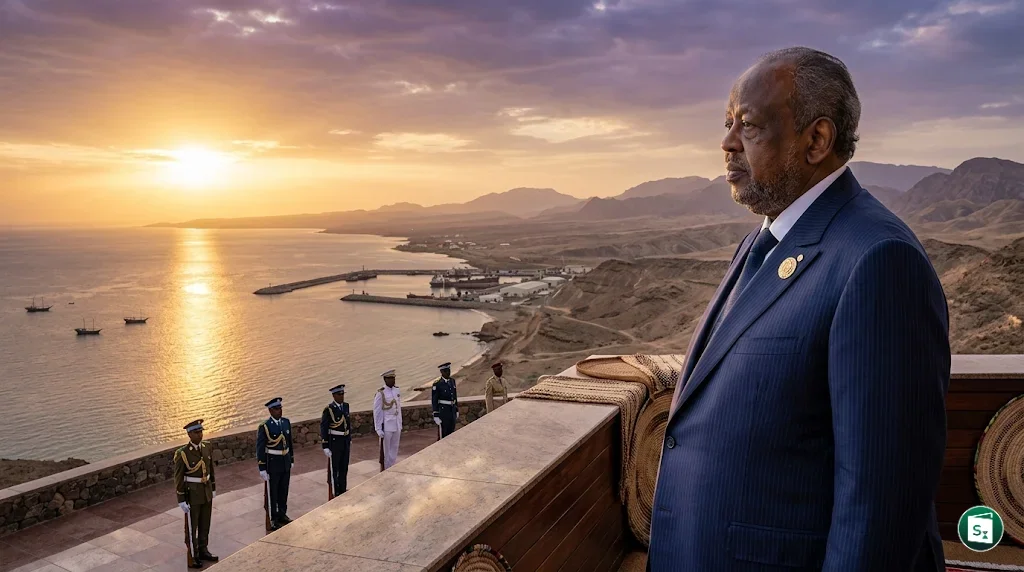
Ismaïl Omar Guelleh has secured his sixth consecutive term as the President of Djibouti following a landslide victory in the April 2026 presidential election. This re-election extends the leadership of one of Africa’s longest-serving presidents over a nation that serves as a critical maritime and military hub in the Horn of Africa. The result reinforces political continuity in a region where Djibouti maintains immense strategic importance at the gateway to the Red Sea.
Election Results and the Sixth Term Victory
The presidential election, held on April 10, 2026, saw a massive victory for the incumbent, with Ismaïl Omar Guelleh securing approximately 97.81% of the total votes. His only challenger, Mohamed Farah Samatar of the Unified Democratic Center (CDU), managed to garner just 2.19% of the mandate. The election process was monitored by observation missions from the African Union (AU) and the Intergovernmental Authority on Development (IGAD), the latter being a regional bloc headquartered in Djibouti City. Both missions characterized the voting process as peaceful and conducted according to existing national standards.
Constitutional Amendments and Political Continuity
President Guelleh has been the central figure in Djibouti’s politics since 1999, when he succeeded his uncle, Hassan Gouled Aptidon, who was the country’s first president after it gained independence from France in 1977. Initially, Guelleh faced a constitutional barrier that barred candidates over the age of 75 from seeking the presidency. However, in October 2025, the National Assembly passed a controversial constitutional amendment that effectively scrapped the age limit, allowing the incumbent to seek his sixth term at the age of 79.
This amendment followed previous changes to the constitution in 2010, which had already abolished term limits to enable a longer tenure. Proponents of these changes often cite the need for stable leadership in a country that acts as a vital security buffer for the global community. Critics, however, pointed out that several opposition parties chose to boycott the 2026 election, expressing concerns over the lack of competitive political space and the fairness of the electoral framework.
Djibouti: The Strategic Maritime Gateway of the Horn of Africa
Despite its small geographic size, Djibouti holds a disproportionately high level of influence in global geopolitics due to its location at the Bab-el-Mandeb Strait. This narrow chokepoint connects the Red Sea to the Gulf of Aden and ultimately the Indian Ocean, serving as a vital gateway for ships travelling through the Suez Canal. This strategic positioning has turned the country into a logistics hub and a preferred site for foreign military installations, earning it the reputation of being “most valuable military real estate” in the world.
The country hosts the only permanent United States military base in Africa, known as Camp Lemonnier. Additionally, it is the site of China’s first overseas military support base, located in Obock. Other major powers including France, Japan, and Italy also maintain a military presence in Djibouti. These bases are used for varied interests such as counter-piracy operations, counter-terrorism, and protecting global energy supplies that pass through the strait. Economically, Djibouti is heavily dependent on its port services, which handle nearly 90% of the external trade for landlocked Ethiopia.
India and Djibouti: A Vital Strategic Partnership
The relationship between India and Djibouti has witnessed significant strengthening over the last decade, particularly in the realms of maritime security and humanitarian assistance. Djibouti played a crucial role in Operation Rahat in 2015, serving as the primary operational hub for the evacuation of thousands of Indian citizens and foreign nationals from war-torn Yemen. In recognition of his role in facilitating this mission and his outreach to India, President Guelleh was conferred with the Padma Vibhushan, India’s second-highest civilian award, in 2019.
Bilateral diplomatic ties reached a new milestone in 2019 when India established a resident mission in Djibouti City. This followed the first-ever visit by an Indian President, Ram Nath Kovind, to the country in 2017. Both nations share a common interest in maintaining a “Safe and Secure Indian Ocean,” with Djibouti being a key partner in India’s SAGAR (Security and Growth for All in the Region) vision. The ongoing political stability under Guelleh’s sixth term is expected to ensure that these strategic and economic collaborative efforts continue without disruption.
Key Takeaways
- Ismaïl Omar Guelleh has been re-elected for a sixth consecutive term as the President of Djibouti with approximately 97.81% of the vote.
- Guelleh has been in power since 1999, having succeeded Hassan Gouled Aptidon, the nation’s first president after its independence from France in 1977.
- A constitutional amendment passed in October 2025 removed the presidential 75-year age limit, allowing the 79-year-old incumbent to seek re-election.
- Djibouti is strategically located at the Bab-el-Mandeb Strait, a critical maritime chokepoint connecting the Red Sea and the Gulf of Aden.
- The nation hosts the only permanent United States base in Africa, Camp Lemonnier, alongside military facilities from China, France, Japan, and Italy.
- India conferred the Padma Vibhushan on President Guelleh in 2019 in recognition of his vital support during Operation Rahat in 2015.