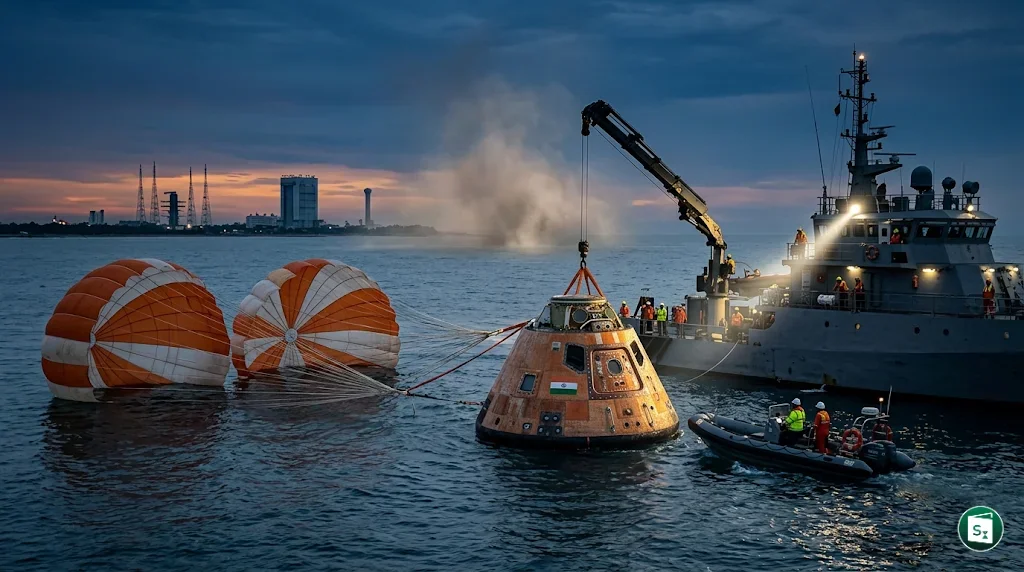
The Indian Space Research Organisation (ISRO) successfully conducted the second Integrated Air Drop Test (IADT-02) for the Gaganyaan mission at the Satish Dhawan Space Centre in Sriharikota on April 17, 2026. This critical test validated the complex parachute-based deceleration system designed to ensure the safe recovery of astronauts during their return from space. By successfully landing a 5.7-tonne simulated crew module in the sea, ISRO has moved closer to launching India’s first uncrewed mission, Gaganyaan G1.
Understanding the Integrated Air Drop Test (IADT-02)
The Integrated Air Drop Test (IADT) is a critical phase in the development of the Gaganyaan mission’s Deceleration System (DS). During the IADT-02 campaign, a simulated Crew Module (CM), which mirrors the mass and dimensions of the actual orbital module, was transported by an Indian Air Force (IAF) Chinook helicopter. The heavy-lift helicopter released the 5.7-tonne module from an altitude of approximately 3 kilometres over a predetermined drop zone in the sea.
This setup allows engineers to observe the system’s performance under realistic aerodynamic conditions similar to the final stages of a spacecraft’s descent into the ocean. The success of this test demonstrates the reliability of the recovery systems that will safeguard Indian astronauts, often referred to as Gaganauts, during the final phase of their journey back to Earth.
The Multi-Stage Parachute Deceleration System
The recovery system tested in IADT-02 involves a highly synchronized sequence of 10 parachutes of four different types. These parachutes are designed to deploy at specific intervals to manage the module’s velocity and ensure a stable descent.
| Parachute Type | Number of Units | Primary Function |
|---|---|---|
| Apex Cover Separation | 2 | Removes the protective cover of the crew module to expose the main parachutes. |
| Pilot Parachutes | 2 | Smaller chutes that pull out the larger drogue and main parachutes. |
| Drogue Parachutes | 2 | Provides initial stabilization and reduces the module’s speed from high levels. |
| Main Parachutes | 4 | Large chutes that provide final deceleration to reach a safe touchdown velocity. |
The complexity of the system is meant to ensure redundancy. For instance, the Main Parachutes are designed so that the module can land safely even if one of them fails to open. This level of safety is a mandatory requirement for human spaceflight missions. These parachutes are designed and developed by the Aerial Delivery Research and Development Establishment (ADRDE), a laboratory of the Defence Research and Development Organisation (DRDO) based in Agra.
Significance for the Gaganyaan G1 Mission
The IADT-02 test is a precursor to the Gaganyaan G1 mission, which is the first uncrewed flight of the programme. The simulated module used in the test weighed 5.7 tonnes, matching the exact mass of the mission’s flight hardware. Success in these air drop tests is a prerequisite for certifying the Crew Recovery and Deceleration System (CRDS) for the first uncrewed flight and the subsequent manned mission.
By validating the parachute deployment sequence, ISRO also tests worst-case scenarios, such as aborts during the ascent phase where the crew module must be safely separated and brought back to the surface. The data collected from the hundreds of sensors integrated into the module will be used to refine the mathematical models for the actual mission. This ensures that the descent remains within the G-force limits that human bodies can tolerate.
Collaborative Efforts: ISRO, IAF, and the Indian Navy
The successful execution of IADT-02 required seamless coordination between multiple national agencies. While ISRO’s Vikram Sarabhai Space Centre (VSSC) in Thiruvananthapuram leads the development of the crew module and deceleration system, the Indian Air Force (IAF) provided the aviation support using a Chinook helicopter.
The Indian Navy plays a vital role in the recovery phase. Following the splashdown in the Bay of Bengal, Navy divers and specialized vessels are deployed to locate and retrieve the module. This recovery procedure is similar to the one that will be used during the actual Gaganyaan mission, where astronauts will be rescued from the sea shortly after touchdown. The coordination between the IAF for the drop and the Navy for the recovery creates a holistic testing environment for India’s space programme.
Evolution of India’s Human Spaceflight Programme
The Gaganyaan mission is India’s first human spaceflight programme, with the goal of sending a crew of three members to an orbit of 400 kilometres for a duration of three days and bringing them back safely to Earth. Prime Minister Modi originally announced the mission during his Independence Day speech in 2018. It is being implemented by ISRO, which is headquartered in Bengaluru and operates under the Department of Space.
The IADT-02 test is the second in a series of integrated air drop campaigns. The first test, IADT-01, was successfully conducted in August 2025. These tests are part of a broader series of qualification milestones, which also included the Test Vehicle Abort Mission (TV-D1) launched in October 2023. Each successful test builds the technical foundation necessary for India to join the elite group of nations—currently consisting of the United States, Russia, and China—that have independent human spaceflight capabilities.
Key Takeaways
- ISRO successfully conducted the second Integrated Air Drop Test (IADT-02) on April 17, 2026, at the Satish Dhawan Space Centre in Sriharikota.
- The test involved dropping a 5.7-tonne simulated Crew Module from an IAF Chinook helicopter at an altitude of 3 kilometres.
- A sophisticated sequence of 10 parachutes of four different types was deployed to stabilize and decelerate the module for a safe splashdown.
- The parachutes used in the mission were designed by the Aerial Delivery Research and Development Establishment (ADRDE), a DRDO lab based in Agra.
- This test was a critical precursor to the uncrewed Gaganyaan G1 mission, validating the Crew Recovery and Deceleration System.
- The broader Gaganyaan mission aims to send a three-member crew to a 400-kilometre orbit for three days before bringing them safely back to Earth.