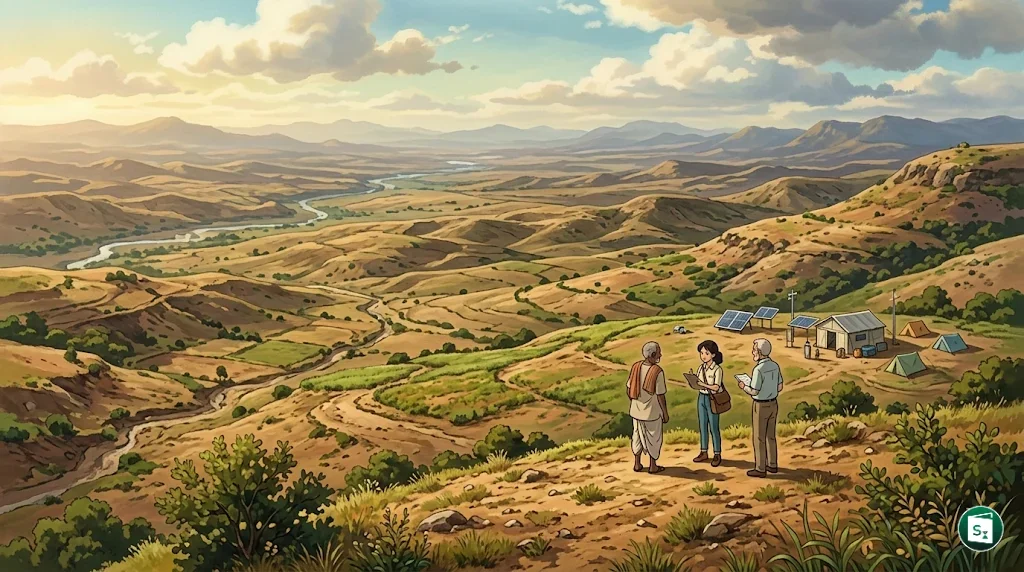
The Space Applications Centre (SAC) of the Indian Space Research Organisation (ISRO) and the Ashoka Trust for Research in Ecology and the Environment (ATREE) signed a Memorandum of Understanding on 16 April 2026 to revolutionize land management in India. This partnership will map approximately 3.2 lakh square kilometres of terrain, focusing on ecologically sensitive and under-monitored regions. This initiative represents a critical step for India in meeting its global commitments toward Land Degradation Neutrality and sustainable environmental restoration.
Mapping India’s Open Natural Ecosystems
The collaboration focuses specifically on Open Natural Ecosystems (ONEs), which include landscapes like semi-arid savannas, grasslands, and deserts. These regions cover nearly 10% of India’s total geographical area but have historically been misclassified or overlooked in national land-use policies. By mapping 319,675 square kilometres, the project aims to identify the ecological health and restoration potential of these diverse habitats.
These ecosystems are vital for local biodiversity and provide livelihoods for millions of people, particularly pastoral communities. Despite their importance, they were often labelled as wastelands in older records. This updated mapping will provide the scientific basis needed to recognize their value and ensure they are managed sustainably rather than being diverted for industrial or infrastructure purposes.
Strategic Goal: Achieving Land Degradation Neutrality
This initiative is a major component of India’s commitment to achieve Land Degradation Neutrality (LDN). India is a signatory to the United Nations Convention to Combat Desertification (UNCCD), which was established in 1994 and is headquartered in Bonn, Germany. Under this convention, India has pledged to restore 26 million hectares of degraded and deforested land by 2030.
Achieving LDN means that the quality and amount of land resources necessary to support ecosystem functions and services remain stable or increase. This is critical for India, where nearly 30% of the land is undergoing some form of degradation. The mapping project will help track progress toward the Bonn Challenge, a global effort to restore 350 million hectares of degraded land by 2030, of which India is a key participant.
Technical Implementation and Nodal Agencies
The project leverages the complementary strengths of two premier institutions. The Space Applications Centre (SAC), based in Ahmedabad and established in 1972, provides cutting edge remote sensing and geospatial mapping technology. ATREE, a Bengaluru based research institution founded by Dr. Kamaljit S. Bawa in 1996, contributes interdisciplinary ecological expertise and extensive field data for validation.
The methodology combines satellite-based observation with ground-level verification to create high-resolution maps. These maps will track land use changes and help estimate above-ground and below-ground carbon levels. This data is essential for understanding how restoration projects impact carbon sequestration, which supports India’s broader climate goals. The resulting datasets will be policy-ready, enabling state and national governments to make informed decisions about land conservation and climate action.
Key Takeaways
- The Space Applications Centre (SAC) of ISRO and ATREE signed an MoU on 16 April 2026 to enhance sustainable land management mapping across India.
- The project involves mapping approximately 3.2 lakh square kilometres, which constitutes nearly 10% of the country’s total land area.
- Mapping efforts will focus on Open Natural Ecosystems (ONEs) such as grasslands and deserts, which are often overlooked in land policy.
- The initiative supports India’s commitment to achieve Land Degradation Neutrality (LDN) by 2030 under the UNCCD framework.
- India has pledged to restore 26 million hectares of degraded land by 2030 as part of the global Bonn Challenge.
- SAC is a premier ISRO centre established in 1972 in Ahmedabad, and ATREE is a Bengaluru based research trust founded in 1996.