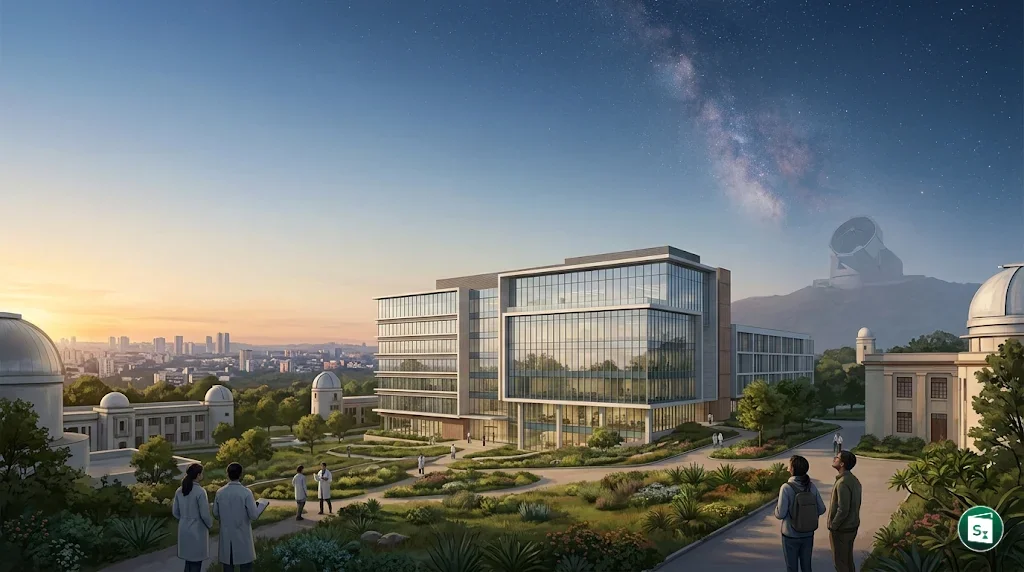
Union Minister Jitendra Singh laid the foundation stone for a new ₹75 crore state-of-the-art facility at the Indian Institute of Astrophysics (IIA) in Bengaluru on April 29, 2026. The seven-storey building, spanning one lakh square feet, is designed to serve as a pivotal hub for advanced research and space instrumentation. This development aligns with the Union Budget 2026’s landmark commitment to establishing four world-class astronomical projects to boost India’s observational capabilities.
Features of the New M.K.V. Bappu Bhavana
The new structure is proposed to be named M.K.V. Bappu Bhavana, in honour of the legendary astronomer and founding director of the IIA, Prof. M.K.V. Bappu. The facility is being constructed by the Central Public Works Department (CPWD) and is expected to be fully operational within two years. It will house advanced laboratories, research classrooms, and conference facilities to support the institute’s growing role in national and international space missions.
Beyond its physical infrastructure, the building will serve as a nerve centre for the design and assembly of high-precision scientific instruments. This is particularly significant as the IIA prepares to lead several massive projects that require sophisticated clean-room environments and specialized testing chambers. The investment of ₹75 crore underscores the government’s focus on providing indigenous infrastructure to reduce reliance on foreign research facilities.
Four World-Class Astronomical Projects: Budget 2026
The ceremony also highlighted the ambitious roadmap laid out in the Union Budget 2026, which allocated approximately ₹3,500 crore for four transformative astronomical projects. These initiatives, to be spearheaded by the IIA, aim to place India at the forefront of global observational astronomy over the next decade.
National Large Solar Telescope (NLST)
The National Large Solar Telescope (NLST) is a state-of-the-art 2-metre aperture telescope to be built at Merak, near Pangong Tso in Ladakh. Once operational, it will be the world’s most powerful solar telescope in its class, capable of capturing high-resolution images of the Sun’s magnetic fields and solar flares. This data is critical for understanding space weather, which can affect satellite communications and power grids on Earth.
National Large Optical-Infrared Telescope (NLOT)
The National Large Optical-Infrared Telescope (NLOT) is set to be a flagship ground-based observatory with a 13.7-metre aperture. Planned for Hanle in Ladakh, this segmented-mirror telescope will allow astronomers to peer into the deep universe, studying the evolution of galaxies, exoplanets, and the nature of dark matter. Its location in the Hanle Dark Sky Reserve offers some of the clearest skies in the world, essential for infrared observations.
Enhancing the Himalayan Chandra Telescope
The existing Himalayan Chandra Telescope (HCT), a 2-metre optical-infrared telescope located at the Indian Astronomical Observatory (IAO) in Hanle, is slated for a massive upgrade. The Upgraded Himalayan Chandra Telescope (uHCT) will feature a 3.7-metre segmented primary mirror, significantly enhancing its light-gathering power and resolution. This upgrade will extend the operational life of the telescope and provide researchers with more sensitive data for stellar and galactic studies.
COSMOS-2 Planetarium and Training Centre
Expanding the reach of astronomy beyond research, the COSMOS-2 Planetarium will be established in Amaravati, Andhra Pradesh. Featuring a cutting-edge LED dome, it is designed to be a national centre for data visualisation and STEM (Science, Technology, Engineering, and Mathematics) education. It will serve as a training hub for the next generation of astronomers and help popularise space science among the public.
Significance for India’s Scientific Infrastructure
The integration of these projects marks a shift towards “Big Science” in India, moving beyond small-scale observatories to international-standard research hubs. By establishing these facilities in Ladakh, the government is leveraging the region’s unique high-altitude geography, which provides a thin atmosphere and low water vapour, ideal for astronomical viewing.
These projects will also support the scientific goals of ISRO (Indian Space Research Organisation) missions, such as Aditya-L1, by providing ground-based complementary data. The development of indigenous telescopes of this scale fosters technological innovation in optics, precision mechanics, and data processing within the Indian industry.
About the Indian Institute of Astrophysics (IIA)
The Indian Institute of Astrophysics (IIA) is an autonomous research institution under the Department of Science & Technology (DST), Government of India. It traces its history back to the Madras Observatory established in 1786, which later moved to Kodaikanal in 1899. The institute was formally established in its current autonomous form in 1971, with its headquarters shifting to Koramangala, Bengaluru, in 1975.
The IIA manages some of India’s most important astronomical facilities, including the Vainu Bappu Observatory at Kavalur, the Kodaikanal Solar Observatory, and the Indian Astronomical Observatory at Hanle. It is currently led by Director Prof. Annapurni Subramaniam.
Key Takeaways
- Union Minister Jitendra Singh laid the foundation stone for the ₹75 crore new building at IIA Bengaluru on April 29, 2026.
- The new 7-story facility is proposed to be named M.K.V. Bappu Bhavana and will be constructed by the CPWD.
- The Union Budget 2026 announced four world-class projects for the IIA with an estimated outlay of ₹3,500 crore.
- The National Large Solar Telescope (NLST), with a 2-metre aperture, will be established at Merak, Ladakh.
- The National Large Optical-Infrared Telescope (NLOT) will feature a 13.7-metre aperture and be located at Hanle.
- The COSMOS-2 Planetarium, featuring an LED dome, will be built in Amaravati, Andhra Pradesh.
- The Indian Institute of Astrophysics is an autonomous body under the Department of Science & Technology (DST).