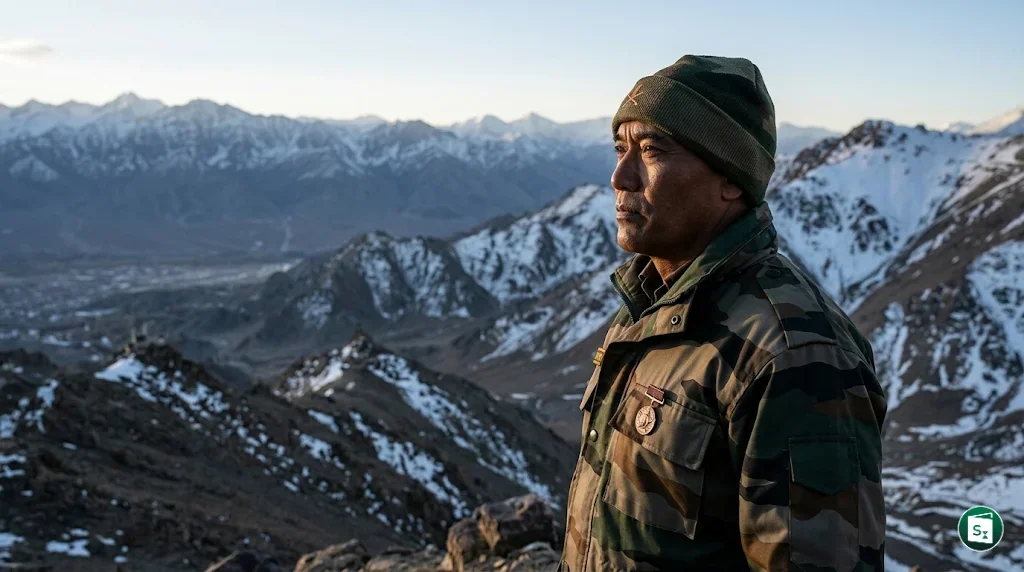
Colonel Sonam Wangchuk, the decorated 1999 Kargil War hero and recipient of the Maha Vir Chakra, passed away at the age of 61 in Leh, Ladakh. Fondly known as the ‘Lion of Ladakh’ for his fearless leadership during Operation Vijay, he is remembered for his pivotal role in capturing the strategic Chorbat La ridge. His passing marks the end of an era for the Ladakh Scouts and the Indian Army, leaving behind a legacy of supreme courage in high-altitude warfare.
The Battle of Chorbat La: Securing the Ridge
The Battle of Chorbat La stands as one of the most remarkable early successes of the Indian Army during the 1999 Kargil War. Located in the Batalik sector at an altitude of approximately 18,000 feet, Chorbat La was a critical ridge line that Pakistani forces aimed to occupy. Capturing this height was essential to block enemy infiltration routes and safeguard the supply lines to the Leh-Srinagar highway.
On May 30, 1999, then-Major Sonam Wangchuk led a column from the Indus Wing of the Ladakh Scouts into the glaciated terrain. Despite being caught in a sudden enemy ambush from higher ground, Wangchuk maintained his composure and led a daring counter-attack from the flank. In hand-to-hand combat and intense exchange of fire, his unit neutralized the enemy position without any artillery cover. This victory pre-empted the enemy’s plans and secured the ridge line for India, providing a major psychological and tactical boost to the Indian forces in the early phase of the conflict.
”Lion of Ladakh”: Heroism During Operation Vijay
The moniker ‘Lion of Ladakh’ was earned through his indomitable spirit and fierce commitment to defending his homeland. During Operation Vijay, Major Wangchuk and his troops from the Ladakh Scouts operated in conditions that were almost beyond human endurance. Temperatures often dipped below minus 30 degrees Celsius, and the oxygen-depleted air made every movement a challenge.
His tactical acumen was displayed when he realized that the enemy had occupied heights that overlooked the Indian supply lines. Instead of waiting for reinforcements, he utilized the local knowledge and high-altitude expertise of his Ladakhi soldiers to launch swift, mountain-borne raids. His actions not only saved countless lives by securing the flanks of the Indian advance but also instilled a sense of pride and confidence in the local population. In recognition of his bravery, two forward posts in the Batalik sector were later named ‘Sonam 1’ and ‘Sonam 2’.
Military Career and Legacy of Colonel Sonam Wangchuk
Born on May 11, 1964, in Sankar, near Leh, Sonam Wangchuk was commissioned into the 4th Battalion of the Assam Regiment in 1987. Before his historic role in the Kargil War, he served in various challenging assignments, including counter-insurgency operations in Northeast India and with the Indian Peace Keeping Force (IPKF) in Sri Lanka.
He was later deputed to the Ladakh Scouts, where his deep roots in the region and understanding of its geography made him an exceptional leader. After the Kargil War, he continued to serve the nation with distinction, rising to the rank of Colonel. He retired in 2018 but remained an active mentor to young officers, often sharing his experiences of survival and leadership in extreme environments. His life remains a testament to the specialized skills of mountain warfare that Indian soldiers have mastered over decades.
Understanding the Maha Vir Chakra: India’s Second-Highest Gallantry Award
The Maha Vir Chakra (MVC) is India’s second-highest military decoration, awarded for acts of conspicuous gallantry in the presence of the enemy. Instituted on January 26, 1950, with retroactive effect from August 15, 1947, it ranks immediately after the Param Vir Chakra. The award is open to personnel from all branches of the Indian Armed Forces, including the Army, Navy, and Air Force.
The medal is made of standard silver and features a five-pointed heraldic star with the points touching the rim. In the center, it bears a gilded version of the National Emblem of India. The reverse side is embossed with ‘Maha Vir Chakra’ in both Hindi and English. The ribbon is half-white and half-orange, symbolizing purity and courage. Over the years, the MVC has been awarded for exceptional bravery in various conflicts, including the 1971 Indo-Pak War and the 1999 Kargil War.
The Ladakh Scouts: Guardians of the High Himalayas
Known as the ‘Snow Warriors’, the Ladakh Scouts is an elite infantry regiment of the Indian Army specialized in high-altitude warfare. The unit’s history dates back to the 1947-48 operations when local militias defended Ladakh against invaders. It was formally raised as a separate unit on June 1, 1963, following the 1962 Sino-Indian War.
Owing to their extraordinary performance during the Kargil War, where they captured several strategic heights, the Ladakh Scouts were granted the status of a full infantry regiment in 2001. The regiment recruits almost exclusively from the local population of Ladakh, utilizing their natural physiological adaptation to thin air and rugged terrain. Their regimental war cry, ‘Ki Ki So So Lhargyalo’, which translates to ‘Victory to the Gods’, resonates through the Himalayan valleys they guard with unwavering vigilance.
Key Takeaways
- Colonel Sonam Wangchuk, the 1999 Kargil War hero and Maha Vir Chakra awardee, passed away at the age of 61.
- He was famously known as the ‘Lion of Ladakh’ for leading the capturing of the strategic Chorbat La ridge at 18,000 feet.
- The Ladakh Scouts, his primary unit, was converted into a full-fledged infantry regiment in 2001 following their service in Operation Vijay.
- The Maha Vir Chakra is India’s second-highest wartime gallantry award, instituted on January 26, 1950.
- The regimental war cry of the Ladakh Scouts is ‘Ki Ki So So Lhargyalo’, which means ‘Victory to the Gods’.
- In recognition of his bravery, the Indian Army named two military posts in the Batalik sector as Sonam 1 and Sonam 2.