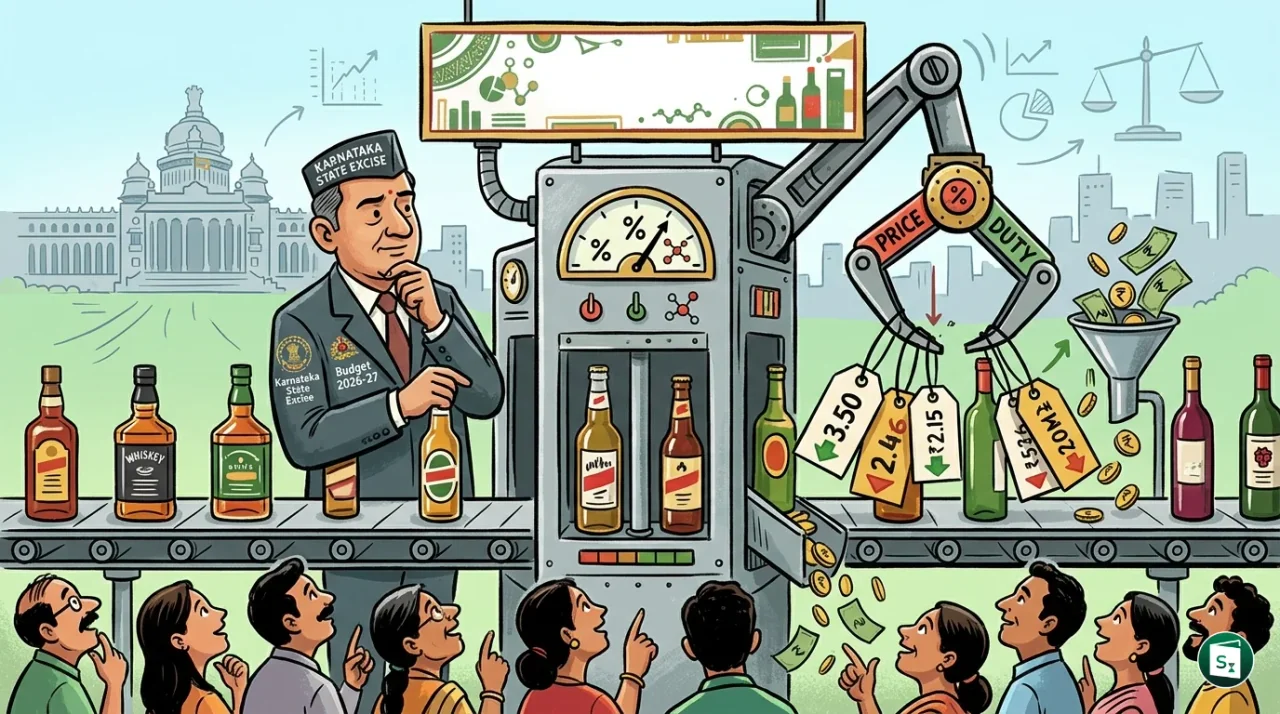
The Karnataka government has officially implemented the Alcohol-in-Beverage excise duty structure, marking the first time an Indian state has adopted a strength-based liquor taxation model. Effective from May 11, 2026, the reform shifts the taxation basis from total liquid volume to the actual percentage of alcohol content in beverages. Announced in the 2026-27 State Budget, this landmark policy aims to simplify pricing, encourage the consumption of lower-strength drinks, and align local liquor rates with neighbouring states.
What is the Alcohol-in-Beverage Taxation Model?
Under the traditional bulk litre model, alcoholic beverages are taxed based on total liquid volume (in litres) regardless of their alcohol percentage. Similarly, the ad valorem taxation system levies excise duty as a percentage of the manufacturing cost or declared price of the product. The Alcohol-in-Beverage (AIB) taxation model, also known as strength-based or alcohol-by-volume (ABV) taxation, represents a fundamental shift. In this model, the tax is directly proportional to the pure ethanol content of the beverage. This is calculated by multiplying the total volume of the liquid by its ABV percentage.
Under the AIB system, higher alcohol concentration translates into higher tax rates, while beverages with lower alcohol content are taxed at lower rates. This creates a strong economic incentive for manufacturers to produce, and consumers to choose, beverages with lower alcohol percentages.
| Tax Model | Basis of Levy | Primary Focus | Social and Market Impact |
|---|---|---|---|
| Bulk Litre | Total liquid volume | Bottle or container size | Encourages high-strength products since tax per unit of alcohol decreases as strength rises. |
| Ad Valorem | Declared product price | Manufacturing or retail cost | Subject to market price manipulations and does not target actual alcohol concentration. |
| Alcohol-in-Beverage | Pure ethanol content | Alcohol By Volume (ABV) percentage | Encourages moderation by taxing high-strength beverages more than low-strength ones. |
Key Reforms in Karnataka’s Excise Duty Structure
The transition to the Alcohol-in-Beverage structure has introduced major operational and fiscal changes in Karnataka’s alcohol retail market. These reforms represent a comprehensive overhaul of the state’s excise system, which had remained largely unchanged for several decades.
Consolidation of Excise Slabs
The state government has simplified the classification system for Indian-Made Liquor (IML). The previous system categorised IML into 16 distinct slabs based on manufacturing costs. The new framework consolidates these into eight simplified slabs. This consolidation reduces administrative complexity, makes regulatory oversight more efficient, and provides a clearer structure for both producers and tax authorities.
Deregulation of Price Fixation
A crucial aspect of this reform is the deregulation of pricing. Under the old system, the state government rigidly controlled and fixed the retail prices of alcoholic products. The new policy removes this government-administered price control. Manufacturers now have the freedom to position and price their products within the designated slabs based on raw material costs, marketing strategies, and market competition.
Recalibration of Additional Excise Duty
The restructuring has led to different price adjustments across various beverage segments due to changes in the Additional Excise Duty (AED) rates. Lower-strength products and premium brands have become more affordable, while budget segment high-strength liquors have seen price increases.
- Premium Spirits and Beer: Additional Excise Duty rates on premium products (falling in slabs 6 to 8) have been reduced by 10% to 15%. Consequently, mild and lager beers with approximately 5% ABV, alongside premium Scotch whiskies, have witnessed price drops of 20% to 25%.
- Budget Segment Liquor: The first five slabs, which cater to mass-market and budget IML brands, have experienced an AED increase of 20% to 30%. This has resulted in a retail price rise of about 20% to 30% for budget-friendly 180 ml packs of whisky, rum, and brandy.
Recommendations of the K. P. Krishnan Committee
The transition to the Alcohol-in-Beverage model stems directly from the recommendations of the Resource Mobilisation Committee (RMC). Headed by former Union Land Resources Secretary and retired IAS officer K. P. Krishnan, the committee was tasked with proposing reforms to enhance state revenue and modernise regulatory frameworks.
Quantifying the Social Cost of Alcohol
The committee conducted a comprehensive study on the socioeconomic impact of alcohol consumption in Karnataka. It estimated that the social costs of alcohol misuse, including public health burdens, road accidents, loss of economic productivity, and domestic violence, amount to approximately ₹51,000 crore annually. This massive sum represents nearly 2% of the state’s Gross Domestic Product (GDP).
Public Health and Pigouvian Taxation
To address these externalities, the K. P. Krishnan Committee advocated for the implementation of a strength-based excise framework. The committee argued that the primary purpose of alcohol taxation should be corrective, functioning as a Pigouvian tax that internalises the negative social costs of consumption. By raising tax rates proportionally with alcohol concentration, the state penalises high-strength, high-harm beverages while nudging consumers toward lower-alcohol alternatives like beer.
Supporting Reforms
Alongside the AIB model, the committee proposed structural measures to improve transparency and mitigate social harm:
- Social Cost Mitigation Fund: The committee recommended establishing a dedicated fund financed by a fixed percentage of the state’s excise collections. This fund would be legally earmarked to support public healthcare, addiction treatment facilities, road safety projects, and family rehabilitation schemes.
- Administrative Modernisation: The report suggested transitioning to an auction-based digital licensing system for retail outlets. This measure aims to eliminate retail monopolies, reduce corruption, and improve ease of doing business in the excise sector.
Global Best Practices and Strategic Significance
The adoption of the Alcohol-in-Beverage model aligns Karnataka with international standards in public health and fiscal policy. The World Health Organization (WHO) has long advocated for specific taxation based on alcohol content as the most effective policy tool to reduce alcohol-related harm.
International Context
Strength-based taxation is widely used in several developed economies. Countries such as the United Kingdom and Finland structure their excise duties specifically around the alcohol by volume of the product. This approach ensures tax neutrality, meaning the tax is levied on the actual intoxicant rather than the type of beverage, the brand, or the liquid volume.
Economic and Strategic Goals
For Karnataka, this reform serves both economic and security purposes. The state government has set an excise collection target of ₹45,000 crore for the 2026-27 financial year. By rationalising the duty structure, the state aims to achieve this target through stable, health-aligned tax revenue rather than encouraging high-volume consumption.
Furthermore, the reform addresses the problem of cross-border smuggling. Historically, wide price disparities between Karnataka and neighbouring states like Maharashtra, Goa, Kerala, Tamil Nadu, Andhra Pradesh, and Telangana created a lucrative black market for illicit liquor. By lowering duties on premium segments and beers, Karnataka aims to make pricing more competitive, thereby reducing the financial incentives for smuggling and protecting domestic state revenues.
Key Takeaways
- Karnataka became the first state in India to implement the strength-based Alcohol-in-Beverage excise duty structure, effective May 11, 2026.
- The reform is based on the recommendations of the Resource Mobilisation Committee led by retired IAS officer K. P. Krishnan.
- The new framework consolidates the number of Indian-Made Liquor slabs from 16 to 8 and deregulates retail pricing.
- The K. P. Krishnan Committee estimated the annual social cost of alcohol consumption in Karnataka at ₹51,000 crore, representing about 2% of the state’s Gross Domestic Product.
- The state government has projected an excise revenue target of ₹45,000 crore for the 2026-27 financial year.
- Additional Excise Duty was reduced by 10% to 15% for premium brands and increased by 20% to 30% for budget-friendly segments.