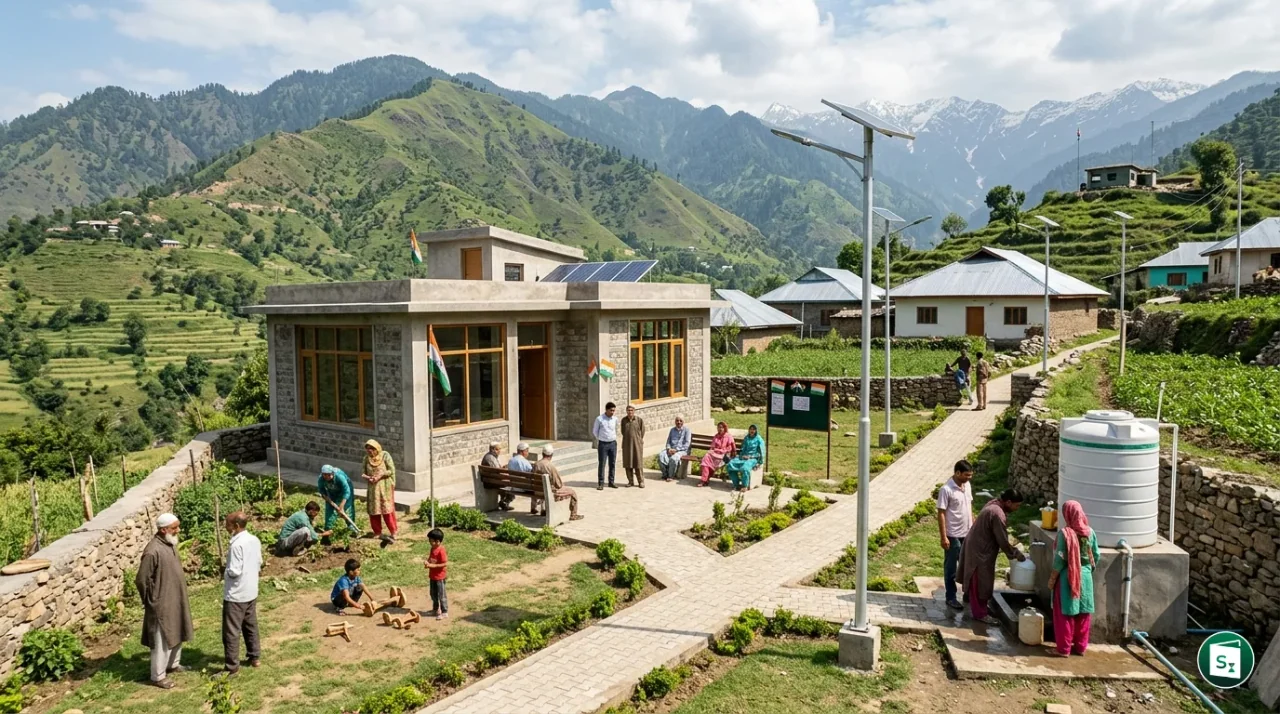
The central government has integrated six strategically located border villages in the Kathua district of Jammu and Kashmir into the second phase of the Vibrant Villages Programme (VVP). These frontier settlements, including Bobiya, Karol Krishna, and Gujjar Chak, are slated for comprehensive infrastructure and socio-economic upgrades to improve living conditions and discourage out-migration. By fostering resilient communities, the initiative seeks to enhance national security and ensure that remote regions are fully assimilated into the country’s development framework.
Transition to Vibrant Villages Programme Phase II
The Vibrant Villages Programme was originally announced in the Union Budget 2022-23 to develop villages along India’s northern border. Administered by the Ministry of Home Affairs (MHA), the initiative initially focused on areas bordering China, including Arunachal Pradesh, Himachal Pradesh, Sikkim, Uttarakhand, and the Union Territory of Ladakh. The programme was designed as a Central Sector Scheme with a total outlay of ₹4,800 crore for its first phase, focusing on holistic development to prevent the “security vacuum” caused by mass migration from border areas.
With the launch of Phase II (VVP-II) in 2026, the central government has significantly expanded the programme’s scope. The new phase covers 1,954 strategic villages across 17 States and Union Territories, extending development efforts to borders shared with Pakistan, Nepal, Bangladesh, Bhutan, and Myanmar. The inclusion of villages in the Kathua district of Jammu and Kashmir marks a vital step in this expansion. The selected villages, including Bobiya, Kadyala, Gajnal, Karol Krishna, Rathua, and Gujjar Chak, are all located in close proximity to the international border, necessitating focused governmental intervention.
Strategic Importance of the Frontier Regions
Border villages are often described as the “first line of defense” for any nation. In the context of India, residents of these remote areas serve as the “eyes and ears” of border guarding forces like the Border Security Force (BSF) and the Indian Army. When villages are abandoned due to lack of basic amenities or employment, it creates a security vacuum that can be exploited for trans-border crimes, infiltration, and smuggling. The inclusion of Kathua’s villages in VVP-II is a proactive measure to ensure these strategic points remain inhabited and vibrant.
The Kathua district shares a sensitive international border with Pakistan. Villages like Bobiya and Gujjar Chak have historically faced challenges related to shelling and limited economic opportunities. By upgrading these areas, the government aims to build a sense of belonging among the border population, ensuring they remain integrated with the national mainstream. This human-centric approach to border management recognizes that a stable and prosperous civilian population is as critical to territorial integrity as military presence.
Pillars of Development and Saturation Approach
The Vibrant Villages Programme employs a “saturation approach,” which means ensuring that every eligible household and village receives 100% coverage of essential government services. The programme focuses on several critical thematic areas through the convergence of existing central and state schemes.
- Infrastructure and Connectivity: Priority is given to all-weather road connectivity, integrated with Pradhan Mantri Gram Sadak Yojana (PMGSY-IV). Reliable telecom connectivity and 24x7 electricity supply are also core targets.
- Economic Livelihood: The programme encourages the “One Village One Product” (OVOP) concept to identify and promote local resources. It supports eco-agribusinesses and provides vocational training to youth to create sustainable income within the village.
- Tourism and Heritage: Border villages are being developed as tourism hubs. This includes promoting homestays, identifying local heritage sites, and creating tourist circuits that allow visitors to experience the unique culture of frontier regions.
- Social Services: Improvements in healthcare, education, and clean drinking water (under the Jal Jeevan Mission) are integral to the plan to enhance the overall quality of life.
Governance and Implementation Mechanism
The implementation of VVP is driven by Vibrant Village Action Plans (VVAPs). These plans are prepared using a bottom-up approach, where district administrations coordinate with Gram Panchayats to identify specific local needs and infrastructure gaps. To ensure effective execution and monitoring, the programme is integrated with the PM Gati Shakti National Master Plan platform. This integration allows for synchronized planning across different ministries and ensures that infrastructure projects like roads, power lines, and digital networks are built in a coordinated manner.
As a Central Sector Scheme, the programme receives 100% funding from the central government. In the second phase, the government has proposed an expenditure of approximately ₹3 crore per village to achieve the desired development outcomes. In states like Jammu and Kashmir, senior bureaucratic officers are assigned to oversee the implementation, conduct field visits, and review Detailed Project Reports (DPRs) to ensure that the projects stay on schedule and meet the quality standards required for harsh frontier terrains.
Key Takeaways
- The Vibrant Villages Programme (VVP) was launched in February 2023 as a Central Sector Scheme to develop strategic settlements along India’s borders.
- The Ministry of Home Affairs (MHA) is the nodal agency responsible for the implementation and monitoring of the programme.
- Phase II of the initiative, launched in 2026, expands development coverage to 1,954 villages across 17 States and Union Territories.
- The six villages included from the Kathua district of J&K are Bobiya, Kadyala, Gajnal, Karol Krishna, Rathua, and Gujjar Chak.
- The programme utilizes a “saturation approach” to achieve 100% household coverage for services like electricity, telecom, and all-weather roads.
- A central goal of the VVP is to prevent out-migration from border regions by identifying local growth centres and promoting One Village One Product (OVOP) initiatives.