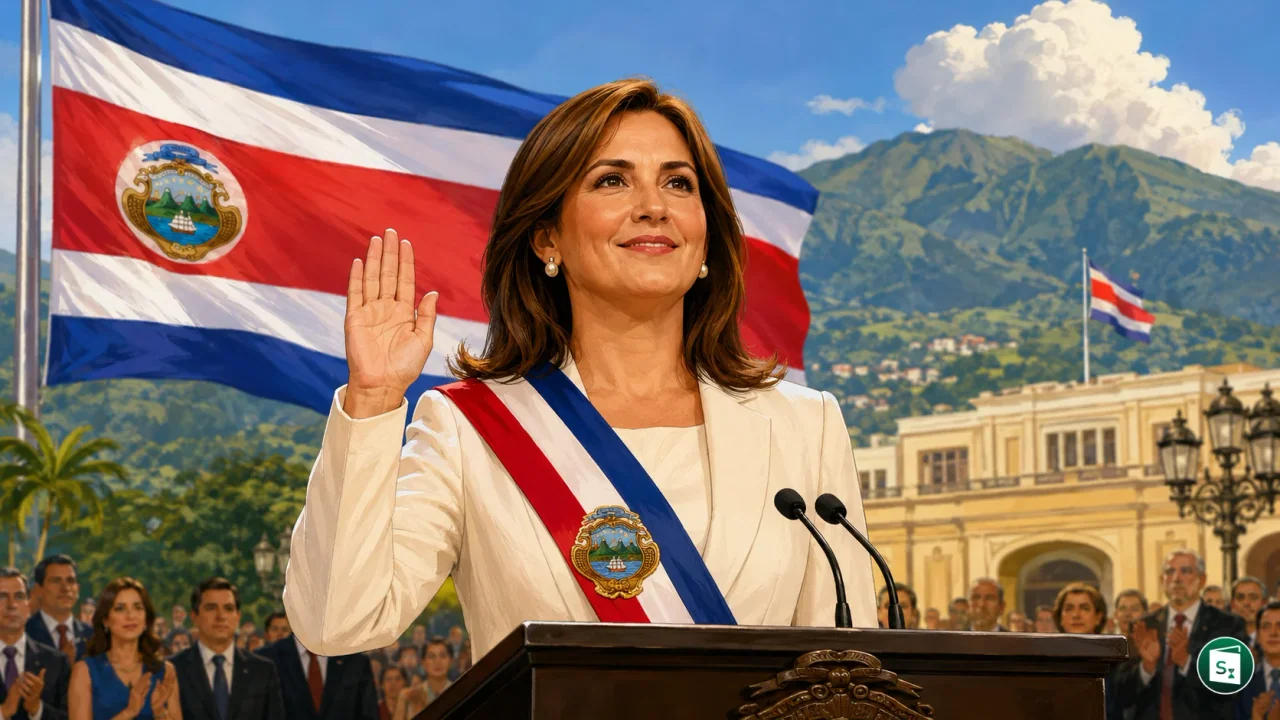
Laura Virginia Fernández Delgado was sworn in as the 50th President of Costa Rica on May 8, 2026, beginning a four-year term that concludes in 2030. A member of the Sovereign People’s Party (PPSO), she succeeds Rodrigo Chaves Robles to become the second woman in the nation’s history to hold the highest office. The inauguration ceremony at the National Stadium in San José signals a period of political continuity for the Central American democracy.
Who is Laura Virginia Fernández Delgado?
Laura Fernández is a seasoned administrator and politician who has held significant positions in the Costa Rican government. Before assuming the presidency, she served as the Minister of National Planning and Economic Policy and later as the Minister of the Presidency under the administration of Rodrigo Chaves Robles. Her tenure in these roles was marked by a focus on streamlining government operations and implementing fiscal reforms.
As a member of the Sovereign People’s Party (PPSO), Fernández campaigned on a platform of “continuity with change,” promising to uphold the populist and reformist agenda of her predecessor. She is the second woman to serve as President of Costa Rica, following Laura Chinchilla, who held the office from 2010 to 2014. Her swearing-in was conducted by Yara Jiménez, the president of the Legislative Assembly, marking the first time in Costa Rican history that one woman has sworn in another as head of state.
The 2026 Presidential Election and PPSO’s Victory
The general election held on February 1, 2026, saw a decisive victory for Laura Fernández and the Sovereign People’s Party (PPSO). Fernández secured approximately 48.53% of the vote, surpassing the 40% threshold required by Costa Rican law to win in the first round and avoid a runoff. She defeated 19 other candidates, including Álvaro Ramos of the National Liberation Party (PLN), who finished in second place.
In addition to the presidential victory, the PPSO achieved a historic milestone in the legislative elections. The party won 31 out of 57 seats in the Legislative Assembly, securing an absolute majority. This is the first time since 1990 that a single party has held such a majority in the unicameral legislature. This mandate provides the Fernández administration with significant legislative support to implement its policy agenda, particularly in the areas of economic modernization and infrastructure development.
Understanding Costa Rica’s Political Structure
Costa Rica is a presidential representative democratic republic known for its long-standing political stability and commitment to peace. A unique feature of its modern history is the abolition of its military in 1948, after which the budget was redirected toward education and healthcare. The executive power is vested in the President, who serves as both the head of state and head of government for a four-year term.
The country’s constitution prohibits consecutive re-election for the presidency. A former president must wait for at least two terms, or eight years, before being eligible to run for office again. This rule ensures a regular turnover of leadership. The legislative power resides in the unicameral Legislative Assembly, consisting of 57 deputies elected through proportional representation. The judicial branch is headed by the Supreme Court of Justice, ensuring a system of checks and balances that has made Costa Rica one of the most stable democracies in Latin America.
India and Costa Rica: Strengthening Bilateral Ties
India and Costa Rica maintain warm and cordial relations, which have been strengthened by high-level visits and growing economic cooperation. In May 2026, India’s Minister of State for External Affairs, Pabitra Margherita, visited Costa Rica to attend the inauguration of President Laura Fernández. During the visit, the Minister met with the newly appointed Foreign Minister, Manuel Tovar, and the Minister of Science and Technology, Paula Bogantes Zamora, to discuss deepening ties in digitalization, biotechnology, and renewable energy.
Economic collaboration forms a core pillar of the relationship, with several Indian Information Technology majors, including Infosys, Wipro, and L&T Infotech, establishing a strong presence in the capital city of San José. To further enhance cultural and educational ties, a ‘Vasudhaiva Kutumbakam’ wall was inaugurated at the University for Peace in San José. India also supports Costa Rica’s development through the Indian Technical and Economic Cooperation (ITEC) programme, providing capacity-building opportunities for Costa Rican professionals.
Key Takeaways
- Laura Virginia Fernández Delgado has been sworn in as the 50th President of Costa Rica for the 2026 to 2030 term.
- She is a member of the Sovereign People’s Party (PPSO) and succeeded Rodrigo Chaves Robles.
- Fernández is only the second woman to serve as the President of Costa Rica in its history.
- The PPSO secured an absolute majority in the 57-seat Legislative Assembly for the first time since 1990.
- Costa Rica is a presidential republic that famously abolished its military in 1948.
- India’s Minister of State for External Affairs, Pabitra Margherita, attended the presidential inauguration in May 2026.