Indian engineering giant Larsen & Toubro has entered into a strategic partnership with France-based Exail Technologies to supply advanced Unmanned Mine Countermeasure systems for the Indian Navy. Under this collaboration, Larsen & Toubro will serve as the prime contractor and system integrator for the Navy’s landmark project to construct 12 Mine Countermeasure Vessels. This agreement marks a critical milestone in India’s efforts to address its long-standing capability gap in underwater mine warfare while boosting domestic defence manufacturing.
A Strategic Indo-French Naval Partnership
In May 2026, Larsen & Toubro and French defence firm Exail Technologies signed a strategic partnership agreement to equip the Indian Navy with advanced mine warfare technology. Under this agreement, Larsen & Toubro will act as the prime contractor and system integrator, offering a comprehensive Unmanned Mine Countermeasure (MCM) suite to shipyards participating in the Indian Navy’s new warship building programme. Exail Technologies will serve as the technology partner, sharing its internationally proven naval drone and autonomous system designs.
This cooperation represents a significant expansion of Indo-French defence ties, moving beyond direct purchases to joint industrial development. The collaboration is structured to support the Make in India and Aatmanirbhar Bharat initiatives by localising the manufacturing and assembly of complex naval drone systems. By combining Exail’s specialized robotics with Larsen & Toubro’s domestic manufacturing capacity, the partnership seeks to establish long-term engineering capabilities for unmanned maritime platforms within India.
Industry leaders highlighted the partnership as a major step toward domestic defence production. S. N. Subrahmanyan, Chairman and Managing Director of Larsen & Toubro, stated that the joint effort combines the company’s system integration expertise with Exail’s operational experience to enhance national security. Arun Ramchandani, Senior Vice President and Head of Precision Engineering and Systems at Larsen & Toubro, emphasized that the alliance leverages the company’s existing naval production infrastructure to build these systems locally. Representing the French partner, Jérôme Bendell, CEO of the Maritime Systems Business Line at Exail Technologies, noted that the agreement supports India’s goal of building sovereign unmanned maritime technologies through local production.
The Indian Navy’s 12-MCMV Programme
The partnership between Larsen & Toubro and Exail Technologies is designed to support the Indian Navy’s comprehensive program to build twelve advanced mine countermeasure vessels. This fleet expansion is critical to safeguarding India’s strategic sea lanes and ensuring the security of its major commercial maritime gateways.
Addressing a Critical Capability Gap
For nearly a decade, the Indian Navy has faced a severe capability gap in dedicated mine warfare platforms. Historically, the navy operated a fleet of Soviet-origin minesweepers, which were divided into the Pondicherry-class (decommissioned between 2007 and 2015) and the Karwar-class (decommissioned between 2017 and 2019). The retirement of the last active minesweeper, INS Kozhikode, in 2019 left the Indian Navy without a single dedicated mine-hunting vessel. While the navy deployed “clip-on” mine-hunting packages on existing ships as a stopgap measure, these auxiliary systems lack the specialized hull designs and deep operational capabilities of purpose-built vessels.
The lack of specialized minesweepers poses a significant risk to India’s maritime trade. Naval mines are cheap to manufacture, easy to deploy from ordinary vessels, and highly effective at blocking access to key waters. A minor mine deployment could shut down operations at any of India’s 13 major ports or disrupt shipping in the Indian Ocean, causing severe economic damage.
Modernizing Fleet Safety Through Indigenous Manufacturing
To resolve this vulnerability, the Defence Acquisition Council (DAC) approved the Acceptance of Necessity (AoN) in July 2025 for a revived program to construct twelve Mine Countermeasure Vessels (MCMVs) at an estimated cost of ₹45,000 crore. This program is being executed under the Buy (Indian-IDDM) category, which stands for Indigenously Designed, Developed and Manufactured. This procurement route requires a high percentage of local design and components, ensuring that the critical technology remains under Indian ownership.
The twelve vessels will be constructed indigenously, with the shipbuilding contract likely split between the lowest (L1) and second-lowest (L2) bidding shipyards. The planned delivery window is set between 2030 and 2037. Unlike older minesweepers that physically entered minefields to sweep for threats, these new MCMVs will use a modern stand-off approach. They will act as motherships, deploying autonomous underwater and surface drones to find and destroy mines from a safe distance.
Advanced Unmanned Mine Countermeasure Technology
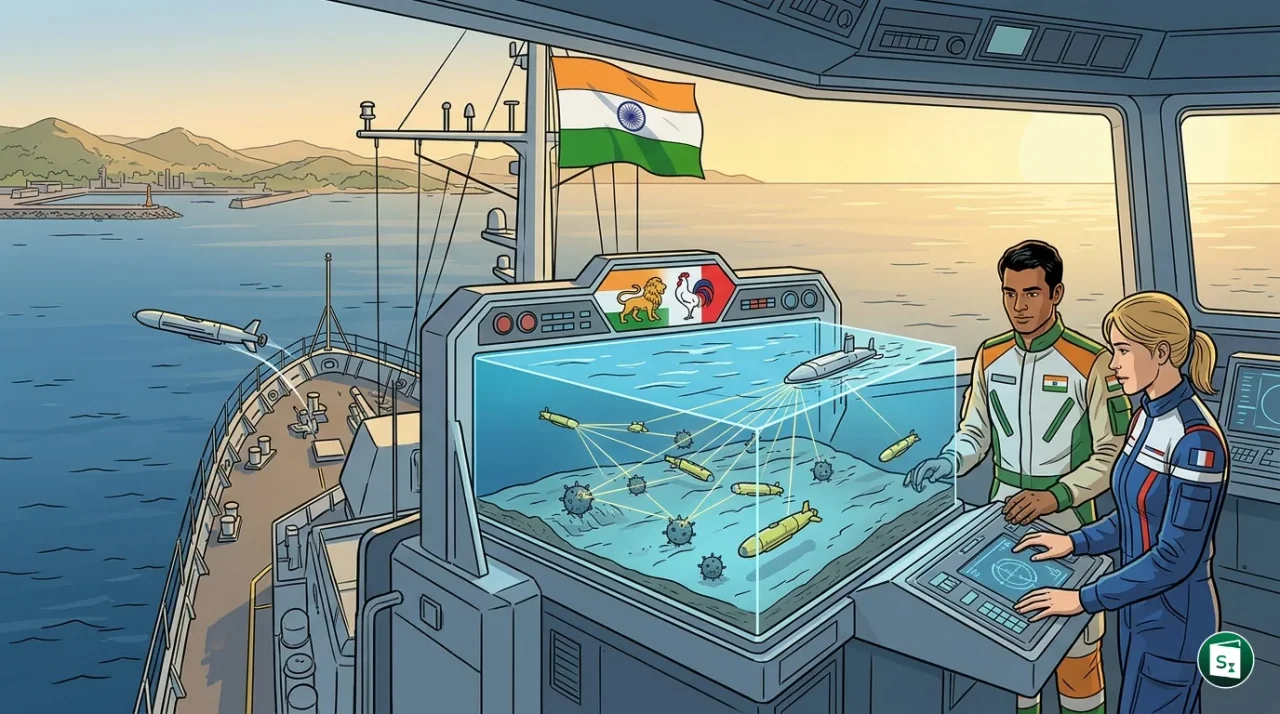
The technology provided by Exail is based on its globally deployed Unmanned MCM Integrated System (UMIS). The system operates as a modular, drone-based toolbox designed to carry out the entire mine-hunting sequence, from initial detection to final neutralization, without requiring human operators to enter danger zones. The entire fleet of unmanned vehicles is managed through a single software platform called Umisoft, which handles command, control, and real-time data analysis.
Core Elements of the Unmanned MCM Suite
The UMIS suite consists of several coordinated robotic platforms that work together to secure maritime zones. The primary surface platform is the Inspector range of unmanned surface vehicles, which includes models like the Inspector 90 and Inspector 125. These autonomous boats function as motherships, deploying, retrieving, and communicating with underwater drones while utilizing AI-based software for navigation and obstacle avoidance.
For underwater operations, autonomous underwater vehicles like the A9-M and A18-M are deployed to conduct long-endurance seafloor surveys. These vehicles scan the seabed using advanced sensors such as Synthetic Aperture Sonar (SAS) to locate potential mine-like objects. Once a target is detected, tethered remotely operated vehicles are deployed. The Seascan vehicle is used to visually identify the threat, while the K-ster is an expendable disposal vehicle that carries a shaped charge to destroy the mine, sacrificing itself in the process.
Operational Capabilities of Unmanned Mine Hunting
Traditional mine-sweeping operations required manned wooden or glass-reinforced plastic vessels to physically sail into suspected minefields. This process placed crew members and highly expensive naval assets at extreme risk. The new unmanned suite eliminates this danger by establishing a safe stand-off distance of several kilometers.
During an operation, an unmanned surface vehicle is sent ahead of the main naval vessel to deploy underwater drones. These underwater drones automatically map the seabed, and their recorded sonar data is processed by the Umisoft software to flag anomalies. Once a suspicious object is classified as a mine, the surface vehicle deploys an identification drone to confirm the target. Finally, a disposal vehicle is launched to neutralize the mine. This entire sequence is managed remotely from the safety of the main ship, ensuring that both personnel and primary warships remain outside the range of potential explosions.
Key Takeaways
- Larsen & Toubro signed a strategic partnership with France-based Exail Technologies in May 2026 to supply unmanned mine countermeasure systems.
- Under the agreement, Larsen & Toubro will serve as the prime contractor and system integrator for building 12 Mine Countermeasure Vessels for the Indian Navy.
- The Defence Acquisition Council granted the Acceptance of Necessity for the twelve mine-hunting vessels in July 2025 at an estimated cost of ₹45,000 crore.
- The new vessels will be built indigenously under the Buy (Indian-IDDM) category, with deliveries planned between 2030 and 2037.
- The Indian Navy has faced a dedicated mine-hunting vessel shortage since the decommissioning of the last Karwar-class minesweeper, INS Kozhikode, in 2019.
- Exail’s Unmanned MCM Integrated System uses autonomous underwater and surface drones controlled by a single software platform called Umisoft.