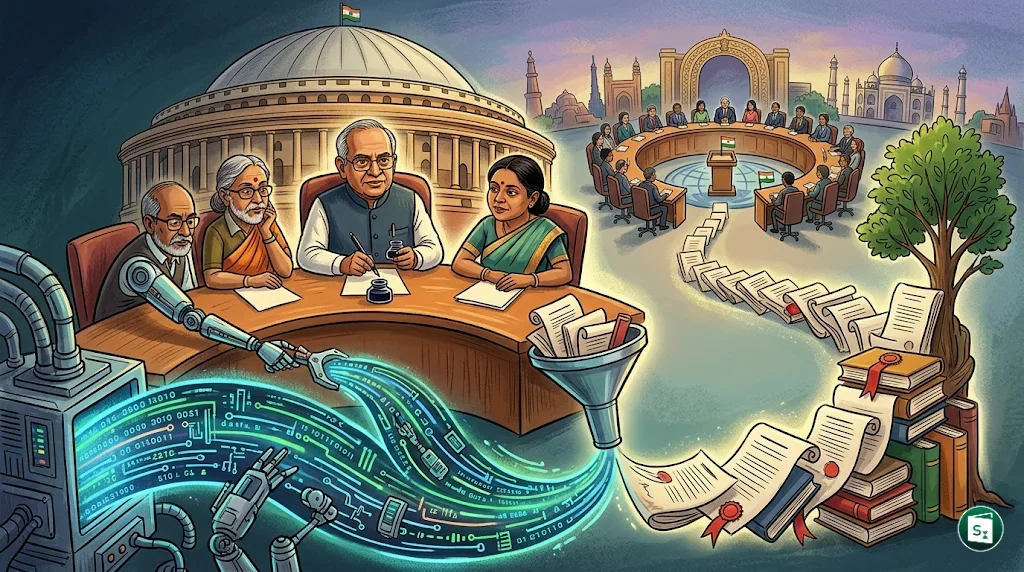
The Ministry of Electronics and Information Technology (MeitY) has constituted the Technology and Policy Expert Committee (TPEC) as the standing advisory body to the newly established AI Governance and Economic Group (AIGEG). Chaired by MeitY Secretary S Krishnan, the committee will translate intricate technological developments into actionable policy insights for the government. This dual structure aims to bolster India’s leadership in global AI governance while managing the domestic socio-economic impacts of emerging technologies.
Strengthening India’s AI Governance Framework
The establishment of the AI Governance and Economic Group (AIGEG) and its advisory arm, the TPEC, comes at a time when India is aggressively expanding its digital infrastructure. Following the launch of the IndiaAI Mission in March 2024 with an outlay of ₹10,372 crore, the government has shifted its focus toward creating a robust regulatory and strategic environment. This new institutional framework is designed to move beyond general guidelines and toward a more cohesive national policy on artificial intelligence.
The Ministry of Electronics and Information Technology (MeitY) serves as the nodal ministry for these initiatives. By creating a multi-layered governance system, the government intends to balance the rapid pace of innovation with the necessary safeguards against risks such as deepfakes, algorithmic bias, and cybersecurity threats. The AIGEG acts as the high-level policy steering body, while the TPEC provides the specialized technical expertise required to navigate the complexities of AI technologies.
Roles and Objectives of the AI Governance and Economic Group
The AI Governance and Economic Group (AIGEG) serves as India’s apex inter-ministerial body for artificial intelligence. It is chaired by the Union Minister for Electronics and IT, Ashwini Vaishnaw, with the Minister of State for Electronics and IT, Jitin Prasada, as its Vice-Chairperson. S Krishnan, the Secretary of MeitY, acts as the convenor of the group, ensuring streamlined communication between various government departments and regulatory agencies.
The primary mandate of the AIGEG is to set the overarching strategic direction for AI development and adoption in India. This involves coordinating policy across different ministries to ensure a coherent national framework that aligns with the country’s broader economic objectives. By centralizing these functions, the group aims to create a unified vision for AI, facilitating growth in the domestic ecosystem while establishing clear standards for ethical and responsible technology use.
The group is also responsible for overseeing the implementation of high-level government initiatives and identifying sectors where AI can drive maximum socio-economic impact. This proactive approach helps the government stay ahead of technological trends, ensuring that India remains a competitive player in the global digital economy.
The Technology and Policy Expert Committee: An Advisory Powerhouse
The Technology and Policy Expert Committee (TPEC) acts as the specialized advisory arm to the AIGEG, providing the technical and strategic depth needed for complex decision-making. Also chaired by S Krishnan, the Secretary of MeitY, the committee bridges the gap between rapid technological advancements and the legal frameworks required to govern them. The group consists of distinguished experts from academia, the technology industry, and digital policy backgrounds.
Academic expertise is provided by members such as Professor B Ravindran, the Head of Data Science and AI at IIT Madras, and Professor Rajat Moona, the Director of IIT Gandhinagar. Representation from leading industry bodies, including the National Association of Software and Service Companies (NASSCOM), the Data Security Council of India (DSCI), and the Manufacturers’ Association for Information Technology (MAIT), ensures that policy recommendations remain practical and industry-aligned. This diverse composition allows the government to craft regulations that are technically sound and socio-economically relevant.
The primary function of the TPEC is to translate sophisticated AI concepts into actionable policy insights for the AIGEG. This includes providing guidance on regulatory design, risk management strategies, and global standards for AI safety. By leveraging these specialized insights, the committee helps the government stay responsive to the evolving digital landscape, ensuring that India’s AI policy is both protective and progressive.
Strategic Significance for India’s Global AI Stature
The creation of the TPEC is a strategic move to strengthen India’s voice in international AI governance. As artificial intelligence becomes a central theme in global diplomacy, India has been positioning itself as a leader, particularly for the Global South. India’s role as the Chair of the Global Partnership on Artificial Intelligence (GPAI) in 2024 laid the groundwork for this institutional expansion. By formalizing a body like the TPEC, the government ensures that India’s domestic regulatory insights can be effectively communicated and integrated into global standards.
This dual-layered governance model also allows India to navigate the complex landscape of international AI agreements more effectively. The TPEC will analyze global trends and help the government adapt its policies to maintain alignment with international safety and ethical protocols. This is particularly important for high-stakes areas like cross-border data flows, cybersecurity, and the prevention of AI-generated misinformation.
Beyond international diplomacy, the institutional structure sends a strong signal to global investors and technology partners. By demonstrating a clear and predictable governance framework, India enhances its reputation as a safe and stable destination for AI research and development. This alignment between domestic policy and global expectations is crucial for attracting the high-quality investment needed to sustain the IndiaAI Mission.
Looking Ahead: Addressing Emerging Challenges
The road ahead for the AIGEG and TPEC involves managing some of the most pressing concerns in the digital world. One of the immediate priorities is the mitigation of risks associated with deepfakes and AI-generated misinformation, which can have significant social and security implications. The TPEC is expected to provide recommendations on technical standards for detecting such content and creating a framework for rapid response.
As AI technology continues to evolve at an unprecedented speed, the government is moving toward a more adaptive and future-forward policy approach. This means that regulations will not be static but will be reviewed and updated regularly based on the insights provided by the expert committee. This flexibility is essential for fostering innovation while protecting the rights of citizens.
In the coming months, the AIGEG is likely to focus on integrating AI governance with other major legislative efforts, such as the potential Digital India Act. By synchronizing these policies, the government aims to create a seamless digital legal ecosystem that balances economic opportunity with robust ethical standards. The success of this dual-committee structure will be measured by its ability to keep India at the forefront of the global AI revolution.
Key Takeaways
- The Ministry of Electronics and Information Technology (MeitY) established the Technology and Policy Expert Committee (TPEC) as a standing advisory body.
- S Krishnan, the Secretary of MeitY, has been appointed as the chairperson of the TPEC.
- The TPEC provides specialized advisory support to the newly established AI Governance and Economic Group (AIGEG).
- The AIGEG is an apex inter-ministerial body chaired by the Union Minister for Electronics and IT, Ashwini Vaishnaw.
- Major academic and industry bodies represented in the TPEC include IIT Madras, IIT Gandhinagar, NASSCOM, DSCI, and MAIT.
- The primary objective of these bodies is to translate complex technical AI concepts into actionable policy insights and strengthen India’s role in global AI governance.