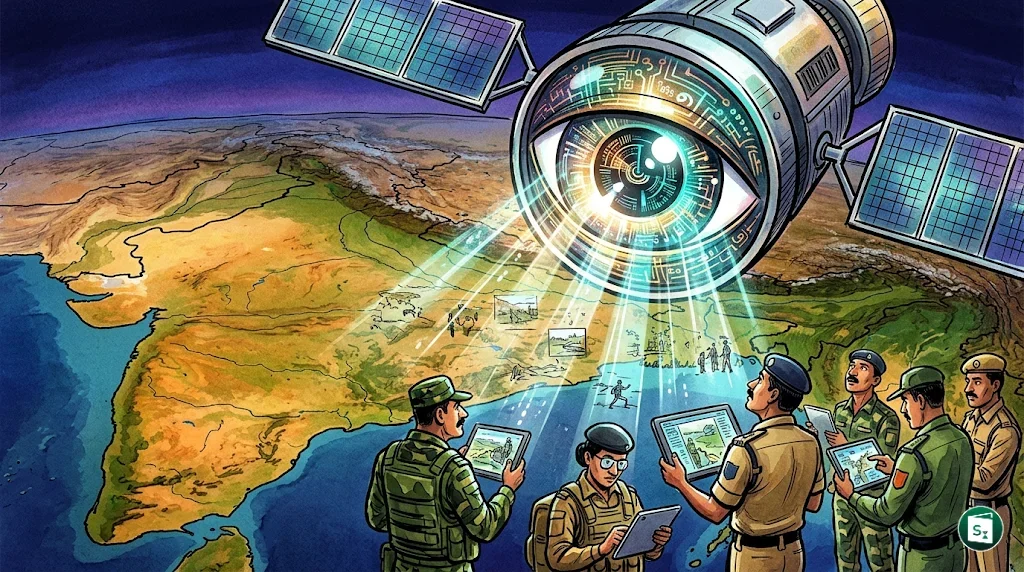
The Ministry of Home Affairs officially received the Prajna satellite imaging system on 24 April 2026 to enhance the situational awareness of India’s security forces. Developed indigenously by the Defence Research and Development Organisation, this artificial intelligence-enabled platform provides real-time decision support for critical internal security operations. The induction of this advanced imaging technology marks a significant shift toward data-driven intelligence gathering for border management and counter-terrorism.
What is Prajna?
Prajna is an indigenously developed, state-of-the-art software platform that leverages Artificial Intelligence (AI) and Machine Learning (ML) to process and analyze vast streams of satellite imagery. Unlike a physical satellite, Prajna serves as the brain that ingests raw data from various space assets and transforms it into actionable intelligence. By automating the identification of patterns and anomalies, the system significantly reduces the time required for manual image analysis.
This system is designed to provide security agencies with a precise and comprehensive view of ground realities. It can process high-resolution multispectral and hyperspectral data to detect hidden structures, troop movements, or unusual activities that might be invisible to the naked eye. The platform ensures that information is not just collected but is immediately useful for tactical planning.
Key Functions and Operational Capabilities
The operational core of Prajna lies in its ability to offer real-time decision support. Traditionally, satellite data processing involved a significant lag between image capture and intelligence extraction. Prajna bridges this gap by using AI algorithms that can flag suspicious activities as they are detected.
| Feature | Description |
|---|---|
| Pattern Recognition | Identifies recurring activities or changes in land use that indicate security threats. |
| Anomaly Detection | Automatically alerts operators to unusual movements or new constructions in sensitive zones. |
| Change Detection | Compares historical data with current images to highlight even minute physical changes on the ground. |
| Object Classification | Differentiates between various types of vehicles, equipment, and structures with high accuracy. |
These capabilities empower security forces to respond to threats with unprecedented speed. For instance, in counter-insurgency operations, the system can map dense forested areas to locate hideouts, while in disaster management, it can provide rapid damage assessment to guide rescue teams.
The Role of CAIR and DRDO in Development
The Prajna system was conceptualized and built by the Centre for Artificial Intelligence and Robotics (CAIR), a premier laboratory under the Defence Research and Development Organisation (DRDO). Based in Bengaluru, CAIR was established in October 1986 and has since been the focal point for India’s research into intelligent systems, robotics, and secure communication technologies.
The DRDO, which was established in 1958 and is headquartered in New Delhi, has increasingly focused on developing indigenous solutions that reduce India’s reliance on foreign technology. By developing Prajna, CAIR has demonstrated its expertise in merging geospatial intelligence with advanced computing. Prior to this, CAIR has also been involved in major projects like the Trigun system, which provides maritime domain awareness, and the Muntra unmanned ground vehicle.
Strategic Significance for Internal Security
For the Ministry of Home Affairs (MHA), Prajna acts as a powerful force multiplier. By providing high-fidelity visual data, it assists central armed police forces like the BSF, CRPF, and NSG in planning missions with greater accuracy. This is particularly vital for border management, where monitoring vast and often inaccessible terrains is a constant challenge.
The system’s ability to provide a “live” operating picture helps in securing critical infrastructure, such as power plants and government installations, from potential sabotage. Moreover, by integrating AI, the MHA can now shift from a reactive security posture to a more proactive one, where potential threats are identified and mitigated before they escalate. This technological leap reflects India’s broader ambition to modernize its internal security framework through the induction of advanced indigeneous tools.
Key Takeaways
- Prajna is an indigenously developed, AI-enabled satellite imaging system handed over to the Ministry of Home Affairs on 24 April 2026.
- The system was designed and developed by the Centre for Artificial Intelligence and Robotics (CAIR), a laboratory under DRDO based in Bengaluru.
- CAIR was established in 1986 and specializes in research related to AI, robotics, and command and control systems.
- The platform uses Artificial Intelligence and Machine Learning to automatically detect patterns, anomalies, and changes in satellite data.
- It serves as a force multiplier for security agencies like the BSF and CRPF by providing real-time situational awareness for border and internal security.
- The DRDO was established in 1958 and is headquartered in New Delhi, operating under the Ministry of Defence.