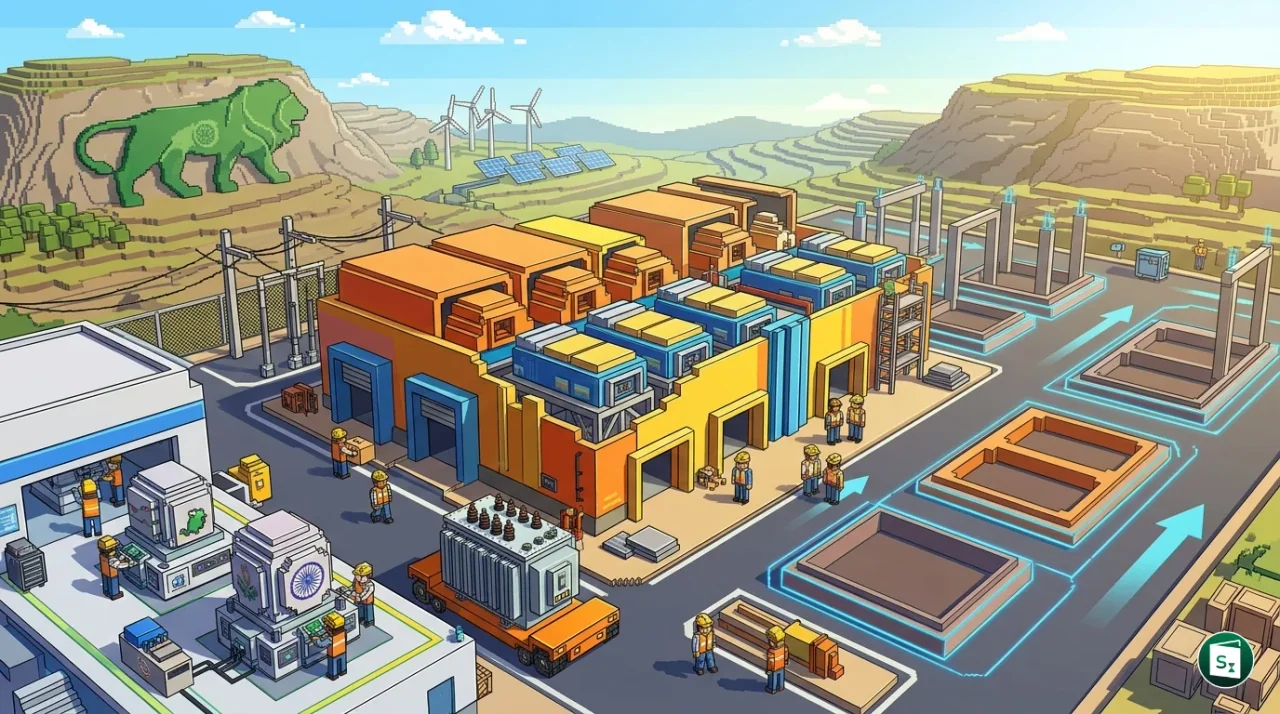
The Ministry of Power has introduced a revised procurement framework for Line Commutated Converter (LCC) type High Voltage Direct Current (HVDC) substations, replacing the previous uniform local content requirement with a phased roadmap. This strategic shift sets a gradual target for domestic manufacturing, starting at 30% local content and reaching 60% by the year 2035. By providing a clear transition window, the government aims to strengthen India’s domestic supply chain for critical, high-value power transmission components.
Understanding the Phased Local Content Roadmap
The updated guidelines, issued by the Ministry of Power, provide a clear schedule for increasing the Minimum Local Content (MLC) in HVDC projects. This roadmap specifically applies to projects executed under Engineering, Procurement, and Construction (EPC) or turnkey contracts. Instead of a mandatory 60% requirement from the outset, the government has broken down the targets over the next decade.
The MLC requirements are structured as follows:
| Fiscal Year Deadline | Minimum Local Content Requirement |
|---|---|
| By FY 2027-28 | 30% |
| By FY 2029-30 | 40% |
| By FY 2031-32 | 50% |
| By FY 2034-35 | 60% |
This phased approach ensures that as India’s power transmission infrastructure expands, domestic manufacturing capacity grows in tandem without causing immediate supply chain bottlenecks for ongoing projects.
Why the Transition from Uniform Norms?
Previously, the government had mandated a uniform 60% local content requirement for all HVDC substations under the Public Procurement (Preference to Make in India) Order, 2017. However, feedback from the industry and state-owned entities like the Power Grid Corporation of India Limited (PGCIL) highlighted significant challenges in meeting such high targets immediately.
HVDC technology involves complex power electronics and specialized components like converter transformers, thyristor valves, and high-speed control and protection systems. While Indian companies have made strides in basic infrastructure, the precision engineering required for these advanced components is currently concentrated among a few global technology leaders. By easing the immediate requirement to 30%, the Ministry of Power is allowing domestic manufacturers to form joint ventures, transfer technology, and set up assembly lines within India at a sustainable pace.
HVDC Technology: The Backbone of India’s Power Grid
High Voltage Direct Current (HVDC) technology is vital for transporting massive amounts of electricity over long distances with minimal energy loss. Unlike traditional Alternating Current (AC) transmission, HVDC is highly efficient for bulk power transfer from remote renewable energy hubs to industrial centers. This technology is a cornerstone of India’s Green Energy Corridors and the ambitious One Sun One World One Grid (OSOWOG) initiative.
LCC vs VSC: Technical Nuances
The current revision specifically targets Line Commutated Converter (LCC) type substations. LCC is a mature, thyristor-based technology known for its robustness and ability to handle extremely high voltages. However, it requires a strong AC grid at the receiving end to function correctly.
In contrast, Voltage Source Converter (VSC) technology uses advanced transistors (IGBTs) and offers greater flexibility, such as the ability to connect to “weak” grids and integrate intermittent wind and solar power more effectively. While the current roadmap focuses on LCC, VSC technology is also gaining traction in India, notably with the Pugalur–Thrissur link, which demonstrated significant domestic participation in its implementation.
Strategic Significance for Aatmanirbhar Bharat
This policy recalibration is a pragmatic step toward achieving Aatmanirbhar Bharat (Self-reliant India) in the high-technology energy sector. By setting long-term, predictable targets, the government is providing the necessary policy stability for global players like GE, Hitachi Energy, and Siemens to deepen their manufacturing roots in India, often in partnership with domestic giants like BHEL.
The gradual increase in local content will not only reduce the high foreign exchange outflow associated with importing specialized equipment but also create high-skilled jobs in power electronics and system integration. Furthermore, as India aims to become a global hub for green energy, having a robust domestic ecosystem for HVDC technology will be critical for exporting engineering services and equipment to other developing nations under South-South cooperation frameworks.
Key Takeaways
- The Ministry of Power has replaced the uniform 60% local content requirement for HVDC LCC substations with a phased roadmap.
- The new targets for Minimum Local Content (MLC) under EPC or turnkey projects start at 30% by FY 2027-28.
- The local content requirement will gradually increase to 40% by FY 2029-30 and 50% by FY 2031-32.
- A final target of 60% local content has been set for all relevant HVDC projects by the year 2035.
- This revision applies specifically to Line Commutated Converter (LCC) technology, which is used for bulk, long-distance power transmission.
- The policy operates under the framework of the Public Procurement (Preference to Make in India) Order, 2017, aiming to boost domestic manufacturing.