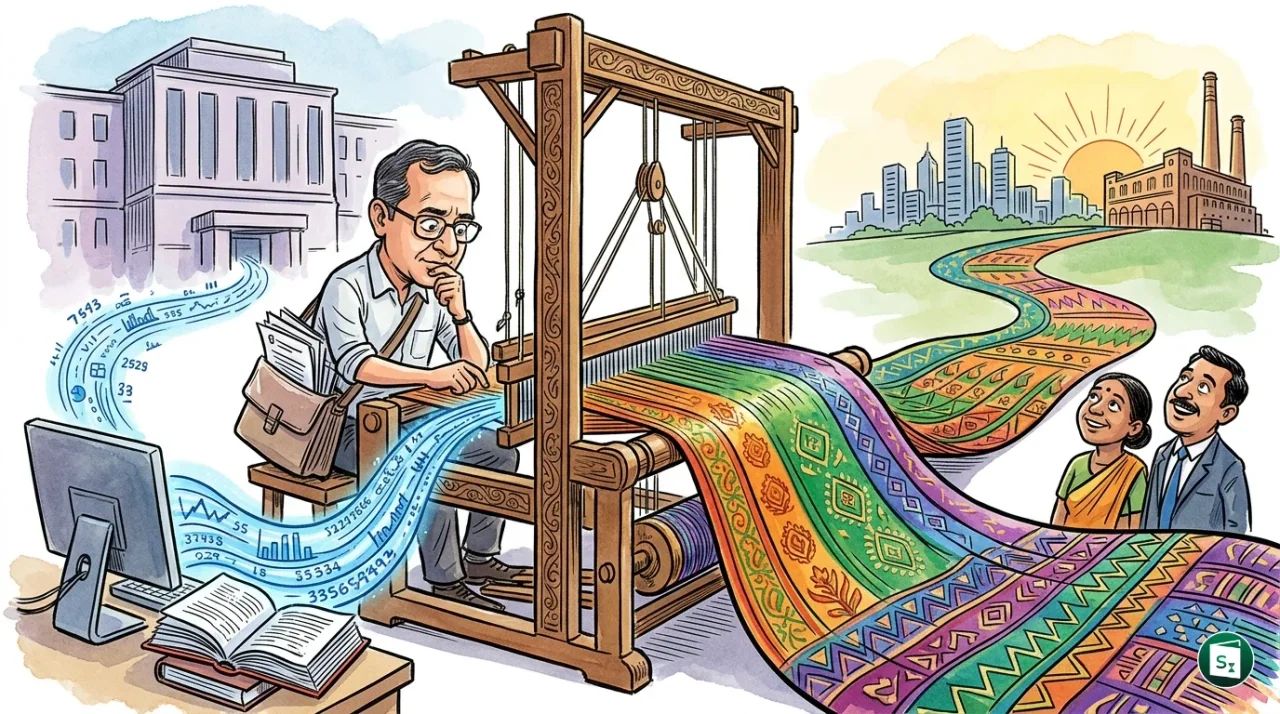
The Ministry of Textiles signed a Memorandum of Understanding with the Indian Council for Research on International Economic Relations on May 14, 2026, in New Delhi to initiate evidence-based policy research in the textile and apparel sector. This collaborative partnership is designed to strengthen the domestic textile industry through data-driven analysis and analytically robust policy formulation. By bridging academic research with governmental execution, the initiative aims to boost India’s competitiveness in the global textile and apparel market.
Details of the Partnership Between the Ministry of Textiles and ICRIER
The collaboration marks a structured effort to enhance the analytical foundation of policy decisions in one of India’s oldest manufacturing sectors. The formal agreement aims to combine the administrative reach of the ministry with the analytical rigor of one of the nation’s premier economic research institutions.
Signatories and Institutional Roles
The Memorandum of Understanding was signed by Shri Akhilesh Kumar, Deputy Director General of the Ministry of Textiles, and Dr. Shekhar Aiyar, Director and Chief Executive of the Indian Council for Research on International Economic Relations (ICRIER). Under this agreement, ICRIER will serve as a research partner and technical advisor.
Established in August 1981 and headquartered in New Delhi, ICRIER is a leading independent, non-profit economic think tank. The institution has a rich history of supporting national policy, with founding members that included former Prime Minister Dr. Manmohan Singh and noted economist Dr. C. Rangarajan. Over the decades, it has specialized in macroeconomic research, international trade, and climate sustainability, making it well-suited to address the globalized challenges of the textile sector.
Core Areas of Collaboration and Research Focus
The primary objective of this agreement is to implement evidence-based research that addresses both domestic bottlenecks and international trade opportunities. This includes a major effort toward strengthening data systems by upgrading and streamlining textile and apparel database systems. Having robust, real-time data is critical for tracking industrial output, measuring employment trends, and identifying fast-changing global market demands.
In addition, ICRIER will provide data-driven analytical inputs to help the government formulate policies across the entire textile value chain. The research team plans to conduct comprehensive assessments of global trade patterns, tariff structures, and non-tariff barriers that impact Indian exports. By identifying regulatory, logistics, and supply chain constraints, the partnership aims to recommend actionable solutions to enhance the efficiency of domestic manufacturers.
Strategic Importance and Challenges of the Textile Sector
The textile and apparel industry serves as a vital engine for economic growth and social development across the country. Because the sector spans the entire value chain (from agricultural cotton production to high-fashion retail), its performance has wide-ranging impacts on both industrial growth and rural livelihoods.
Key Economic Indicators
To understand the scale of the sector, it is helpful to look at its core contributions to India’s national economy. The following table highlights the industry’s key indicators in terms of production, jobs, and global trade:
| Parameter | Statistical Value | Significance for the Indian Economy |
|---|---|---|
| Contribution to GDP | Approximately 2.3% | Underscores the sector’s foundational role in national economic output. |
| Direct Employment | Over 45 million people | The second-largest employer after agriculture, crucial for rural and semi-urban livelihoods. |
| Global Export Position | 6th largest exporter | Holds a 3.9% share of global trade, representing a key source of foreign exchange. |
| Share of India’s Total Exports | 11% to 12% | Demonstrates the industry’s significant contribution to India’s merchandise export basket. |
| Share of Industrial Production | Around 13% | Reflects the sector’s heavy weight in India’s total domestic manufacturing output. |
Structural Challenges Hindering Global Competitiveness
Despite its massive scale, the domestic industry faces several structural bottlenecks that limit its growth and export potential. One major challenge is value chain fragmentation, where different production stages (such as spinning, weaving, processing, and garmenting) are geographically scattered and dominated by small, unorganized units. This lack of integration leads to high logistics costs and prolonged turnaround times, making it difficult for Indian exporters to compete with integrated manufacturing hubs.
Additionally, the sector faces intense global competition from countries such as Bangladesh, Vietnam, and Cambodia. These nations benefit from preferential trade agreements and duty-free access to major consumer markets like the European Union and the United States. In contrast, Indian exporters often face higher import tariffs in these key regions, creating a competitive disadvantage that must be countered through domestic efficiency, technological modernization, and smart policy design.
Key Government Initiatives in the Textile Sector
To address structural challenges and accelerate modernization, the government has launched several comprehensive programs. These programs are aimed at attracting massive capital investments, expanding employment, and boosting exports, particularly in modern and high-value product categories.
Pradhan Mantri Mega Integrated Textile Region and Apparel (PM MITRA) Parks
The Pradhan Mantri Mega Integrated Textile Region and Apparel (PM MITRA) scheme is a flagship initiative designed to build integrated, world-class infrastructure. Under this scheme, the government is establishing seven mega textile parks in strategic locations across India, including Tamil Nadu, Telangana, Karnataka, Maharashtra, Gujarat, Madhya Pradesh, and Uttar Pradesh. These parks offer a plug-and-play manufacturing system that brings the entire value chain (from spinning and weaving to garmenting and logistics) into a single geographical area.
By integrating these processes, the parks aim to significantly lower logistics costs and improve global competitiveness. Each park is designed to attract an estimated ₹10,000 crore in investment and generate approximately 1 lakh direct and 2 lakh indirect jobs, driving localized industrial growth.
Production Linked Incentive (PLI) Scheme for Textiles
To encourage the production of high-value and non-traditional apparel, the government introduced the Production Linked Incentive (PLI) Scheme for Textiles with an approved financial outlay of ₹10,683 crore over a five-year period. While India has traditionally been strong in cotton-based textiles, the global market has shifted heavily toward synthetic and specialized products. The PLI scheme specifically targets the manufacturing of Man-Made Fibre (MMF) apparel, MMF fabrics, and technical textiles. By offering financial incentives based on incremental sales, the program encourages manufacturers to scale up operations, adopt advanced technology, and increase India’s share in these high-growth global segments.
National Technical Textiles Mission (NTTM)
The National Technical Textiles Mission (NTTM) was launched with a total budget of ₹1,480 crore to position India as a global leader in high-tech industrial fabrics. Technical textiles are specialized materials used in non-aesthetic applications, such as healthcare (meditech), agriculture (agrotech), defense (protech), and infrastructure (geotech). The mission focuses on driving domestic innovation through targeted academic partnerships and research grants, including the Grant for Research and Entrepreneurship across Aspiring Innovators in Technical Textiles (GREAT) scheme. Through these initiatives, the government aims to increase domestic consumption, promote import substitution, and build a highly skilled workforce of 50,000 trained individuals to support this advanced manufacturing segment.
The Role of Evidence-Based Policy in Transforming Textiles
The signature of the research agreement between the Ministry of Textiles and ICRIER comes at a crucial juncture when India is seeking to sign bilateral Free Trade Agreements (FTAs) with major economies, including the European Union and the United Kingdom. Formulating trade and industrial policy without granular, empirical data can lead to sub-optimal resource allocation and ineffective incentive designs. By relying on rigorous, data-driven research, policymakers can better understand tariff sensitivities, assess the impact of non-tariff barriers, and negotiate trade agreements from a position of factual strength.
Moreover, evidence-based research helps bridge the gap between policy design and industry needs. Within the framework of the “Make in India” initiative, the textile sector requires targeted policy interventions that align with global demand. Comprehensive research can identify high-potential niche categories (such as technical textiles or sustainable, organic apparel) and direct public investment and subsidies toward these high-performance areas. By replacing speculative planning with empirical evidence, the government can optimize schemes like the PLI and PM MITRA, ensuring that national resources are directed where they can generate the highest employment and export returns.
Key Takeaways
- The Ministry of Textiles signed a Memorandum of Understanding with the Indian Council for Research on International Economic Relations (ICRIER) on May 14, 2026, in New Delhi to conduct evidence-based policy research in the textile and apparel sector.
- ICRIER, established in August 1981 and headquartered in New Delhi, is a leading independent, non-profit economic think tank whose founding members included former Prime Minister Dr. Manmohan Singh and noted economist Dr. C. Rangarajan.
- The Indian textile and apparel industry is a major economic driver, contributing 2.3% to India’s GDP, accounting for 11% to 12% of national exports, and serving as the second-largest employer after agriculture with over 45 million direct workers.
- Under the flagship PM MITRA scheme, the government is establishing seven mega textile parks across Tamil Nadu, Telangana, Karnataka, Maharashtra, Gujarat, Madhya Pradesh, and Uttar Pradesh, with each park designed to attract ₹10,000 crore in investments.
- The National Technical Textiles Mission (NTTM) operates with a budget of ₹1,480 crore to promote high-tech industrial fabrics and includes specialized programs like the GREAT scheme for aspiring research entrepreneurs.