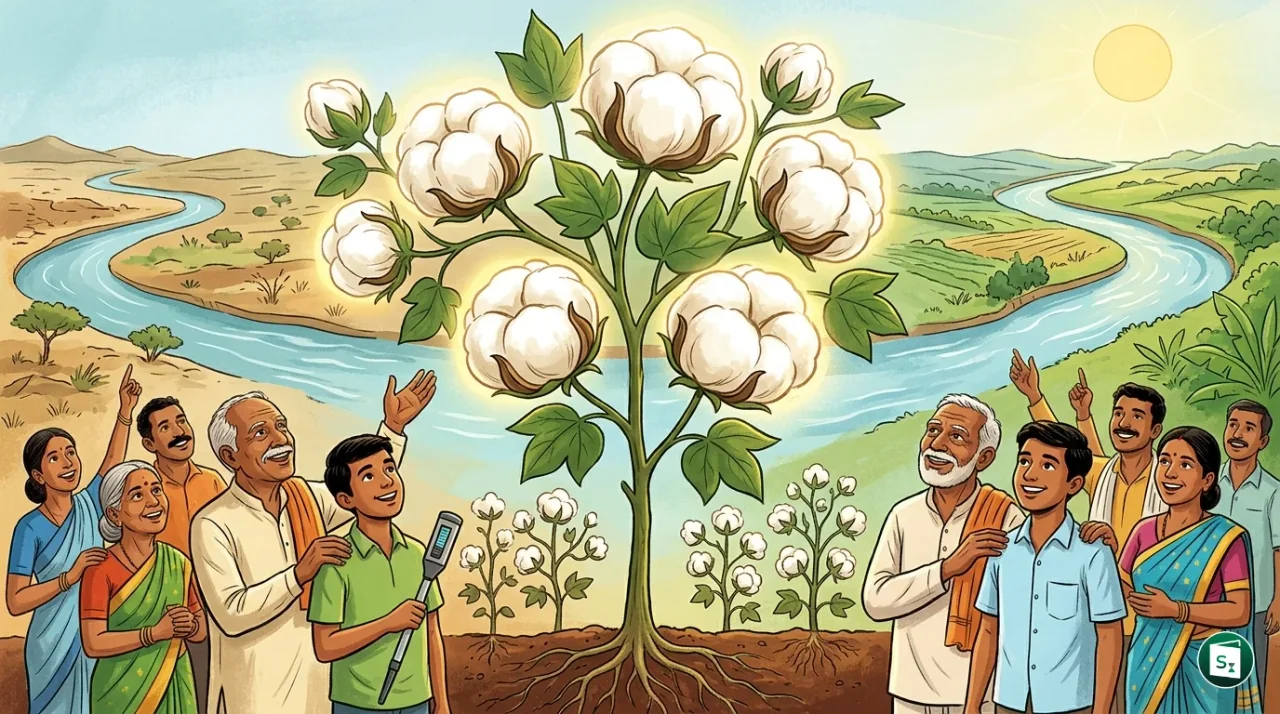
The Union Cabinet, chaired by Prime Minister Narendra Modi, approved the Mission for Cotton Productivity (Kapas Kanti) with a total financial outlay of ₹5,659.22 crore. Spanning five years from FY 2026-27 to 2030-31, the mission aims to transform India’s cotton landscape by nearly doubling lint productivity and enhancing the global competitiveness of Indian cotton. This strategic move is expected to benefit approximately 32 lakh farmers across 14 major cotton-growing states in its initial phase.
Key Pillars of the Mission: Outlay and Implementation
The Mission for Cotton Productivity, also referred to as Kapas Kanti, is a collaborative initiative spearheaded by the Ministry of Agriculture and Farmers Welfare and the Ministry of Textiles. With an approved budget of ₹5,659.22 crore, the mission is structured to address the long-standing bottlenecks in the cotton value chain. The implementation strategy involves a concentrated effort in 140 districts across 14 major cotton-growing states, including Gujarat, Maharashtra, Telangana, and Rajasthan.
To ensure scientific rigor, the mission will leverage the expertise of various national research bodies. The Indian Council of Agricultural Research (ICAR), through its 10 specialized institutes, will lead the research and development efforts. Furthermore, 10 centres of the All India Coordinated Research Project (AICRP) on Cotton and the Council of Scientific and Industrial Research (CSIR) will collaborate to provide technical support and upscale advanced production technologies.
Ambitious Productivity and Production Targets
India is the world’s largest producer of cotton, yet it faces significant challenges regarding lint productivity, which remains below the global average. The Kapas Kanti mission sets clear, quantifiable goals to bridge this gap and boost overall output. By 2030-31, the government aims to achieve a achieve a total production of 498 lakh bales, where one bale equals 170 kg.
The primary focus is on increasing yield per hectare through better irrigation, pest management, and the use of high-quality seeds. The following table highlights the key performance indicators targeted under the mission:
| Indicator | Current Status (Approx.) | Target by 2030-31 |
|---|---|---|
| Lint Productivity | 440 kg per hectare | 755 kg per hectare |
| Total Annual Production | 350 to 380 lakh bales | 498 lakh bales |
| Beneficiary Farmers | - | 32 lakh farmers |
| Geographic Scope | - | 140 districts |
Advancing Agronomic Practices: The High-Density Planting System
A cornerstone of the Kapas Kanti mission is the promotion of the High-Density Planting System (HDPS). Traditionally, Indian cotton farmers have followed wide spacing between plants, which often leads to lower yields and inefficient use of land. HDPS involves planting more cotton plants per unit area with closer spacing, which can significantly enhance productivity, especially in rain-fed regions.
This method requires specialized short-duration and compact plant varieties that are suitable for mechanical harvesting. By shifting to HDPS, the mission expects to help farmers maximize their land utilization and reduce the time the crop stays in the field, thereby minimizing the risk of pest attacks such as the Pink Bollworm.
Strengthening the Value Chain: From R&D to Global Branding
The mission adopts a holistic approach to the cotton value chain, moving beyond just cultivation to encompass processing and branding. A key component is the modernization of approximately 2,000 ginning and processing factories. Upgrading these facilities is crucial for reducing contamination in lint, which has been a major hurdle in getting premium prices for Indian cotton in international markets.
To position Indian cotton as a premium product globally, the mission will scale up the Kasturi Cotton Bharat initiative. This branding exercise focuses on:
- Traceability: Ensuring that the origin of the cotton can be tracked throughout the supply chain.
- Quality Assurance: Implementing stringent testing protocols at national cotton testing infrastructure.
- Sustainability: Promoting environmentally friendly practices that resonate with global buyers.
Additionally, the mission encourages the diversification and use of other natural fibers like banana, bamboo, and flax to promote a circular economy within the textile sector.
Strategic Alignment with the 5F Vision
The Kapas Kanti mission is deeply integrated with the government’s 5F Vision, which stands for Farm to Fibre to Factory to Fashion to Foreign. This strategy aims to create a seamless ecosystem where Indian agriculture and industry work in tandem to capture a larger share of the global textile market.
By increasing the availability of high-quality lint, the mission ensures a steady supply of raw materials (Fibre) for Indian textile units (Factory). This, in turn, boosts the production of finished garments (Fashion) that can be exported (Foreign) to international markets. The mission’s focus on digital integration and market access for farmers further streamlines the transition from “Farm to Fibre,” ensuring that the primary producers receive a fair share of the value created.
Significance for Indian Farmers and the Economy
The approval of the Mission for Cotton Productivity marks a transformative moment for India’s agrarian economy. With an estimated 32 lakh cotton farmers set to benefit, the mission directly addresses the challenge of stagnant farm incomes by providing access to high-yielding, climate-resilient, and pest-resistant seeds. The focus on 140 districts ensures that the benefits reach the heart of India’s cotton belt, empowering small and marginal farmers with modern agronomic tools.
Economically, the mission is poised to strengthen India’s position as a global cotton hub. By targeting a production of 498 lakh bales by 2031, India can not only meet its domestic demand but also become a reliable exporter of high-quality, traceable cotton. This will have a positive multiplier effect on the textile industry, contributing significantly to the national GDP and supporting the livelihoods of millions of people involved in the textile value chain.
Key Takeaways
- The Union Cabinet approved the Mission for Cotton Productivity (Kapas Kanti) with a total outlay of ₹5,659.22 crore.
- The mission will be implemented over a five-year period from FY 2026-27 to 2030-31.
- The initiative aims to increase lint productivity from 440 kg/hectare to 755 kg/hectare by 2031.
- India targets a total cotton production of 498 lakh bales (170 kg per bale) by the end of the mission period.
- The program initially focuses on 140 districts across 14 states and is expected to benefit 32 lakh cotton farmers.
- The mission is strategically aligned with the government’s 5F Vision: Farm to Fibre to Factory to Fashion to Foreign.