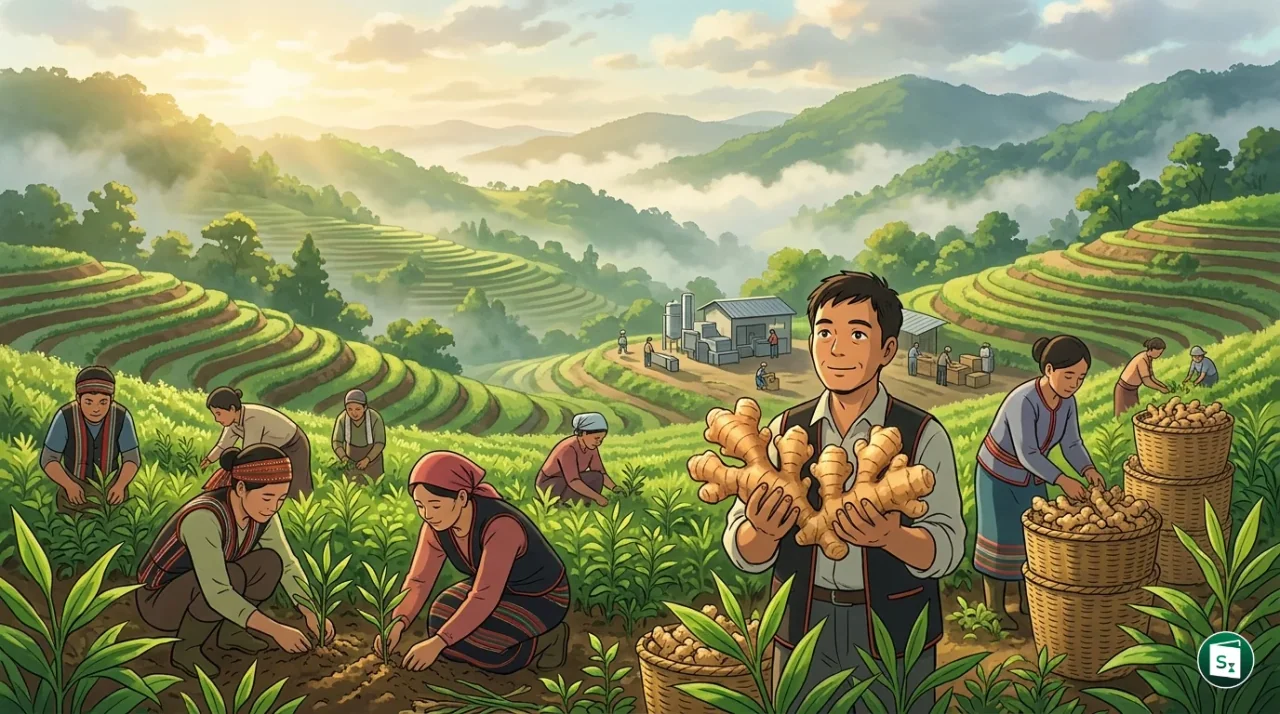
The Union Minister for Development of North Eastern Region, Jyotiraditya Scindia, and the Mizoram Chief Minister, Lalduhoma, launched the Mizoram Ginger Mission on May 13, 2026, to transform the state’s ginger cultivation. With a total financial outlay of ₹189.79 crore, the project focuses on establishing modern value chains and raising farmer incomes. The mission specifically aims to brand and export Mizoram’s unique, Geographical Indication-certified, pharmaceutical-grade ginger to international markets.
What is the Mizoram Ginger Mission?
The initiative is officially designated as the Mizoram Ginger Unique Selling Proposition (USP) – Sustainable Cultivation & Value Chain Development Project. Supported by the Ministry of Development of North Eastern Region (MDoNER), the mission has a total financial allocation of ₹189.79 crore. This project is designed to transition the local ginger sector from subsistence farming to a commercial enterprise. The main goal is to integrate approximately 20,000 farming households into a modern, traceable, and quality-assured value chain, which will help double local incomes.
The mission uses a multi-agency approach to support cultivation and post-harvest management. MDoNER works alongside the North Eastern Council (NEC), which is the regional planning body for the Northeast established in 1971 and headquartered in Shillong, Meghalaya. In addition, the project leverages convergence with several central ministries, including the Ministry of Agriculture and Farmers Welfare, the Ministry of Rural Development, and the Ministry of Food Processing Industries. It also coordinates with national institutions like the National Bank for Agriculture and Rural Development (NABARD), the Indian Council of Agricultural Research (ICAR), and the Agricultural and Processed Food Products Export Development Authority (APEDA).
| Organisation | Established Year | Headquarters |
|---|---|---|
| Ministry of DoNER | 2001 (Ministry in 2004) | New Delhi |
| North Eastern Council (NEC) | 1971 | Shillong, Meghalaya |
| NABARD | 1982 | Mumbai, Maharashtra |
| APEDA | 1986 | New Delhi |
| ICAR | 1929 | New Delhi |
The Four Pillars of the Ginger Movement
During the launch of the project, the Union Minister described the mission as a comprehensive movement built upon four strategic pillars. These pillars aim to restructure the agricultural economics of Mizoram by changing how ginger is grown, processed, and sold.
The first pillar is convergence, which focuses on pooling resources and expertise from different central ministries, financial institutions, and state agencies. The second pillar is value addition, which shifts the focus from selling raw ginger at low prices to processing it into dried ginger, powder, and oleoresin. The third pillar is branding, which aims to establish a premium global identity for Mizo ginger in international markets. The final pillar is market integration, which aims to connect farmers directly with buyers in high-value export destinations across Southeast Asia, the Middle East, and Europe.
Why Mizo Ginger is Globally Prized
Mizoram’s ginger is widely recognised for its superior quality, distinctive aroma, low fiber content, and medicinal properties. Its key unique selling proposition is its exceptionally high oleoresin content, which ranges between 6% and 8%. This is more than double the global average of approximately 3%, making it highly desirable for the pharmaceutical, nutraceutical, and cosmetic industries.
To protect and promote this unique crop, the local varieties, namely Thingpui and Thinglaidum, were awarded the Geographical Indication (GI) tag in 2021 under the name Mizo Ginger. In December 2025, the government think-tank NITI Aayog officially designated Mizoram as the Ginger Capital of India to recognize its high production potential. Currently, a major challenge is that local farmers receive only ₹8 to ₹15 per kilogram for raw ginger, while processed ginger in international markets can sell for more than ₹500 per kilogram. By branding Mizo Ginger as a premium product, the mission aims to help farmers capture this global price premium.
Infrastructure and the Mualkawi Processing Hub
A key component of the mission is the development of robust post-harvest infrastructure to prevent crop spoilage and enable processing. The project implements a hub-and-spoke infrastructure model. The main processing hub will be established at Mualkawi in Champhai district, which is Mizoram’s largest ginger-producing region. This central hub will handle large-scale washing, drying, oil extraction, and packaging.
To ensure that farmers in remote parts of the state can access these facilities, the hub will be supported by three smaller spoke centers located at Tualcheng, Vaphai, and Zotlang. These spoke centers will function as primary collection, sorting, and grading units. To fund this post-harvest and processing infrastructure, the Ministry of DoNER sanctioned ₹30.13 crore under the Focused Development Component (FDC) of the North Eastern Council. This decentralized network is expected to drastically reduce transport costs and post-harvest losses.
Integration with State and Central Schemes
To ensure long-term sustainability, the Mizoram Ginger Mission is designed to integrate closely with existing state and central government initiatives. At the state level, the mission aligns with Mizoram’s flagship handholding scheme, Bana Kaih. Launched by the state government, this scheme is designed to support farmers by offering resource handholding, financial assistance, and marketing channels. A key benefit of this integration is the provision of a minimum support price for ginger, which establishes a stable floor price and protects growers from sudden market crashes.
At the central level, the mission complements India’s focus on organic farming and agricultural exports from the northeastern region. By aligning with the Act East Policy, the project leverages Mizoram’s proximity to Southeast Asian borders to open up direct land-based trade routes. Furthermore, the emphasis on traceability and quality control prepares local produce to meet the strict sanitary and phytosanitary standards of European and Middle Eastern markets, paving the way for sustainable export growth.
Key Takeaways
- The Mizoram Ginger Mission was launched in May 2026 with a total outlay of ₹189.79 crore to enhance ginger cultivation and value chain development in Mizoram.
- Supported by the Ministry of Development of North Eastern Region (MDoNER), the project aims to integrate approximately 20,000 farming households into a traceable and quality-assured market chain.
- The local ginger varieties Thingpui and Thinglaidum are clubbed under the Geographical Indication (GI) tag Mizo Ginger, which was awarded in 2021.
- Mizo Ginger contains a unique oleoresin concentration of 6% to 8%, which is more than double the global average of 3%, making it highly valuable for pharmaceutical use.
- The government think-tank NITI Aayog officially designated Mizoram as the Ginger Capital of India in December 2025.
- Infrastructure includes a central processing hub in Mualkawi (Champhai district) and three spoke centers in Tualcheng, Vaphai, and Zotlang, supported by ₹30.13 crore sanctioned by the North Eastern Council.