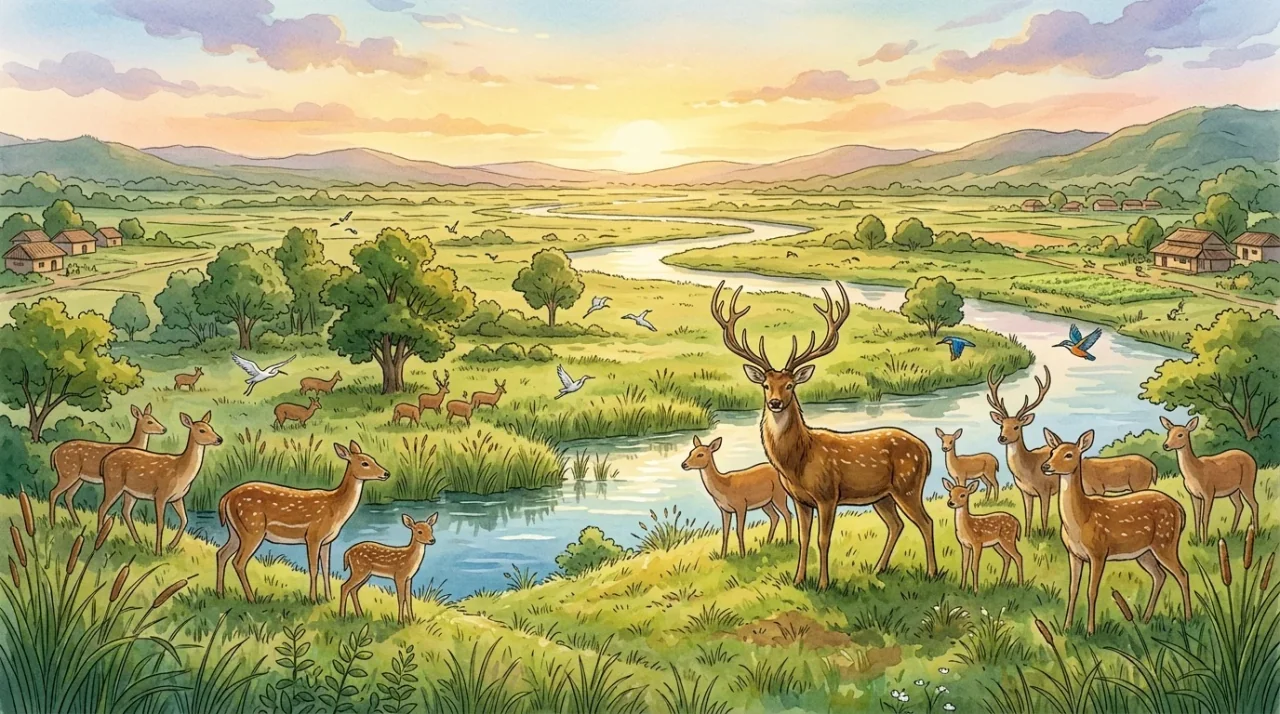
The Ministry of Environment, Forest and Climate Change has issued a draft notification to establish an Eco-Sensitive Zone spanning 408.7 square kilometres around the Barasingha Wildlife Sanctuary in Uttar Pradesh. This proposed buffer zone aims to act as a vital ecological shield, protecting the sanctuary’s diverse flora and fauna from the pressures of external developmental activities. Formerly known as the Hastinapur Wildlife Sanctuary, the protected area is a critical habitat for the Barasingha, the state animal of Uttar Pradesh.
Overview of the Proposed Eco-Sensitive Zone
The proposed Eco-Sensitive Zone (ESZ) encompasses a total area of 408.7 square kilometres, extending across five major districts in western Uttar Pradesh. These districts include Muzaffarnagar, Meerut, Hapur, Bijnor, and Amroha. The zone is designed to encompass approximately 307 villages, creating a regulated transition area between the core wildlife habitat and human-dominated landscapes.
Acting as a shock absorber, the ESZ is intended to mitigate the impact of industrialisation and urban expansion on the sanctuary’s fragile ecosystem. By establishing this buffer, the Ministry of Environment, Forest and Climate Change (MoEFCC) aims to provide an additional layer of protection to the sanctuary, ensuring that developmental pressures do not compromise the survival of the region’s unique biodiversity.
About the Barasingha Wildlife Sanctuary
The Barasingha Wildlife Sanctuary, originally established as the Hastinapur Wildlife Sanctuary in 1986, was renamed in June 2023. The name change highlights the sanctuary’s significance as a primary conservation site for the Barasingha (Swamp Deer), which is the state animal of Uttar Pradesh. Spanning a vast area along the upper reaches of the Ganga River, the sanctuary protects a diverse array of riverine and grassland ecosystems.
A major highlight of the sanctuary is the Haiderpur Wetland, which was designated as a Ramsar site in 2021. This wetland is a critical haven for migratory birds and various aquatic species. Beyond the swamp deer, the sanctuary provides a secure habitat for leopards, hog deer, cheetal, and sambar. The riverine stretches are home to crocodiles, turtles, and the endangered Gangetic dolphin, while the grasslands support the Sarus crane, the state bird of Uttar Pradesh.
Management and Regulatory Framework
The management of the Eco-Sensitive Zone will be overseen by a dedicated Monitoring Committee chaired by the District Magistrate of the respective districts. This committee is responsible for ensuring that all activities within the buffer zone comply with the environmental guidelines set by the central government. Furthermore, the state government is mandated to formulate a Zonal Master Plan (ZMP) for the ESZ within two years of the final notification. The ZMP will outline the land-use patterns and conservation strategies to be followed in the region.
Activities within the ESZ are strictly categorized into three levels of regulation:
- Prohibited Activities: These include commercial mining, stone quarrying, the establishment of major hydroelectric projects, and highly polluting industries.
- Regulated Activities: Small-scale infrastructure projects, the expansion of existing roads, and the setting up of eco-friendly resorts are permitted only after obtaining specific clearances.
- Permitted Activities: Traditional agricultural practices, organic farming, and rainwater harvesting by local communities are encouraged and allowed without restrictions.
Ecological Significance of the Region
The Barasingha Wildlife Sanctuary and its surrounding areas are of immense ecological importance due to their location within the fertile Gangetic plains. This region serves as a vital biological corridor, connecting various fragmented habitats and allowing for the safe movement of wildlife. The sanctuary’s riverine ecosystem is particularly significant for the survival of several endangered species that depend on the seasonal fluctuations of the Ganga River.
Furthermore, the inclusion of the Haiderpur Wetland makes this area a key destination for thousands of migratory birds that arrive from Central Asia and Siberia during the winter months. By notifying the Eco-Sensitive Zone, the government ensures that these critical breeding and feeding grounds are protected from noise pollution, chemical runoff, and habitat fragmentation, thereby safeguarding India’s commitment to international conservation agreements like the Ramsar Convention.
Understanding Eco-Sensitive Zones
Eco-Sensitive Zones (ESZ) are areas notified by the MoEFCC around National Parks and Wildlife Sanctuaries to create a transition zone between highly protected areas and areas with higher human activity. The primary legal basis for these zones is Section 3 of the Environment (Protection) Act, 1986, which empowers the central government to restrict industrial and developmental activities in ecologically fragile regions.
In June 2022, the Supreme Court originally mandated a minimum 1-kilometre ESZ for all protected areas. However, this order was later modified in April 2023, allowing for area-specific buffer zones that consider local geographic and social conditions. The establishment of an ESZ is a crucial step in maintaining the ecological integrity of a protected area while ensuring that local communities can continue their traditional livelihoods in a sustainable manner.
Key Takeaways
- The Ministry of Environment, Forest and Climate Change (MoEFCC) has proposed a 408.7 square kilometre Eco-Sensitive Zone around the Barasingha Wildlife Sanctuary.
- The Barasingha Wildlife Sanctuary, originally established in 1986 as the Hastinapur Wildlife Sanctuary, was renamed in June 2023.
- The sanctuary is spread across five districts of Uttar Pradesh: Muzaffarnagar, Meerut, Hapur, Bijnor, and Amroha.
- The Haiderpur Wetland, located within the sanctuary, has been a designated Ramsar site since 2021.
- A Monitoring Committee chaired by District Magistrates will oversee the management, and a Zonal Master Plan must be created within two years.
- The Barasingha (Swamp Deer) and Sarus Crane are the state animal and state bird of Uttar Pradesh, respectively.
- Eco-Sensitive Zones are legally established under Section 3 of the Environment (Protection) Act, 1986.