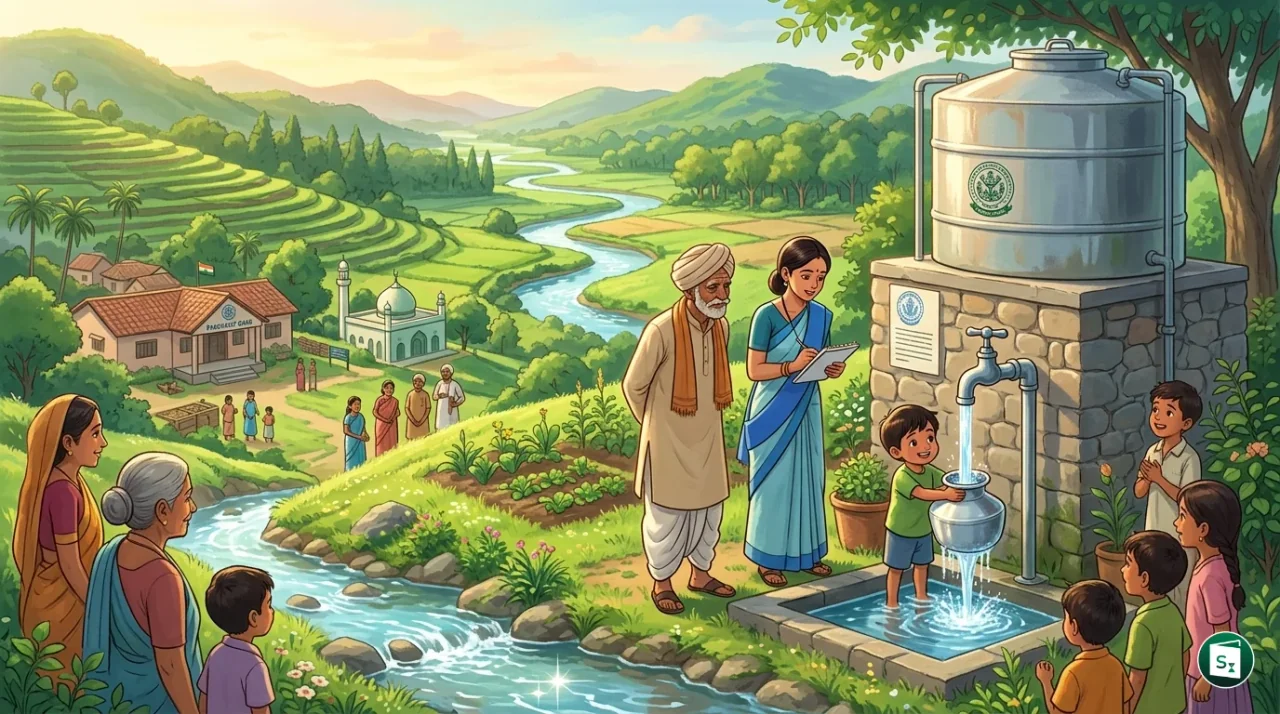
The Ministry of Jal Shakti (MoJS) signed reform-linked Memoranda of Understanding (MoUs) with Uttarakhand, Karnataka, Tripura, Mizoram, and Ladakh on May 9, 2026, to implement the restructured Jal Jeevan Mission (JJM) 2.0. These agreements transition rural water governance from a project-based infrastructure approach to a decentralized, service-delivery model. By empowering local bodies, the mission aims to ensure long-term sustainability and accountability in providing safe drinking water to every rural household by December 2028.
Shift Towards Service-Linked Water Governance
The approval of Jal Jeevan Mission 2.0 by the Union Cabinet in March 2026 signaled a fundamental shift in India’s rural water policy. While the initial phase of the mission, launched on August 15, 2019, focused on creating the massive physical infrastructure required for tap water connectivity, the second phase prioritizes the consistency and quality of water supply. The reform-linked MoUs are a key tool in this transition, ensuring that states commit to specific governance standards in exchange for central support.
This new service-delivery model moves away from simply counting the number of taps installed. Instead, it emphasizes parameters such as regularity, adequate quantity (at least 55 litres per person per day), and prescribed water quality. The agreements signed with the five states and UTs provide a structured framework to monitor these metrics through a dedicated digital ecosystem, moving towards the national vision of Viksit Bharat @2047.
Empowering Gram Panchayats and VWSCs
A central pillar of the reform-linked MoUs is the empowerment of Gram Panchayats (GPs) and Village Water & Sanitation Committees (VWSCs). Under the new framework, these local bodies are no longer just passive beneficiaries but are the primary custodians of their village water systems. This approach aligns with the 73rd Constitutional Amendment, which envisions Panchayats as institutions of self-governance with specific responsibilities for drinking water and sanitation.
The MoUs mandate a structured handover process known as ‘Jal Arpan’. Once a water supply scheme is completed, it is formally handed over to the GP or VWSC after a successful trial run. This local committee is then responsible for the daily operation, routine maintenance, and minor repairs of the in-village infrastructure. To ensure financial sustainability, the committees are encouraged to implement community-led user fee models, fostering a sense of ownership (‘Jan Bhagidari’) among the residents.
The “Sujalam Bharat” Digital Framework
To support the decentralized governance model, the Ministry has introduced the ‘Sujalam Bharat’ digital framework. This platform provides a uniform national interface for tracking water service delivery from the source to the individual tap. Every water supply scheme is assigned a unique Sujal Gaon ID, enabling real-time monitoring of water quality, quantity, and supply hours.
The digital framework also integrates tools like ‘Jal Seva Aankalan’, which allows Gram Panchayats to collect systematic feedback from community members. This data-driven approach ensures that local water operators and committees are accountable to the citizens they serve. By digitizing the mapping of water systems, the government aims to create a transparent and responsive utility-based model that can identify and address supply gaps immediately.
Progress and Outlook for Jal Jeevan Mission
As of early 2026, the Jal Jeevan Mission has achieved significant milestones, providing tap water connectivity to approximately 15.82 crore rural households, covering more than 81% of the target population. This is a massive leap from the 3.23 crore connections that existed at the start of the mission in 2019. Several states and Union Territories have already achieved 100% household tap water connectivity, setting a benchmark for others to follow.
The extension of the mission to December 2028 and the signing of these reform-linked MoUs reflect the government’s commitment to not just ‘Har Ghar Jal’ but to ‘Sujal Gaon’. By integrating water supply with other rural development schemes like MGNREGS and Swachh Bharat Mission, the Ministry is ensuring source sustainability and effective greywater management, making rural India resilient to future water challenges.
Key Takeaways
- The Ministry of Jal Shakti signed reform-linked MoUs with five states and UTs (Uttarakhand, Karnataka, Tripura, Mizoram, and Ladakh) on May 9, 2026.
- The agreements implement Jal Jeevan Mission (JJM) 2.0, which has been extended until December 2028 to ensure 100% rural tap water connectivity.
- A decentralized governance model empowers Gram Panchayats and Village Water & Sanitation Committees (VWSCs) to manage local water infrastructure.
- The Jal Arpan initiative facilitates the formal handover of completed water schemes to local bodies for operation and maintenance.
- The Sujalam Bharat digital framework will map water systems from source to tap, assigning each village a unique Sujal Gaon ID.
- As of March 2026, the mission has provided tap water to over 15.82 crore rural households, representing more than 81% of the national target.