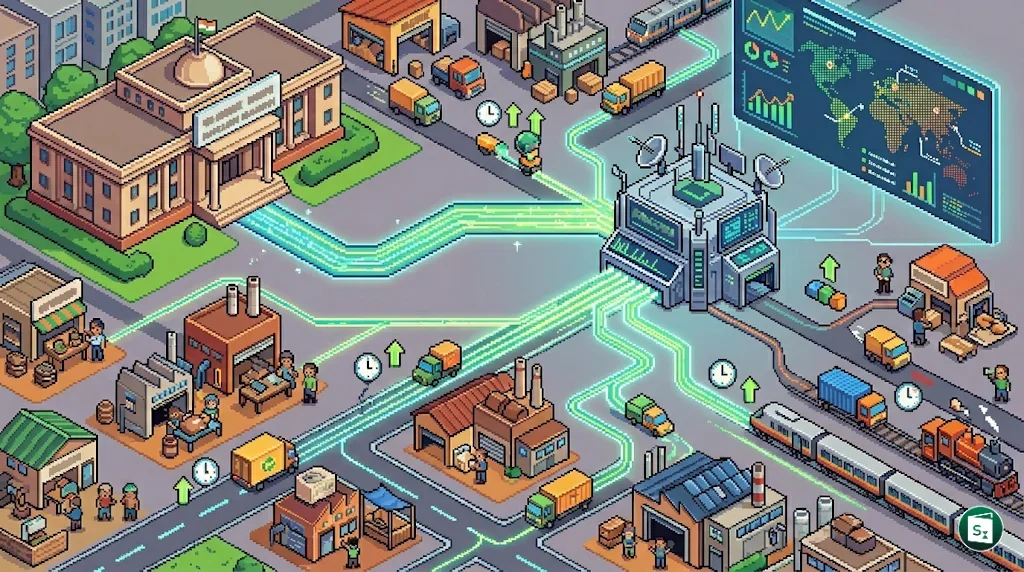
The Ministry of Micro, Small and Medium Enterprises signed a Memorandum of Understanding with NICDC Logistics Data Services Limited in New Delhi to enhance logistics efficiency for small businesses. This collaboration establishes a digital framework for seamless data exchange, allowing the Ministry to utilize real-time logistics intelligence for more effective policymaking. By improving supply chain visibility, the initiative aims to reduce operational costs and bolster the global competitiveness of Indian MSMEs.
Digital Framework for MSME Supply Chain
The core of this partnership is the creation of a robust digital infrastructure that connects the Ministry of MSME with high-tech logistics networks. Through API-based integration, the Ministry will gain direct access to a vast stream of logistics data, enabling a more granular understanding of how goods move across the country. This integration is expected to be linked with the Udyam portal, the primary registration platform for small businesses in India.
This data-driven approach marks a significant shift in how the government supports the MSME sector. By analyzing real-time information on cargo movement and transport bottlenecks, the Ministry can design policies that address specific regional or sectoral hurdles. For small business owners, this framework promises better visibility into their supply chains, helping them manage inventories more effectively and reduce transit delays.
Leveraging the Logistics Data Bank and ULIP
NICDC Logistics Data Services Limited (NLDSL), which was established as a joint venture between the Government of India and the Japanese IT giant NEC Corporation, serves as the backbone for digital logistics in the country. The company operates under the National Industrial Corridor Development Corporation (NICDC) and is widely recognized for its flagship project, the Logistics Data Bank (LDB). This system uses RFID technology to provide near real-time tracking for containerized cargo, covering 100% of India’s export-import container volume.
Real-Time Tracking for Small Enterprises
By leveraging the Unified Logistics Interface Platform (ULIP), another mission-critical digital infrastructure managed by NLDSL, the Ministry of MSME can provide small enterprises with the same level of logistics visibility as large corporations. ULIP integrates over 43 digital systems from across 11 central ministries, including rail, road, and port databases. This integration allows MSMEs to track their shipments in real-time, monitor port dwell-times, and receive analytics on transit performance.
The collaboration will specifically focus on providing MSMEs with actionable insights into cargo movement. By reducing the information asymmetry that often plagues smaller players, the partnership empowers them to negotiate better rates with transporters and optimize their storage and inventory cycles. This level of transparency is crucial for businesses aiming to meet strict delivery timelines in international trade.
Strategic Goal: Reducing Costs and Improving Competitiveness
A primary objective of this agreement is to lower the high logistics costs that burden the Indian economy, which currently stand at approximately 13-14% of the GDP. The National Logistics Policy (NLP), launched in 2022, aims to reduce these costs to around 8% to match global benchmarks. Because MSMEs often operate on thin margins, high transportation and warehousing expenses can severely impact their viability. By providing access to the digital tools managed by NLDSL, the government is leveling the playing field for smaller enterprises.
Cost optimization through data involves more than just tracking packages; it includes minimizing “empty runs” (where vehicles return without cargo) and optimizing routes based on real-time traffic and port congestion data. This initiative also complements other government programs like the RAMP (Raising and Accelerating MSME Performance) scheme, which is supported by the World Bank. Together, these interventions are designed to build a more resilient and cost-effective supply chain ecosystem for the millions of small businesses that form the backbone of the Indian economy.
The Broader Context: National Logistics Policy and GatiShakti
This partnership is a vital component of the larger PM GatiShakti National Master Plan, which focuses on integrated infrastructure planning and multimodal connectivity. While PM GatiShakti addresses the physical infrastructure gaps, the MoMSME-NLDSL agreement tackles the digital and data gaps. By aligning with the National Logistics Policy, the government is moving towards a “single-window” logistics experience where data flows as freely as physical goods.
NLDSL operates under the guidance of the National Industrial Corridor Development and Implementation Trust (NICDIT), ensuring that its data services are aligned with India’s long-term industrial corridor goals. The integration of logistics data with MSME support systems is expected to pave the way for more sophisticated interventions, such as cluster-based logistics hubs and AI-driven demand forecasting for small producers. Ultimately, these technology-led reforms are central to India’s vision of becoming a global manufacturing hub by improving the ease of doing business for its most vital economic segment.
Key Takeaways
- The Ministry of MSME signed an MoU with NICDC Logistics Data Services Limited (NLDSL) in April 2026 to establish a data-driven logistics ecosystem.
- The collaboration leverages API-based integration to provide small businesses with real-time cargo tracking and supply chain intelligence.
- NLDSL is a joint venture between the Government of India and NEC Corporation of Japan that operates the Logistics Data Bank (LDB).
- The Logistics Data Bank utilizes RFID technology to ensure end-to-end visibility for 100% of India’s export-import container volume.
- This initiative aligns with the National Logistics Policy (NLP) goal of reducing India’s logistics costs from 14% to 8% of the GDP.
- The digital framework will utilize the Unified Logistics Interface Platform (ULIP) to integrate data from over 43 systems across multiple ministries.