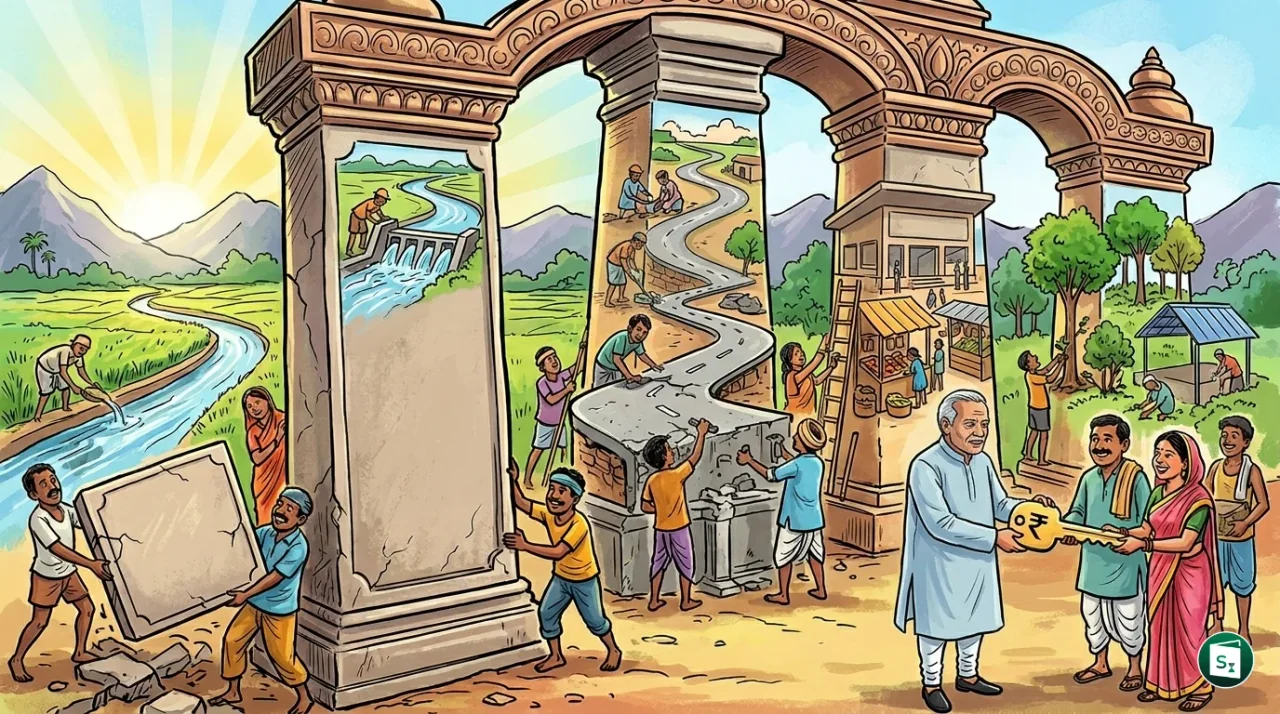
The Ministry of Rural Development notified the implementation of the Viksit Bharat - Guarantee for Rozgar and Ajeevika Mission (Gramin) Act, 2025, which will come into force on July 1, 2026. This landmark legislation completely repeals and replaces the Mahatma Gandhi National Rural Employment Guarantee Act, 2005. The new framework transitions India’s rural employment policy from a demand-based welfare scheme into a structured, productivity-led rural development mission.
Transitioning from MGNREGA to the VB-G RAM G Act
The Union Minister of Rural Development, Shri Shivraj Singh Chouhan, announced the official notification of the Viksit Bharat - Guarantee for Rozgar and Ajeevika Mission (Gramin) Act, 2025. The new legislation will come into force on July 1, 2026, officially repealing the Mahatma Gandhi National Rural Employment Guarantee Act, 2005. This transition marks a fundamental shift in how rural labor and community development are financed and executed.
Under the previous framework of MGNREGA, the program functioned as a demand-driven scheme where the central government was statutory-bound to release funds based on the actual work demand generated at the village level. In contrast, the VB-G RAM G Act introduces a normative allocation system. The central government will now establish a state-wise funding ceiling at the beginning of each financial year based on objective parameters. If a state government exceeds its designated normative allocation, it must fund the additional expenses from its own state treasury.
This reform aims to improve budgetary predictability and encourage state governments to manage resources more efficiently. The core differences between the two legislative frameworks are highlighted below:
| Feature | MGNREGA, 2005 | VB-G RAM G Act, 2025 |
|---|---|---|
| Statutory Work Guarantee | 100 days per household | 125 days per household |
| Funding Model | Demand-driven funding | Normative allocation ceiling |
| Agricultural Season | Work provided year-round on demand | Mandatory seasonal pause up to 60 days |
| Asset Creation Focus | Individual and community assets | Four thematic domains for durable assets |
| Governance System | Paper and digital records | Fully digital with biometric authentication |
Enhanced Employment Guarantee and Key Provisions
The foremost highlight of the new Act is the increase in the statutory employment guarantee. Every eligible rural household whose adult members volunteer for unskilled manual work is now guaranteed 125 days of employment per financial year, up from 100 days under the previous legislation. This additional month of guaranteed employment is expected to provide a significant safety net for the rural poor, particularly during lean agricultural seasons.
To prevent labor shortages in the agricultural sector, the Act introduces a mandatory seasonal pause of up to 60 days in a financial year. During peak agricultural periods such as sowing and harvesting, state governments can temporarily suspend guaranteed works. This pause ensures that local farmers have access to sufficient agricultural labor when demand is highest. The guaranteed 125 days of work will be distributed across the remaining 305 days of the year.
The transition to the new system has been designed to prevent disruption to rural livelihoods. All ongoing works initiated under MGNREGA will continue under the new framework. Additionally, existing job cards that have completed the mandatory e-KYC process will remain valid during the transition phase. The government will gradually replace these cards with new Gramin Rozgar Guarantee Cards. The statutory right to an unemployment allowance is also preserved. If the local administration fails to provide work within 15 days of receiving an application, the worker is entitled to compensation.
Four Thematic Domains of Work
Under the VB-G RAM G Act, the creation of assets is directed toward structural development and long-term sustainability rather than temporary labor tasks. The legislation divides permissible works into four thematic domains:
- Water Security: This includes watershed management, rainwater harvesting, groundwater recharge, and the rejuvenation of traditional water bodies. These works seek to mitigate the impact of droughts and improve agricultural productivity in water-scarce regions.
- Core Rural Infrastructure: This involves the construction of rural roads, drainage systems, sanitation facilities, Anganwadi centers, and primary school buildings. These assets are aimed at improving connectivity and basic services in rural settlements.
- Livelihood-Related Infrastructure: This focuses on creating facilities that directly support income diversification. Key projects include rural markets, community storage facilities, agricultural processing sheds, and livestock shelters.
- Climate Resilience: This comprises infrastructure meant to protect rural communities from extreme weather and disasters. Projects include flood protection embankments, disaster shelters, soil conservation structures, and afforestation initiatives.
The planning process for these works starts at the grassroot level. Gram Panchayats will formulate annual Viksit Gram Panchayat Plans based on localized developmental needs. These plans will then be aggregated into the Viksit Bharat National Rural Infrastructure Stack and integrated with spatial planning platforms such as the PM Gati Shakti National Master Plan to ensure synchronization with broader national infrastructure priorities.
Funding Pattern and Technology Integration
The VB-G RAM G Mission is implemented as a Centrally Sponsored Scheme. The cost-sharing mechanism for the program differs based on the geographic and developmental classification of the states:
- For most states, the funding is shared in a 60:40 ratio between the Central Government and the respective State Government.
- For North-Eastern and Himalayan states, the cost-sharing ratio is 90:10, with the Central Government bearing ninety percent of the financial burden.
Technology integration plays a pivotal role in the administration of the new Act, aiming to enhance transparency and eliminate leakages. The framework mandates biometric attendance and face-authentication systems at all work sites to curb proxy attendance. Additionally, all assets built under the scheme are subject to mandatory geo-spatial tracking and geo-referencing, capturing spatial data before, during, and after the completion of the project. A centralized real-time dashboard will offer public access to project statuses, worker attendance, and fund expenditures. Wages will continue to be paid through direct electronic transfers into the bank accounts of the beneficiaries, bypassing administrative intermediaries.
Key Takeaways
- The VB-G RAM G Act, 2025 is set to come into force on July 1, 2026, officially repealing the MGNREGA, 2005.
- The new Act increases the statutory rural employment guarantee from 100 days to 125 days of unskilled manual work per financial year per household.
- The program introduces a mandatory seasonal pause of up to 60 days in a financial year to protect agricultural labor availability during peak sowing and harvesting seasons.
- The VB-G RAM G scheme transitions funding from a demand-driven model to a state-wise normative allocation ceiling determined by the Central Government.
- Under the cost-sharing formula for this Centrally Sponsored Scheme, the funding ratio is set at 60:40 for general category states and 90:10 for North-Eastern and Himalayan states.
- The scope of work is focused on four thematic domains consisting of water security, core rural infrastructure, livelihood-related infrastructure, and climate resilience.