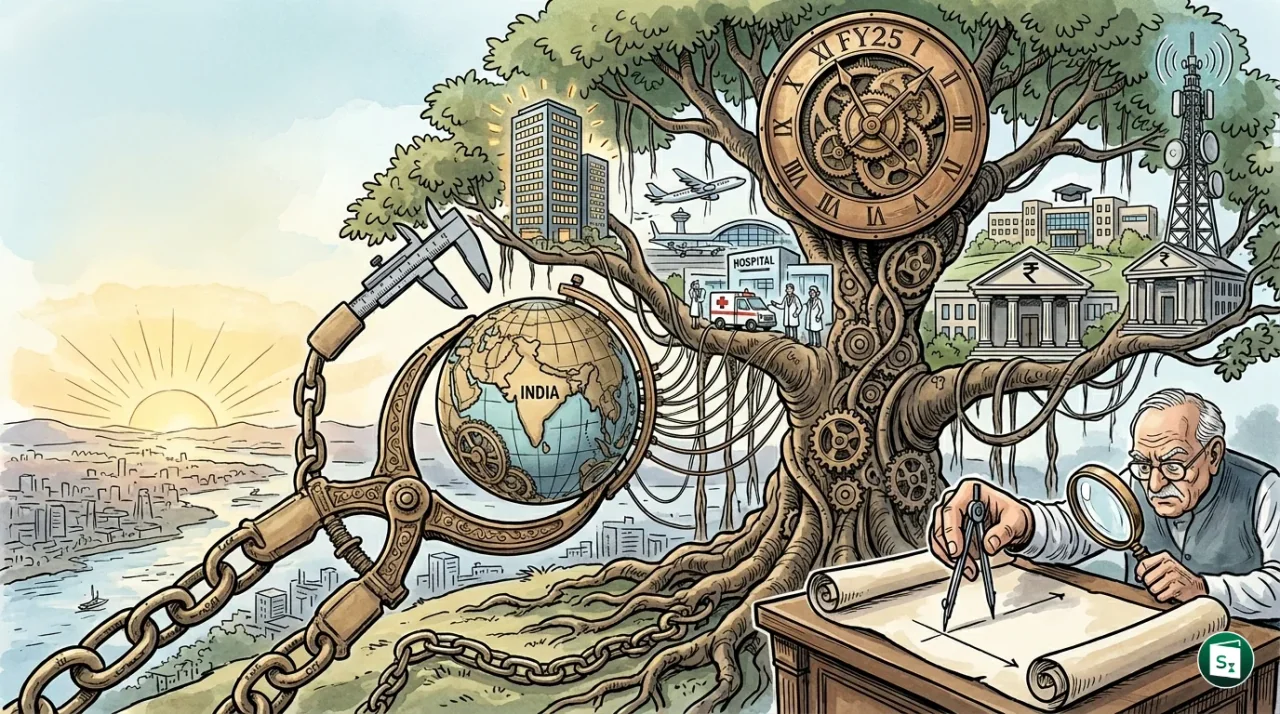
The Ministry of Statistics and Programme Implementation (MoSPI) has proposed a new Index of Service Production (ISP) to provide a monthly high-frequency indicator for India’s formal services sector. This index, using FY25 as its base year, aims to fill a critical data gap in the country’s economic monitoring by tracking real-time performance in a sector that contributes over half of the national GDP. The move aligns India with global best practices, complementing the existing industrial trackers with a dedicated measure for services.
Understanding the Index of Service Production
The Index of Service Production (ISP) is designed to measure the short-term volume changes in the services sector’s output. While India already tracks industrial growth through the Index of Industrial Production (IIP), the services sector, which is the largest component of the Indian economy, has lacked a similar high-frequency, monthly indicator. The ISP will cover the formal services sector at the 2-digit National Industrial Classification (NIC) level, ensuring a comprehensive view of various sub-sectors.
The index focuses on the formal sector, leveraging data from organized enterprises to reflect the pulse of the economy. By providing timely data on service activities, the ISP will enable policymakers and economists to identify trends, bottlenecks, and growth patterns much earlier than the quarterly GDP releases. This transition to a monthly tracking system is expected to significantly enhance the precision of macroeconomic forecasting in India.
Tri-Source Framework for Data Collection
To ensure robust data coverage, MoSPI has proposed a Tri-Source model for compiling the ISP. This methodology combines multiple data streams to capture the diversity of service activities across the country. The three primary pillars of this framework include:
- Goods and Services Tax Network (GSTN): The primary source for turnover data in market-oriented services such as trade, transport, hospitality, and real estate.
- Administrative Records: Data from regulatory bodies and ministries to cover specialized sectors like banking, insurance, and telecommunications.
- Enterprise Surveys: Specialized surveys such as the Annual Survey of Incorporated Services Sector Enterprises (ASISSE) will be used for sectors where administrative data is less accessible, including health and education.
By integrating these diverse sources, the ISP aims to cover at least 70% of the services Gross Value Added (GVA). This approach ensures that the index is not only comprehensive but also resilient to data gaps in specific sub-sectors.
The Need for a Monthly Service Sector Indicator
The introduction of the ISP addresses a long-standing “blind spot” in Indian economic statistics. While the IIP provides monthly insights into mining, manufacturing, and electricity, the services sector has historically been tracked only through quarterly and annual GDP estimates. Given that services account for over 53% of India’s GVA, the lack of a frequent indicator made it difficult to assess the real-time health of the economy’s most dominant engine.
A monthly index allows for a more granular understanding of economic shifts. For instance, disruptions in transport or a surge in digital financial services can be detected and responded to within weeks rather than months. This frequency is vital for the Reserve Bank of India (RBI) in its monetary policy deliberations and for the government in fine-tuning fiscal interventions.
Deflation Strategy and the Role of Price Indices
One of the technical challenges in compiling the ISP is converting nominal turnover, as reported in GST filings, into real volume terms. Since turnover is measured in current prices, it includes the impact of inflation. To isolate the actual production volume, MoSPI will use a deflation strategy involving price indices.
The primary tool for this will be the Service Producer Price Indices (SPPI). While SPPIs are currently under development for several sub-sectors, the ministry intends to use existing proxies in the interim. These include:
- Consumer Price Indices (CPI): Specific components of the CPI will be used for consumer-facing services.
- Wholesale Price Index (WPI): Certain WPI components may serve as proxies for business-to-business services.
- GVA Implicit Deflators: Used as a broad measure of price change across the sector.
The use of a dedicated Producer Price Index (PPI) is a significant advancement. Unlike the CPI, which measures price changes from the consumer’s perspective, the PPI tracks the prices received by producers, providing a more accurate reflection of production costs and output value.
Economic Significance of the New Index
The launch of the ISP is a major milestone in India’s journey toward data-driven governance. By synchronizing the tracking of industrial and service production, the government can achieve a more balanced view of the economy. This is particularly important as India transitions into a services-led economy with global leadership in sectors like IT, business process outsourcing, and fintech.
Furthermore, the ISP will improve the quality of Gross Domestic Product (GDP) estimation. Currently, the first advance estimates of GDP rely heavily on industrial data as a proxy for the entire economy. A dedicated services index will reduce the reliance on such proxies, making early economic forecasts more reliable. For global investors and rating agencies, this transparency and frequency of data will bolster confidence in the stability and growth trajectory of the Indian market.
Key Takeaways
- The Ministry of Statistics and Programme Implementation (MoSPI) proposed the Index of Service Production (ISP) to monitor the monthly output of India’s formal services sector.
- The new index will use FY25 as its base year and aims to cover at least 70% of the services Gross Value Added (GVA).
- Data for the ISP will be collected using a Tri-Source model, integrating GSTN data, administrative records, and enterprise surveys like ASISSE.
- MoSPI will employ a deflation strategy using Producer Price Indices (PPI) or sector-specific Consumer Price Indices (CPI) to calculate real volume terms from nominal turnover.
- The ISP will complement the Index of Industrial Production (IIP), providing high-frequency data for a sector that contributes more than 50% of India’s economy.
- The index tracks performance at the 2-digit National Industrial Classification (NIC) level to ensure comprehensive sub-sector coverage.