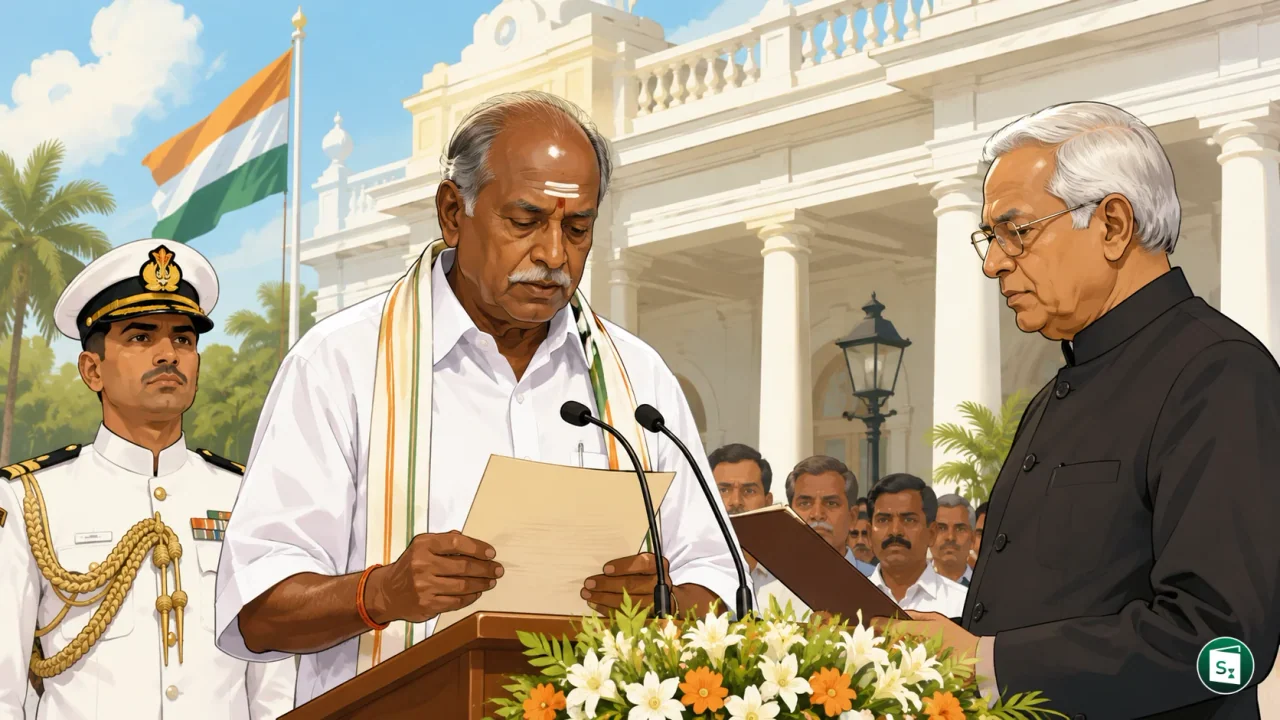
The founder of the All India N.R. Congress, N. Rangasamy, was sworn in as the Chief Minister of Puducherry for a record-breaking fifth term on May 13, 2026. The oath of office and secrecy was administered by the Lieutenant Governor of Puducherry, K. Kailashnathan, at a ceremony held at the Lok Nivas. This swearing-in marks the formation of the second consecutive National Democratic Alliance coalition government in the Union Territory.
Swearing-in Ceremony and Government Formation
The swearing-in ceremony took place following the Puducherry Legislative Assembly elections held in 2026, where the alliance led by the All India N.R. Congress and the Bharatiya Janata Party secured a majority. The coalition won 18 out of the 30 elected seats in the house, paving the way for the formation of the government. Alongside N. Rangasamy, other key leaders including AINRC leader Malladi Krishna Rao and BJP leader A. Namassivayam were also administered the oath of office as cabinet ministers.
This government marks the second consecutive term for the National Democratic Alliance in the Union Territory. The event was attended by senior political leaders and administrative officials at the Lok Nivas, which serves as the official residence of the Lieutenant Governor. The new administration is expected to focus on infrastructural expansion, boosting tourism, and streamlining administrative clearances in the region.
Political Journey of N. Rangasamy and AINRC
N. Rangasamy has been a central figure in the politics of Puducherry for more than two decades. He initially served as the Chief Minister representing the Indian National Congress. After serving in that role from 2001 to 2006 and again from 2006 to 2008, internal differences led him to break away from the party. He subsequently founded the All India N.R. Congress on February 7, 2011. The letters ‘N.R.’ in the party’s name represent the founder’s initials while officially expanding to Namathu Rajiyam, which means ‘our rule’ in Tamil.
Under the banner of the newly formed party, he led the coalition to victory in the 2011 elections, serving his third term as Chief Minister until 2016. In 2021, the AINRC joined the National Democratic Alliance led by the BJP, returning him to power for a fourth term. His fifth term, starting in May 2026, cements his position as the longest-serving Chief Minister in the history of the Union Territory.
The table below outlines N. Rangasamy’s five tenures as Chief Minister:
| Tenure | Period | Political Party / Coalition |
|---|---|---|
| First Term | 2001 to 2006 | Indian National Congress |
| Second Term | 2006 to 2008 | Indian National Congress |
| Third Term | 2011 to 2016 | All India N.R. Congress |
| Fourth Term | 2021 to 2026 | AINRC-BJP Alliance (NDA) |
| Fifth Term | Assumed May 2026 | AINRC-BJP Alliance (NDA) |
Constitutional and Legislative Structure of Puducherry
The administrative and constitutional setup of Puducherry is distinct from typical Indian states, governed by a blend of historical treaties, constitutional amendments, and parliamentary laws.
Administrative Evolution and Integration
Puducherry, formerly known as Pondicherry, was a French colonial establishment comprising four geographically non-contiguous regions, namely Pondicherry, Karaikal, Mahé, and Yanam. Although a de facto administrative transfer to the Indian Union occurred on November 1, 1954, the de jure transfer of legal sovereignty was finalized through the Treaty of Cession signed on May 28, 1956. Following ratification by the French Parliament, the exchange of instruments of ratification took place on August 16, 1962, formally bringing the territory into the Indian Union.
To incorporate these establishments, the Parliament enacted the Constitution (Fourteenth Amendment) Act, 1962, which received the presidential assent on December 28, 1962. This amendment inserted Article 239A into the Constitution, empowering Parliament to create a local legislature and a Council of Ministers for the territory. It also allocated one seat in the Rajya Sabha and increased the Union Territory quota in the Lok Sabha to represent Puducherry.
Assembly Composition and Nominated Members
The legislative framework was operationalized through the Government of Union Territories Act, 1963. Under this Act, the Legislative Assembly of Puducherry consists of 30 elected members chosen through direct elections from territorial constituencies.
In addition, the Act empowers the Central Government to nominate not more than three members to the assembly. The Supreme Court of India has upheld that these nominated legislators enjoy the same voting rights and privileges as elected members, including the right to vote on the budget and in confidence motions. The apex court also clarified that the Union Government is not required to consult the territorial government when appointing these nominated members.
Executive Powers and Council of Ministers
As a Union Territory, Puducherry is administered by the President of India through an Administrator, designated as the Lieutenant Governor. The current Lieutenant Governor, K. Kailashnathan, is a retired 1979-batch IAS officer of the Gujarat cadre who took the oath of office on August 7, 2024.
Under Section 45 of the Government of Union Territories Act, 1963, the Chief Minister is appointed by the President of India, and other ministers are appointed by the President on the advice of the Chief Minister. The ministers hold office during the pleasure of the President and are collectively responsible to the Legislative Assembly. While the 91st Constitutional Amendment Act, 2003 limits the size of the Council of Ministers in Indian states to 15 percent of the assembly strength, and Article 239AA limits Delhi’s cabinet to 10 percent, the 1963 Act does not specify a numerical limit for Puducherry. In practice, the Council of Ministers in Puducherry has typically comprised six members, representing exactly 20 percent of the elected house.
Key Takeaways
- N. Rangasamy, founder of the All India N.R. Congress, was sworn in as the Chief Minister of Puducherry for a record-breaking fifth term on May 13, 2026.
- The oath of office was administered by K. Kailashnathan, a retired 1979-batch IAS officer of the Gujarat cadre who took charge as the Lieutenant Governor of Puducherry on August 7, 2024.
- Puducherry was formally integrated as a Union Territory via the Constitution (Fourteenth Amendment) Act, 1962, which inserted Article 239A to enable the creation of the local legislature.
- Under the Government of Union Territories Act, 1963, the Puducherry Legislative Assembly consists of 30 elected members and up to three nominated members designated by the Central Government.
- While the 91st Constitutional Amendment Act, 2003 limits the ministerial size of states to 15 percent of assembly strength, Puducherry’s cabinet is governed by the 1963 Act and is typically composed of six members, including the Chief Minister.