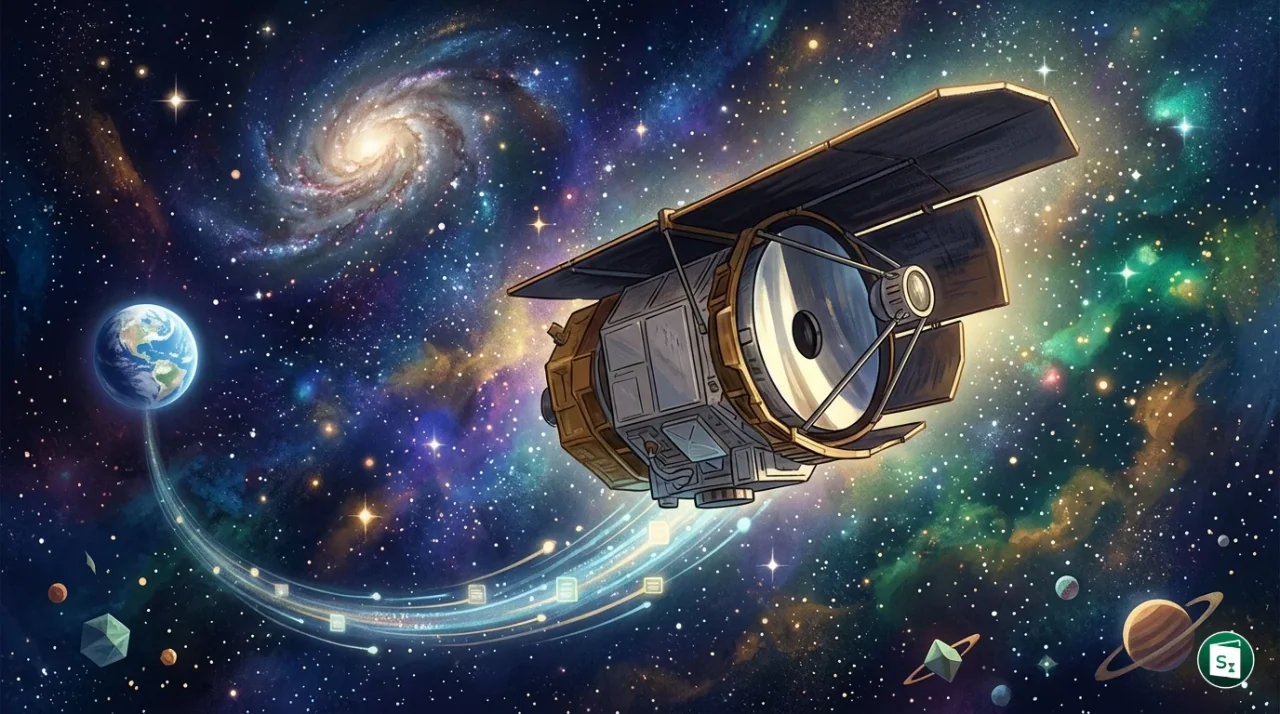
NASA has officially unveiled the Nancy Grace Roman Space Telescope, a state-of-the-art observatory designed to perform massive surveys of the infrared universe. Named after the first Chief Astronomer of NASA, the telescope will be stationed 1.5 million kilometres from Earth to investigate the mysteries of dark energy and search for exoplanets. This mission provides a field of view 100 times larger than that of the Hubble Space Telescope, enabling it to map the sky at unprecedented speeds.
Honouring the Legacy of the ‘Mother of Hubble’
The telescope is a tribute to Dr. Nancy Grace Roman, who served as NASA’s first Chief Astronomer and was a pivotal figure in the development of the Hubble Space Telescope. Born in 1925, she was the first woman to hold an executive position at NASA after the agency was established in 1958. Her vision for a large, space-based telescope revolutionized astronomy, earning her the title of the ‘Mother of Hubble’.
Dr. Roman was instrumental in securing the funding and organizational support necessary to launch the Hubble mission in 1990. By naming this new observatory after her, NASA acknowledges her contributions to making space-based observatories a reality. The project, which has been under development for approximately 10 years, reflects her lifelong commitment to exploring the universe beyond the limitations of Earth’s atmosphere.
A Technological Leap: Mirror Size and Wide-Field Vision
While the Nancy Grace Roman Space Telescope shares a 2.4-meter primary mirror with the Hubble Space Telescope, its internal architecture is vastly different. The telescope is optimized for wide-field surveys, allowing it to capture images that cover an area 100 times larger than Hubble’s infrared camera in a single exposure. This capability enables astronomers to conduct large-scale surveys of the universe in a fraction of the time it would take existing observatories.
The observatory’s primary instrument, the Wide Field Instrument (WFI), is a 300-megapixel camera that will provide the same high resolution as Hubble but across a much broader expanse of the sky. This panoramic view is essential for mapping the distribution of galaxies and identifying rare cosmic events that might otherwise be missed by telescopes with a narrower focus.
| Feature | Hubble Space Telescope | Roman Space Telescope |
|---|---|---|
| Primary Mirror | 2.4 meters | 2.4 meters |
| Field of View | Baseline | 100x larger |
| Imaging Speed | Targeted (Slower) | Survey (Much Faster) |
| Data Transmission | ~2.7 Gigabytes per day | ~11 Terabytes per day |
Scientific Objectives: Dark Energy, Dark Matter, and Exoplanets
One of the most ambitious goals of the Roman mission is to investigate Dark Energy, the mysterious force that is causing the expansion of the universe to accelerate. By measuring the positions and distances of millions of galaxies, the telescope will help scientists understand how dark energy has influenced the cosmic structure over billions of years. It will also assist in mapping the distribution of Dark Matter, which provides the gravitational scaffolding for galaxies.
Beyond cosmology, the telescope will be a powerful tool for discovering Exoplanets. Using a technique called Gravitational Microlensing, it will monitor the light from distant stars for subtle dips caused by the gravity of passing planets. This method is particularly effective at finding planets that are far from their host stars or those that are similar in mass to Earth. Additionally, the mission features a Coronagraph Instrument (CGI), which blocks the light of bright stars to directly image the planets orbiting them.
Mission Logistics: Orbit, Launch, and Data Transmission
The observatory is scheduled to launch aboard a SpaceX Falcon Heavy rocket from the Kennedy Space Center in Florida. Following launch, it will travel to the Sun-Earth Lagrange Point 2 (L2), located approximately 1.5 million kilometres from Earth. This location is ideal for space telescopes as it provides a stable environment and an unobstructed view of the deep universe while keeping the Sun, Earth, and Moon behind the observatory’s sunshield.
Developed over 10 years at a cost of approximately 4 billion dollars, the telescope features a high-speed communication system. It is capable of transmitting 11 terabytes (TB) of data daily to Earth, ensuring that the vast amounts of information captured during its wide-field surveys can be analyzed by scientists in near real-time. This data rate is significantly higher than that of the James Webb Space Telescope, which typically transmits around 60 gigabytes of data per day.
Global Significance: The Future of Space Surveys
The Nancy Grace Roman Space Telescope marks a shift from the deep and narrow observations of previous missions to a wide-area survey approach. While the James Webb Space Telescope excels at looking back to the very first stars with incredible detail, the Roman telescope will provide the necessary context by mapping how those stars and galaxies are distributed across the vast cosmic web.
This mission is expected to discover thousands of new planets and provide the most detailed map of the universe’s large-scale structure ever created. By providing high-resolution data on such a massive scale, it will serve as a foundational resource for the global astronomical community, complementing the findings of Hubble and Webb. The insights gained from this observatory could potentially rewrite our understanding of how the universe began and where it is heading.
Key Takeaways
- The telescope is named after Dr. Nancy Grace Roman, who was the first Chief Astronomer at NASA and is known as the ‘Mother of Hubble’.
- It features a 2.4-meter primary mirror and provides a field of view that is 100 times larger than that of the Hubble Space Telescope.
- The observatory will be positioned at the Sun-Earth Lagrange Point 2 (L2), which is located 1.5 million kilometres from Earth.
- The mission is designed to transmit 11 terabytes (TB) of data to Earth every day, far exceeding the data rates of previous space telescopes.
- Its primary scientific goals include the investigation of Dark Energy, Dark Matter, and the discovery of Exoplanets through gravitational microlensing.
- The project was developed over 10 years at a cost of 4 billion dollars and is expected to launch aboard a SpaceX Falcon Heavy rocket.