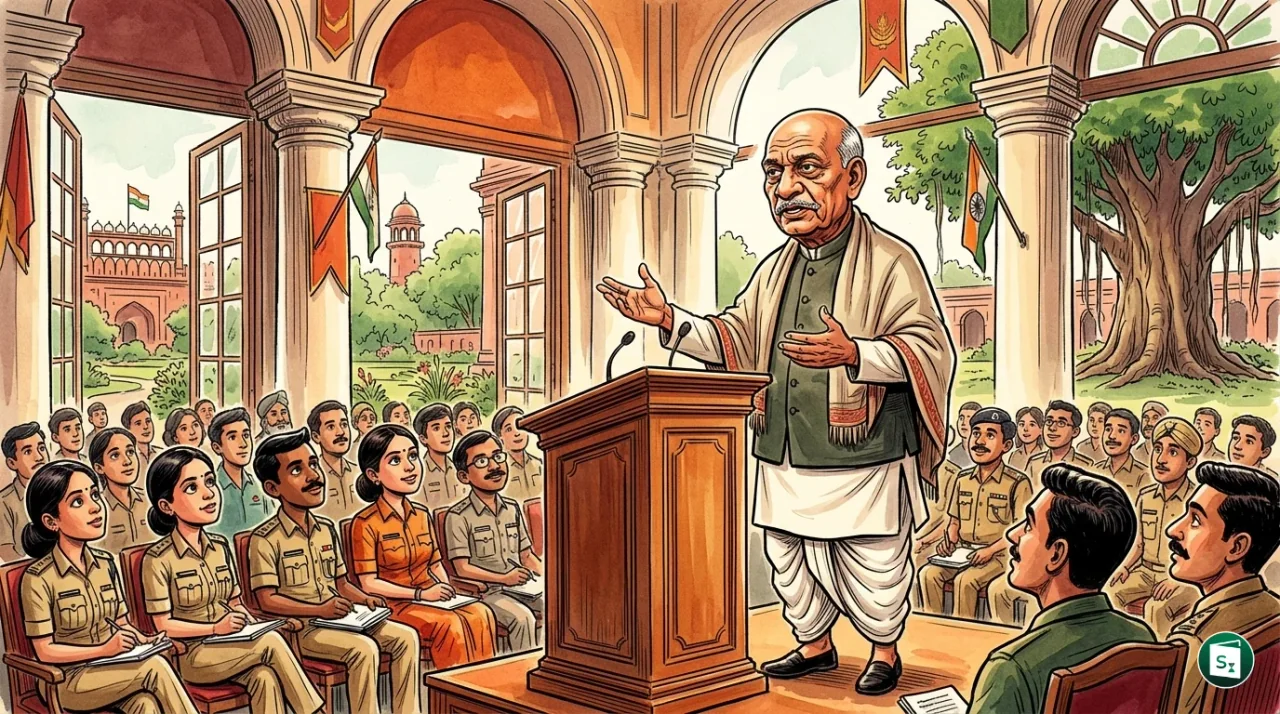
India observed the 18th National Civil Services Day on April 21, 2026, centering on the theme of citizen-centric governance and inclusive development. The occasion served as a platform for the government to recognize exceptional public service and reaffirm the commitment to building a developed nation by 2047. Through various events, the day highlighted the evolving role of civil servants in navigating India’s digital transformation and strategic infrastructure goals.
Historical Context: The Birth of the “Steel Frame”
The significance of April 21 dates back to 1947, when Sardar Vallabhbhai Patel, India’s first Home Minister, addressed the first batch of administrative service probationers. Speaking at Metcalfe House in Delhi, Patel famously described the civil services as the “Steel Frame of India.” He emphasized that while the services were previously part of a colonial administration, they must now transform into a dedicated force serving the people of a free and sovereign nation.
Although the historical event took place in 1947, the Government of India officially designated April 21 as National Civil Services Day in 2006. The first celebration was held at Vigyan Bhawan in New Delhi. This day allows civil servants to rededicate themselves to the cause of the nation and reflect on their professional ethics and performance. It also honors the legacy of Sardar Patel, whose vision for a unified and efficiently governed India remains the cornerstone of Indian administration.
Theme for 2026: Viksit Bharat and Last Mile Delivery
The theme for the 18th National Civil Services Day in 2026 was “Viksit Bharat: Citizen Centric Governance and Development at the Last Mile.” This theme underscores the government’s priority of ensuring that the benefits of developmental schemes reach the most remote and marginalized populations. It reflects a shift toward a more responsive and accountable administration that places the citizen at the heart of all policy implementation.
To achieve this vision, the civil service is being encouraged to adopt a more proactive approach. This involves not just implementing top-down policies but also engaging with local communities to understand their unique challenges. The focus on Last Mile Delivery is particularly critical in sectors like healthcare, education, and rural infrastructure, where geographical barriers often hinder progress. By leveraging technology and innovative administrative practices, civil servants are tasked with bridging these gaps and ensuring equitable growth across the country.
Prime Minister’s Awards for Excellence in Public Administration
A highlight of the National Civil Services Day is the presentation of the Prime Minister’s Awards for Excellence in Public Administration. These awards were instituted to acknowledge the extraordinary and innovative work done by districts and central or state government organizations. In 2026, the awards focused on several priority areas, including the Holistic Development of Districts, the Aspirational Blocks Programme, and innovations in public service delivery.
The selection process for these awards is rigorous, involving multiple stages of evaluation to identify projects that have made a tangible impact on citizens’ lives. Winners receive a trophy, a scroll of honor, and a monetary grant of ₹20 lakhs to further support public welfare initiatives in their respective regions. By showcasing these best practices, the government aims to encourage other administrative units to replicate successful models and foster a culture of excellence across the bureaucracy.
Reforming the Services: Mission Karmayogi and Digital Transformation
The modern civil service in India is undergoing a structural transformation through Mission Karmayogi, officially known as the National Programme for Civil Services Capacity Building (NPCSCB). This mission aims to shift the administrative culture from a “rule-based” to a “role-based” system, emphasizing continuous learning and competency-driven performance. A key component of this initiative is the iGOT-Karmayogi digital platform, which provides an extensive library of courses and learning resources to over 1.5 crore registered learners.
In April 2026, the government organized Sādhana Saptah, a week-long nationwide program to strengthen adaptive development and humane aptitude. This initiative, marking five years of Mission Karmayogi, focused on equipping officers with emerging technologies such as Artificial Intelligence (AI) and data analytics. By integrating these tools into governance, the administration seeks to improve decision-making processes and ensure that public service delivery is both efficient and future-ready.
Constitutional and Institutional Framework
The legal foundation for the civil services in India is rooted in Part XIV of the Indian Constitution, specifically within Articles 308 to 323. Of particular importance is Article 312, which empowers Parliament to create All India Services common to the Union and the States. These services provide a unified administrative backbone that ensures continuity and stability across different levels of government.
At the institutional level, the Department of Administrative Reforms and Public Grievances (DARPG), operating under the Ministry of Personnel, Public Grievances and Pensions, is the nodal agency for organizing National Civil Services Day. The DARPG is responsible for framing policies related to administrative reforms and ensuring the effective implementation of public grievance redressal mechanisms. This institutional setup, combined with constitutional protections, enables civil servants to perform their duties with the necessary degree of autonomy and professional integrity.
Key Takeaways
- National Civil Services Day is celebrated annually on April 21 to commemorate Sardar Patel’s 1947 address to administrative probationers.
- The theme for 2026 was “Viksit Bharat: Citizen Centric Governance and Development at the Last Mile,” focusing on inclusive growth.
- Sardar Vallabhbhai Patel famously referred to the civil services as the “Steel Frame of India” during his historic speech at Metcalfe House.
- The Prime Minister’s Awards for Excellence in Public Administration were presented to recognize innovation and impact in district governance.
- Mission Karmayogi is the national program for capacity building, aimed at transitioning the service from a rule-based to a role-based system.
- Article 312 of the Indian Constitution provides the legal basis for the creation of All India Services by the Parliament.