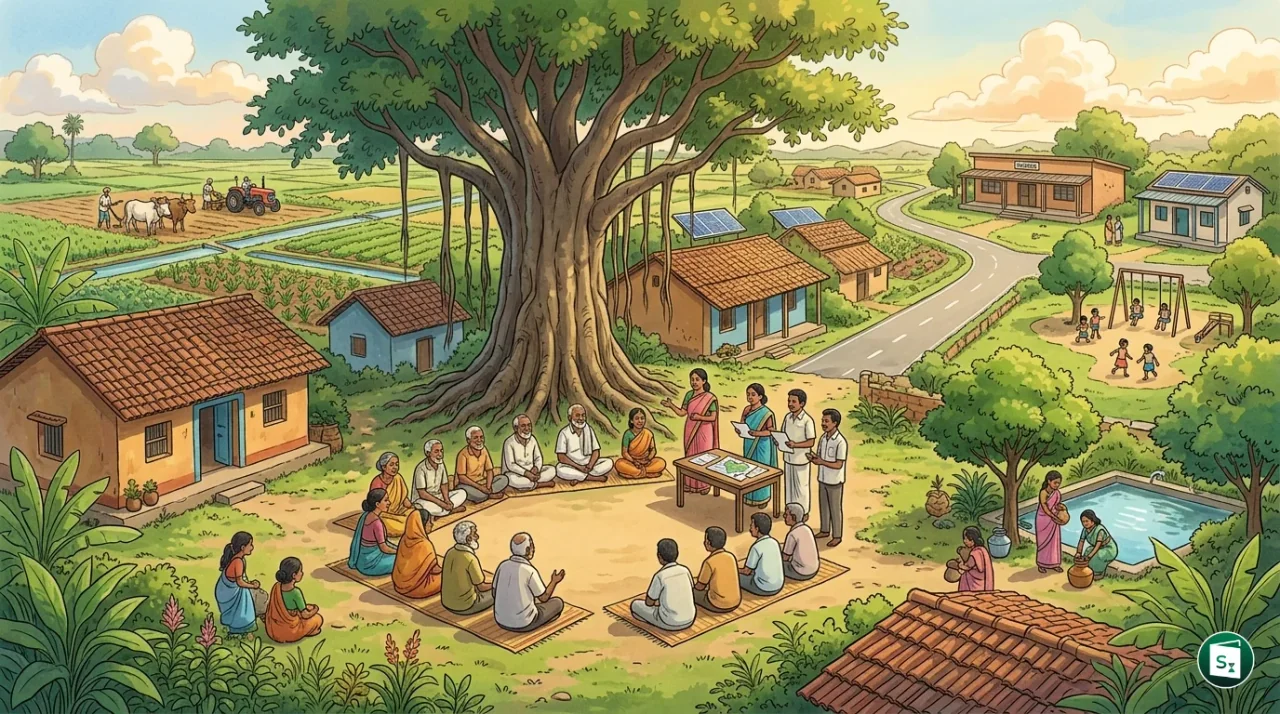
India celebrated the 17th National Panchayati Raj Day on April 24, 2026, to honour the foundational role of local self-government in the country’s democratic fabric. Observed under the theme “Sashakt Panchayat, Sarvangeen Vikas,” the day marked the anniversary of the 73rd Constitutional Amendment Act coming into force in 1993. This annual observance serves as a vital platform for the government to reaffirm its commitment to decentralised governance and rural empowerment.
Empowered Panchayats for Comprehensive Development: The 2026 Vision
The theme for 2026, “Sashakt Panchayat, Sarvangeen Vikas” (Empowered Panchayat, Comprehensive Development), highlights the critical link between local autonomy and national progress. This vision focuses on transforming Gram Panchayats into self-reliant units capable of delivering essential services and driving sustainable growth. By empowering these local bodies with greater financial and administrative resources, the government aims to ensure that development reaches the last mile, aligning with the broader Viksit Bharat 2047 agenda.
Comprehensive development at the village level involves integrated planning across various sectors, including health, education, and sanitation. The Ministry of Panchayati Raj (MoPR), established in 2004, has been instrumental in providing technical and financial support to Panchayati Raj Institutions (PRIs) to achieve these goals. The 2026 celebrations emphasized the need for Panchayats to leverage technology and data-driven governance to enhance transparency and accountability.
Historical Milestone: The 73rd Constitutional Amendment Act
National Panchayati Raj Day commemorates the day the 73rd Constitutional Amendment Act, 1992, received legal force on April 24, 1993. This landmark legislation provided constitutional status to Panchayati Raj Institutions, transforming them from advisory bodies into mandatory units of self-government. While village councils existed in various forms since ancient times, and were notably inaugurated in Nagaur, Rajasthan, by Pandit Jawaharlal Nehru in 1959, it was the 1992 amendment that institutionalized their role across the nation.
The act gave practical shape to Article 40 of the Directive Principles of State Policy, which mandates the state to organize village panchayats and endow them with the necessary powers. By making regular elections and the devolution of power mandatory, the amendment ensured that grassroots democracy became a permanent and justiciable feature of the Indian Constitution. This shift has been pivotal in enabling local communities to participate directly in the decision-making processes that affect their daily lives.
Constitutional Framework and the Three-Tier System
The 73rd Amendment introduced Part IX and the Eleventh Schedule to the Constitution, providing a uniform structure for rural governance. It mandated a three-tier system consisting of the Gram Panchayat at the village level, the Panchayat Samiti at the intermediate or block level, and the Zila Parishad at the district level. This hierarchy ensures a streamlined flow of administration and development funds from the district down to the smallest village unit.
At the heart of this system is the Gram Sabha, a body consisting of all registered voters in a village. The Gram Sabha acts as the ultimate authority for local planning and auditing, ensuring that the community remains at the center of development. Furthermore, the Eleventh Schedule lists 29 functional subjects—including agriculture, minor irrigation, and rural housing—that state legislatures may devolve to the Panchayats to facilitate self-governance.
Nanaji Deshmukh Awards and the Drive for Excellence
A major highlight of National Panchayati Raj Day is the presentation of the National Panchayat Awards, which recognize the best-performing PRIs across the country. The most prestigious among these is the Nanaji Deshmukh Sarvottam Panchayat Satat Vikas Puraskar, awarded to the best-performing Gram, Intermediate, and District Panchayats. These awards incentivize local bodies to achieve sustainable development goals (SDGs) and implement innovative solutions to local challenges.
Other categories include the Child-Friendly Panchayat Award and the Gram Urja Swaraj Puraskar, which focuses on energy self-sufficiency. These recognitions foster a spirit of healthy competition among Panchayats, encouraging them to improve service delivery in areas like child immunization, clean drinking water, and renewable energy. The award-winning Panchayats often serve as models for others, demonstrating the transformative power of effective local leadership.
Digital Transformation: e-GramSwaraj and Inclusive Governance
The digitalization of Panchayats has been a cornerstone of the recent governance reforms. Tools like the e-GramSwaraj portal and mobile application have integrated the planning, accounting, and monitoring processes of Panchayats onto a single platform. This digital ecosystem enables citizens to track the progress of local projects and the utilization of funds in real-time, significantly reducing the scope for corruption and ensuring that resources are spent effectively.
Inclusive governance is another key focus of the Panchayati Raj Day celebrations. The SVAMITVA (Survey of Villages and Mapping with Improvised Technology in Village Areas) scheme, launched by the Ministry of Panchayati Raj, uses drone technology to provide property cards to rural household owners. By providing legal ownership records, the scheme empowers rural citizens to use their property as a financial asset for loans, further driving economic growth and social stability in rural India.
Key Takeaways
- India observed the 17th National Panchayati Raj Day on April 24, 2026, with the theme “Sashakt Panchayat, Sarvangeen Vikas.”
- The day commemorates the 73rd Constitutional Amendment Act, 1992, which came into effect on April 24, 1993, providing constitutional status to local bodies.
- The Ministry of Panchayati Raj (MoPR), established in 2004, oversees the development and empowerment of Panchayati Raj Institutions.
- The amendment introduced Part IX and the Eleventh Schedule to the Constitution, which includes 29 functional subjects for devolution.
- The Nanaji Deshmukh Sarvottam Panchayat Satat Vikas Puraskar is the highest award presented to top-performing Panchayats for sustainable development.
- Key digital initiatives like the e-GramSwaraj portal and the SVAMITVA scheme are driving transparency and economic empowerment in rural India.