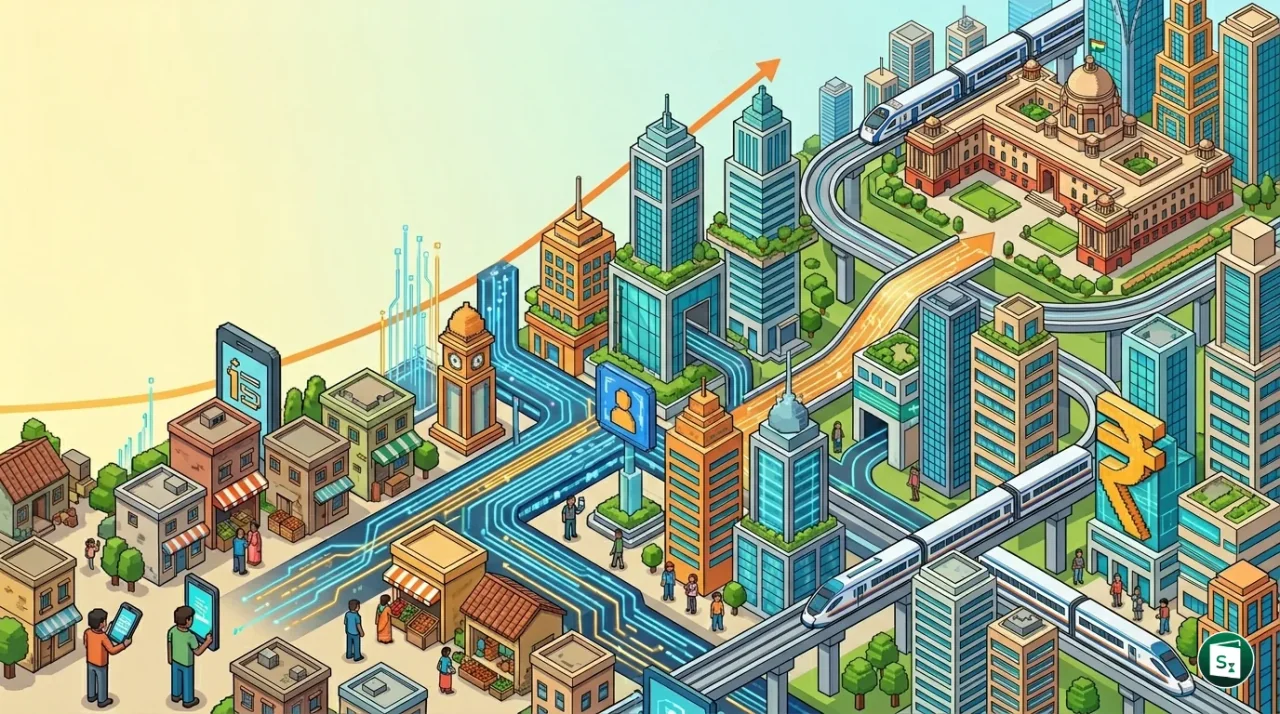
NITI Aayog released a strategic roadmap titled DPI@2047 for Viksit Bharat on May 04, 2026, outlining a vision to transform India into a $30 trillion economy by 2047 through digital public infrastructure. The report, developed in partnership with the EkStep Foundation and Deloitte, reveals that DPI initiatives currently contribute nearly 1% of India’s GDP, a figure projected to rise to 4% by 2030. This comprehensive strategy introduces a two-phase implementation plan aimed at fostering non-linear, inclusive socio-economic growth across the country.
The Strategic Roadmap for Digital Transformation
The DPI@2047 for Viksit Bharat report, launched by NITI Aayog (National Institution for Transforming India), serves as a blueprint for India’s digital evolution over the next two decades. Released by the Aayog’s Frontier Tech Hub (FTH), the strategic roadmap emphasizes transitioning from basic digital inclusion to productivity-led economic growth. The initiative aligns with the national goal of achieving a $30 trillion economy and a per capita income of $18,000 by the centenary of India’s independence in 2047.
NITI Aayog, established on January 1, 2015, headquartered in New Delhi, has collaborated with the EkStep Foundation—a non-profit co-founded by Nandan Nilekani—and consultancy firm Deloitte to frame this implementation strategy. The roadmap builds on India’s existing digital public infrastructure, which includes foundational elements like Aadhaar, UPI (Unified Payments Interface), and DigiLocker.
Economic Impact and GDP Projections
The report highlights the significant role that digital infrastructure plays in India’s macroeconomic landscape. Currently, DPI initiatives account for approximately 1% of the Gross Domestic Product (GDP). However, with the implementation of the proposed strategies, this contribution is expected to quadruple, reaching 4% of GDP by 2030. This expansion is driven by the ability of DPI to lower transaction costs, improve market access, and enhance the efficiency of service delivery.
The roadmap projects that by leveraging digital platforms, India can unlock new avenues for livelihood and productivity. This is particularly relevant for achieving the Viksit Bharat @ 2047 vision, which seeks to make India a developed nation. The integration of technology into governance and commerce is seen as a primary driver for non-linear growth, enabling the country to leapfrog traditional developmental hurdles.
Strategic Phases: DPI 2.0 and DPI 3.0
The NITI Aayog roadmap establishes a clear two-phase trajectory for India’s digital transformation, focusing on different levels of economic maturity and societal needs.
Phase I: DPI 2.0 (2025–2035)
This phase, titled “Realising Aspirations,” is focused on empowering livelihoods at scale. The objective is to remove structural bottlenecks that hinder the growth of individual citizens and small businesses. By 2035, the goal is to achieve mass inclusion and build a broad base of capable citizens who can actively participate in the formal economy. This involves scaling existing systems to ensure that every Indian has access to high-quality digital services that facilitate income generation and financial stability.
Phase II: DPI 3.0 (2035–2047)
The second phase, titled “Achieving Prosperity,” shifts the focus toward grassroots innovation and high-value local economic growth. Between 2035 and 2047, the strategy aims to create a distributed innovation engine where local solutions address local challenges. This phase is designed to ensure broad-based and sustained prosperity, transforming India from a consumer of digital services into a global leader in technological innovation.
Focus Sectors and Systemic Enablers
DPI 2.0 identifies eight high-impact sectoral transformations that are essential for inclusive growth. These sectors are chosen for their potential to impact the maximum number of citizens and drive significant economic value.
| Sector | Key Focus Area |
|---|---|
| MSMEs | Enhancing market access and job discovery for small businesses. |
| Agriculture | Improving farmer livelihoods through digital market linkages. |
| Education | Creating learner-centric systems and personalized learning. |
| Health | Achieving universal health coverage and data interoperability. |
| Credit Access | Facilitating easier financial inclusion for the unbanked. |
| Energy | Promoting decentralized energy solutions and smart grids. |
| Livelihood | Empowering workers with digital skill-matching tools. |
| Benefit Delivery | Ensuring efficient and leak-proof delivery of social welfare. |
To support these sectors, the roadmap emphasizes several systemic enablers. These include the widespread adoption of Artificial Intelligence (AI) for personalized, vernacular advisory services and the use of better data to enhance decision-making. The strategy also highlights the importance of scaling technology entrepreneurship across the country to create a robust digital ecosystem.
Implementation through Iterative Cycles
The execution of the roadmap follows a unique model of two-year iterative cycles. This approach is designed to ensure that the digital solutions developed are both scalable and effective on the ground.
In the first year of each cycle, the focus is on “lighthouse” pilot projects. These projects are implemented in partnership with champion states and Union Territories (UTs) to test and refine digital models. The goal is to identify successful interventions that can address specific developmental challenges.
In the second year, the strategy shifts to scaling these successful models across the country. This district-led demand aggregation ensures that the solutions are localized and meet the specific needs of different regions. By alternating between pilot testing and national scaling, the roadmap aims to create a continuous loop of innovation and implementation.
Key Takeaways
- NITI Aayog released the DPI@2047 for Viksit Bharat roadmap on May 04, 2026, in collaboration with the EkStep Foundation and Deloitte.
- Digital Public Infrastructure (DPI) currently contributes nearly 1% of India’s GDP, and this share is projected to reach 4% by 2030.
- The strategy consists of two phases: DPI 2.0 (2025-2035) for empowering livelihoods and DPI 3.0 (2035-2047) for grassroots innovation and prosperity.
- Eight high-impact sectors, including MSMEs, Agriculture, Education, and Health, are identified for targeted digital transformation under DPI 2.0.
- The implementation model uses two-year iterative cycles, starting with lighthouse pilot projects in champion states before nationwide scaling.
- NITI Aayog, established on January 1, 2015, to replace the Planning Commission, serves as India’s premier policy think tank headquartered in New Delhi.