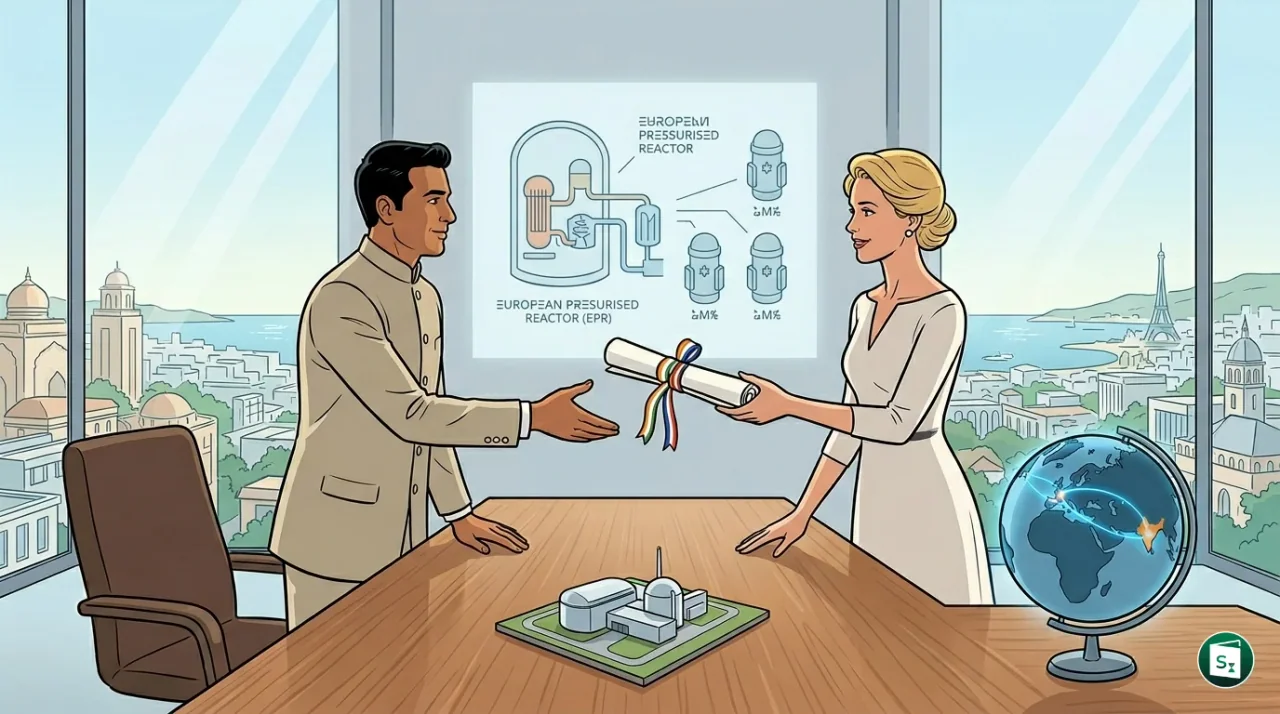
NLC India Limited has entered into a strategic partnership with the French state-owned energy giant Electricite de France (EDF) to develop nuclear power projects in India. The collaboration marks NLCIL’s first major step into the nuclear sector, focusing on deploying advanced European Pressurised Reactor (EPR) and Small Modular Reactor (SMR) technologies. This move is part of the company’s broader objective to diversify its energy portfolio and reach a total generation capacity of 20 GW by 2030.
NLC India and EDF Join Forces for Nuclear Power
The Non-Disclosure Agreement (NDA) signed between NLC India Limited and Electricite de France (EDF) on May 11, 2026, establishes a framework for technical cooperation and project evaluation. This partnership is significant as it brings together NLCIL, a prominent Navratna Public Sector Undertaking (PSU) under the Ministry of Coal, and EDF, one of the world’s largest nuclear power operators.
The collaboration will initially focus on conducting feasibility studies for nuclear power plants across various locations in India. By leveraging EDF’s extensive experience in operating over 50 nuclear reactors in France and its expertise in advanced reactor designs, NLCIL aims to transition from a primarily coal-based energy producer to a multi-fuel energy conglomerate. This strategic shift aligns with India’s national goal of increasing the share of clean energy in the total power mix to meet its climate commitments.
Advanced Nuclear Technologies: EPR and SMR
The partnership explores two distinct but complementary nuclear technologies: the large-scale European Pressurised Reactor (EPR) and the emerging Small Modular Reactor (SMR) technology. Both are designed to address the dual challenges of high energy demand and carbon neutrality.
European Pressurised Reactor (EPR) Features
The European Pressurised Reactor (EPR) is a third-generation (Generation III+) Pressurized Water Reactor (PWR) developed by Framatome and EDF. It is considered one of the most advanced and safest reactor designs globally, featuring multiple layers of protection to prevent radioactive leakage. Key features include:
- Four-fold Redundancy: Major safety systems are organized into four independent trains, ensuring that the reactor can remain safe even if multiple systems fail simultaneously.
- Aircraft Crash Protection: The reactor building is encased in a thick, reinforced concrete shell designed to withstand the impact of a commercial aircraft.
- Core Catcher: A specialized device located under the reactor vessel is designed to catch and cool molten fuel in the extremely unlikely event of a core meltdown.
Small Modular Reactors (SMRs) Explained
Small Modular Reactors (SMRs) are advanced nuclear reactors that have a power capacity of up to 300 MW(e) per unit, which is about one-third of the generating capacity of traditional nuclear power reactors. They are “modular” because their components can be factory-assembled and transported to a site for installation.
SMRs offer several advantages, including lower capital costs, shorter construction timelines, and the ability to be located in remote areas or sites not suitable for larger reactors. India has recently shown a keen interest in SMRs to decarbonize heavy industries and provide a stable base load for the renewable-heavy power grid.
NLC India’s Vision 2030: From Coal to Clean Energy
NLC India Limited, formerly known as the Neyveli Lignite Corporation, was incorporated on November 14, 1956, and is headquartered in Neyveli, Tamil Nadu. Operating under the administrative control of the Ministry of Coal, NLCIL holds the prestigious Navratna status. While the company has historically been a leader in lignite mining and thermal power generation, it is now undergoing a massive transformation.
The company has set an ambitious target to achieve a total power generation capacity of 20 GW by 2030. This diversified portfolio will include:
- Thermal Power: Expansion of existing lignite and coal-based plants using supercritical technology.
- Renewable Energy: Significant investments in solar and wind power projects.
- Nuclear Power: Entry into the nuclear sector through international collaborations to provide clean, high-capacity baseload power.
To achieve this goal, NLCIL plans a capital expenditure of approximately ₹1.25 lakh crore, marking one of the largest investment programs by an Indian energy PSU in recent years.
Strengthening India’s Nuclear Energy Roadmap
India’s nuclear energy sector has traditionally been the exclusive domain of the Nuclear Power Corporation of India Limited (NPCIL), which operates under the Department of Atomic Energy (DAE). However, to accelerate the growth of nuclear power and meet the national target of 100 GW by 2047, the government has recently encouraged other Public Sector Undertakings to enter the field.
NLC India’s partnership with EDF follows similar initiatives by other energy giants like NTPC and Indian Oil Corporation, which have also signed agreements to explore nuclear power development. This diversification is crucial for:
- Energy Security: Nuclear power provides a reliable, carbon-free source of electricity that can complement the intermittent nature of solar and wind energy.
- Technology Transfer: Collaboration with global leaders like EDF facilitates the transfer of high-end nuclear technology and best practices in safety and operation.
- Economic Growth: Large-scale nuclear projects create significant employment opportunities and stimulate the domestic manufacturing supply chain through the Make in India initiative.
By bringing together French technical excellence and Indian implementation capabilities, this partnership is expected to play a pivotal role in India’s journey toward its Net Zero 2070 target.
Key Takeaways
- NLC India Limited (NLCIL) and Electricite de France (EDF) signed a Non-Disclosure Agreement on May 11, 2026, for nuclear power collaboration.
- The partnership focuses on deploying European Pressurised Reactor (EPR) and Small Modular Reactor (SMR) technologies.
- The EPR is a third-generation reactor featuring advanced safety systems like four-fold redundancy and a core catcher.
- SMRs are modular reactors with a capacity up to 300 MW(e), designed for flexible deployment and lower capital costs.
- NLCIL is a Navratna PSU under the Ministry of Coal, headquartered in Neyveli, Tamil Nadu, and established in 1956.
- The company aims to reach a total power generation capacity of 20 GW by 2030 through a diversified energy portfolio.
- India has set a long-term goal to achieve 100 GW of nuclear power capacity by the year 2047.