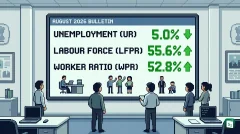
The National Statistical Office (NSO) has released the Periodic Labour Force Survey (PLFS) quarterly bulletin for the fourth quarter of the financial year 2025-2026, covering the period from January to March 2026. The report highlights a marginal decrease in India’s urban unemployment rate to 6.6 percent for persons aged 15 and above, down from 6.7 percent in the previous quarter. However, the overall national unemployment rate rose slightly to 5.0 percent due to an increase in rural unemployment, highlighting the diverging labour market conditions between rural and urban India.
What is the Periodic Labour Force Survey?
The Periodic Labour Force Survey (PLFS) is India’s primary official mechanism for estimating key employment and unemployment indicators. Launched in April 2017 by the Ministry of Statistics and Programme Implementation (MoSPI), the survey was established to address the lack of high-frequency and reliable labour market data in the country. The survey is conducted by the National Statistical Office (NSO), which was formed in May 2019 by merging the National Sample Survey Office (NSSO) and the Central Statistics Office (CSO). Both the ministry and the NSO are headquartered in New Delhi.
From its inception in 2017 until December 2024, the NSO published PLFS quarterly bulletins focusing exclusively on urban areas using the Current Weekly Status (CWS) framework. However, in January 2025, MoSPI implemented a major methodological revamp of the survey’s sampling design. This reform enabled the generation of high-frequency quarterly estimates for both rural and urban areas, alongside new monthly employment estimates. The bulletin for the quarter ending March 2026 represents the fourth quarterly bulletin under this revamped, comprehensive national reporting framework.
The scale of the survey ensures statistical robustness and represents a massive countrywide operation. For the January to March 2026 quarter, the NSO gathered data from a sample of 5,61,822 persons distributed across the country. This sample included 3,20,387 individuals in rural areas and 2,41,435 individuals in urban areas, ensuring that the findings accurately reflect diverse regional economic realities.
Key Findings from the Q4 FY26 Quarterly Bulletin
The quarterly bulletin for the final quarter of the financial year 2025-2026 highlights the key employment metrics of the Indian economy. To provide a clear overview of the national employment situation, the table below summarizes the three primary indicators (Labour Force Participation Rate, Worker Population Ratio, and Unemployment Rate) for persons aged 15 years and above under the Current Weekly Status (CWS) framework:
| Labour Market Indicator (Current Weekly Status) | All-India (Combined) | Rural Areas | Urban Areas |
|---|---|---|---|
| Labour Force Participation Rate (LFPR) | 55.5% | 58.2% | 50.2% |
| Worker Population Ratio (WPR) | 52.8% | 55.7% | 46.9% |
| Unemployment Rate (UR) | 5.0% | 4.3% | 6.6% |
Labour Force Participation Rate Trends
The Labour Force Participation Rate (LFPR) measures the proportion of the population aged 15 years and above that is either actively employed or seeking work. During the fourth quarter of the financial year 2025-2026, the overall LFPR stood at 55.5 percent, showing a small decrease from the 55.8 percent recorded in the October to December 2025 period.
When analyzed by region, rural areas maintained a higher LFPR of 58.2 percent, though this represents a slight decline from the 58.4 percent observed in the previous quarter. Similarly, the urban LFPR decreased to 50.2 percent from 50.4 percent in the preceding quarter.
Gender-based analysis reveals significant disparities in participation rates. The female LFPR remained relatively low but stable at 34.7 percent at the national level, compared to 34.9 percent in the third quarter. In rural regions, the female LFPR was estimated at 39.2 percent, while in urban regions, it stood at 25.4 percent. In contrast, the male LFPR was much higher, reaching 78.6 percent in rural areas and 75.0 percent in urban areas, indicating that male participation remains the primary driver of the measured labour force.
Worker Population Ratio Trends
The Worker Population Ratio (WPR) is defined as the percentage of employed persons in the total population. It serves as a direct indicator of the active workforce size in the country. During the January to March 2026 quarter, the national WPR for individuals aged 15 years and above stood at 52.8 percent, representing a slight decline from the 53.1 percent reported in the preceding quarter.
This regional distribution of the WPR shows that rural areas continue to employ a larger share of their population compared to urban centers. In rural India, the WPR was estimated at 55.7 percent, while in urban India, it was significantly lower at 46.9 percent.
Gender-specific WPR data highlights substantial differences in actual employment levels between men and women. Among males aged 15 and above, the WPR reached 75.2 percent in rural areas and 70.6 percent in urban areas. Among females, the WPR was recorded at 37.6 percent in rural regions and 23.1 percent in urban regions. In terms of absolute numbers, the survey reports that India had an average of 57.4 crore employed individuals during the quarter, comprising 40.2 crore male workers and 17.2 crore female workers.
Unemployment Rate Dynamics
The Unemployment Rate (UR) represents the percentage of unemployed persons among the total population in the active labour force. At the national level, the overall unemployment rate for individuals aged 15 years and above experienced a marginal increase, rising to 5.0 percent in the January to March 2026 quarter from 4.8 percent in the previous quarter.
In urban areas, the job market showed signs of improvement as the urban unemployment rate decreased to 6.6 percent, down from 6.7 percent in the preceding quarter. In contrast, rural regions experienced a rise in joblessness, with the rural unemployment rate increasing to 4.3 percent from 4.0 percent in the October to December 2025 period.
Despite the marginal improvement in overall urban employment, gender-specific data reveals persistent challenges. The female unemployment rate in urban areas rose to 9.1 percent during the quarter. Furthermore, youth unemployment, which covers the crucial 15 to 29 age group, saw an upward trend. The unemployment rate for young women increased to 17.7 percent, up from 16.6 percent in the previous quarter, while the unemployment rate for young men was reported at 14.0 percent.
Structural Changes in Rural and Urban Employment
A key finding of the January to March 2026 quarterly bulletin is the structural shift taking place within rural India. There is a noticeable movement of the workforce away from primary agricultural activities toward the secondary (manufacturing and construction) and tertiary (services) sectors. The share of rural workers engaged in agriculture fell to 55.8 percent during this quarter, down from 58.5 percent in the preceding quarter.
Additionally, the nature of rural employment contracts showed signs of formalization. The share of regular wage and salaried employees in rural areas increased to 15.5 percent from 14.8 percent in the previous quarter. At the same time, the proportion of self-employed individuals in rural regions declined to 62.5 percent.
The table below outlines these major structural shifts in rural employment during the quarter:
| Rural Employment Parameter | October to December 2025 (Q3) | January to March 2026 (Q4) | Trend and Interpretation |
|---|---|---|---|
| Agricultural Sector Share | 58.5% | 55.8% | Decline in primary sector dependency |
| Secondary Sector Share | Not specified | 22.6% | Growth in manufacturing and construction |
| Tertiary Sector Share | Not specified | 21.7% | Expansion of services, trade, and transport |
| Regular Salaried Employees | 14.8% | 15.5% | Improvement in secure, formal contracts |
| Self-Employed Workers | Not specified | 62.5% | Decline in informal self-employment |
These shifts indicate that the rural economy is slowly diversifying, creating non-farm employment opportunities that offer regular wages. However, with self-employment still accounting for nearly two-thirds of the rural workforce, informal livelihood activities remain the dominant source of income in rural India.
Understanding the Methodology: Current Weekly Status
To accurately interpret the findings of the Periodic Labour Force Survey, it is essential to understand the underlying statistical concepts and methodologies used by the NSO. The quarterly bulletins utilize the Current Weekly Status (CWS) framework to estimate labour market indicators, which differs from the annual reports that rely on both CWS and the Usual Status approach.
Under the CWS framework, the activity status of a person is determined based on a short reference period of seven days preceding the date of the survey. A person is classified as employed if they have worked for at least one hour on any day during this reference week. This approach is highly effective at capturing short-term, seasonal variations in employment and underemployment, making it ideal for high-frequency quarterly monitoring. In contrast, the Usual Status approach uses a much longer reference period of 365 days, which captures chronic or long-term employment patterns rather than seasonal fluctuations.
The key labour market indicators estimated in the report are defined as follows:
- Labour Force Participation Rate (LFPR): This is the percentage of the population aged 15 years and above that constitutes the labour force. It includes both individuals who are currently employed and those who are unemployed but actively seeking or available for work.
- Worker Population Ratio (WPR): This is the percentage of employed persons in the total population of the same demographic group. It indicates the actual utilization of labour resources in the economy.
- Unemployment Rate (UR): This is the percentage of unemployed persons among the people in the labour force. It is calculated by dividing the number of unemployed individuals by the total number of individuals in the labour force (employed plus unemployed).
By using these standardized metrics, the NSO provides a consistent, comparable baseline for tracking structural changes in the Indian labour market over time.
Key Takeaways
- The National Statistical Office (NSO) released the Periodic Labour Force Survey (PLFS) quarterly bulletin for the fourth quarter of the financial year 2025-2026 on May 11, 2026.
- The urban unemployment rate for individuals aged 15 years and above decreased marginally to 6.6 percent from 6.7 percent in the previous quarter.
- The overall national unemployment rate rose to 5.0 percent from 4.8 percent in the preceding quarter due to a rise in rural unemployment to 4.3 percent.
- The all-India Labour Force Participation Rate (LFPR) for individuals aged 15 and above was estimated at 55.5 percent during the quarter.
- In rural areas, the share of workers engaged in the agricultural sector declined to 55.8 percent, while regular salaried employment rose to 15.5 percent.
- The Periodic Labour Force Survey (PLFS) was launched in April 2017 by the Ministry of Statistics and Programme Implementation (MoSPI) to generate high-frequency employment indicators.