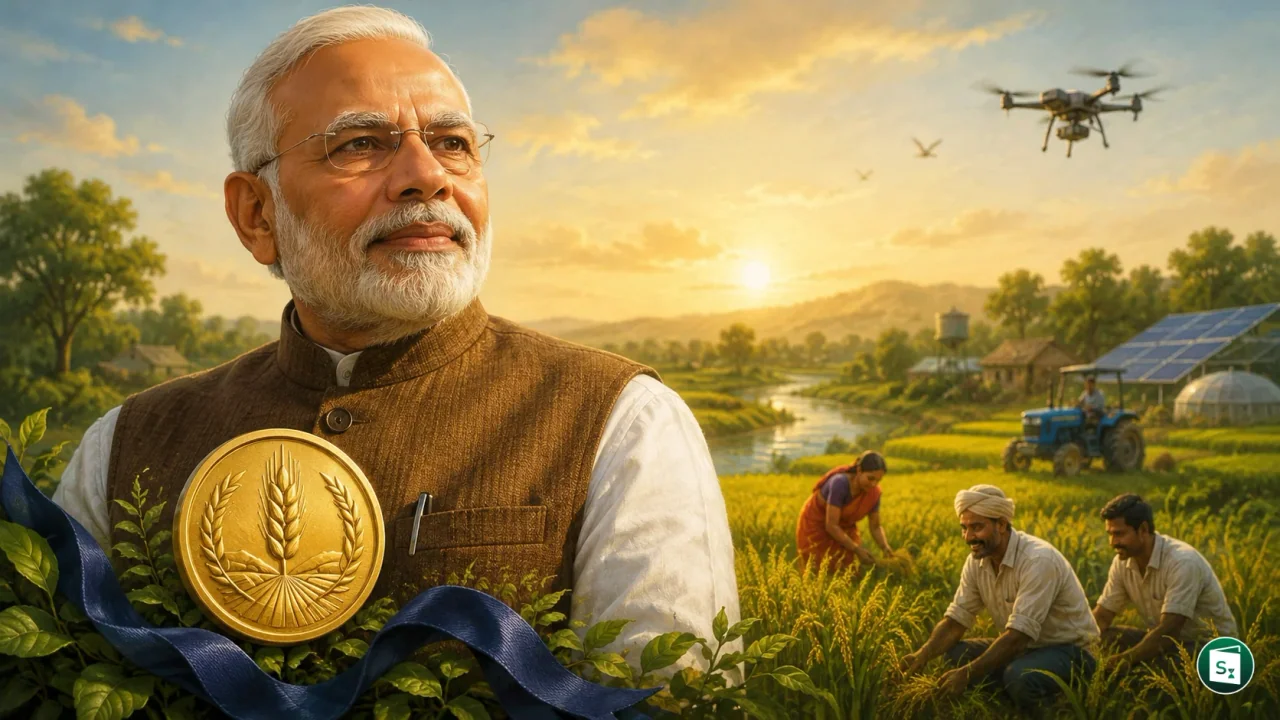
The Food and Agriculture Organization (FAO) of the United Nations conferred the prestigious Agricola Medal upon Prime Minister Narendra Modi in Rome on May 22, 2026. The award recognizes India’s historic strides in achieving food self-sufficiency and establishing the world’s largest food safety nets under his leadership. This honour places India at the forefront of global efforts to combat hunger and promote sustainable agricultural practices.
What is the FAO Agricola Medal?
The Agricola Medal is the highest institutional honour bestowed by the Food and Agriculture Organization (FAO) of the United Nations. Established in 1977, the medal is named after the Latin word for ‘farmer’ and is typically awarded by the FAO Director-General to heads of state or government. It signifies exceptional leadership in the fields of agriculture, food security, and rural development.
The medal features a representation of a farmer at work, symbolizing the vital role of agricultural communities in global sustenance. By conferring this award, the FAO highlights the importance of visionary statecraft in achieving Sustainable Development Goal 2 (SDG 2), which aims to achieve Zero Hunger by 2030. Notable past recipients of this medal include world leaders like Pope John Paul II and former French President Jacques Chirac. Prime Minister Modi is the second Indian Prime Minister to receive this honour, following Dr. Manmohan Singh who was recognized in 2008.
Recognition of India’s Agrifood Transformation
The award serves as a global acknowledgement of India’s transition from a food-deficit nation to a food-surplus power. Under the current administration, India has implemented structural reforms that leverage technology to enhance the lives of over 110 million farmers. One of the key factors cited for this recognition is India’s success in managing a massive food safety net during global crises, including the period following the COVID-19 pandemic.
India’s leadership in the International Year of Millets (2023) also played a significant role in this achievement. By promoting climate-resilient and nutrient-dense crops like millets, referred to as Shree Anna, India has provided a sustainable solution to global nutrition challenges. The FAO highlighted that India’s efforts in diversifying the global food basket and focusing on soil health through the Soil Health Card Scheme have been exemplary for other developing nations.
Key Pillars of India’s Food Security Framework
The recognition is largely attributed to several flagship schemes that have strengthened India’s agricultural and social fabric. These initiatives focus on both ensuring availability for the vulnerable and enhancing productivity for the farmers.
The World’s Largest Food Safety Net
The Pradhan Mantri Garib Kalyan Anna Yojana (PMGKAY) stands as a monumental success in India’s food security strategy. Originally launched in 2020, the scheme was extended in 2024 for a period of five years, ensuring its operation through December 2028. Under this scheme, approximately 81.35 crore beneficiaries receive 5 kg of free food grains every month. This initiative has been instrumental in mitigating the impact of food inflation and ensuring nutritional security for nearly two-thirds of the population.
Direct Income Support for Farmers
The PM-KISAN (Pradhan Mantri Kisan Samman Nidhi) scheme provides direct income support of ₹6,000 per year to eligible land-holding farmer families in three equal instalments. Since its launch in 2019, the scheme has leveraged Direct Benefit Transfer (DBT) to send funds directly into the bank accounts of over 11 crore farmers. This financial cushion allows small and marginal farmers to meet their immediate input costs like seeds and fertilizers.
Key Agricultural Schemes at a Glance
| Scheme Name | Launch Year | Primary Objective |
|---|---|---|
| PMGKAY | 2020 | Provides free food grains to over 80 crore people |
| PM-KISAN | 2019 | Direct income support of ₹6,000 per year to farmers |
| Soil Health Card | 2015 | Scientific soil testing for balanced fertilizer use |
| PM Fasal Bima Yojana | 2016 | Comprehensive crop insurance against natural risks |
| Digital Agriculture Mission | 2024 | Building Digital Public Infrastructure for farming |
Technology in Agriculture
The government has also prioritized the Digital Agriculture Mission, which builds a Digital Public Infrastructure (DPI) for the sector. This includes a digital registry of farmers and AI-based advisory services, helping farmers make informed decisions about crop selection and pest management. These technological interventions have significantly reduced wastage and improved the efficiency of the agrifood supply chain.
About the Food and Agriculture Organization (FAO)
The Food and Agriculture Organization (FAO) is a specialized agency of the United Nations that leads international efforts to defeat hunger and improve nutrition and food security. It was founded on 16 October 1945 in Quebec City, Canada, a date now observed annually as World Food Day. The organization moved its headquarters to Rome, Italy, in 1951.
The FAO’s primary goal is to help its 194 member nations, along with the European Union, achieve food security for all and ensure that people have regular access to enough high-quality food to lead active, healthy lives. Its work is guided by the Latin motto ‘Fiat panis’, which translates to ‘Let there be bread’. The current Director-General of the FAO is Qu Dongyu, who has served since August 2019. The organization plays a critical role in providing technical assistance, formulating policies, and collecting data on global agriculture and forestry.
Global Significance of the Award
The conferment of the Agricola Medal on Prime Minister Modi carries immense geopolitical and strategic weight. It reinforces India’s position as a global leader in food security, particularly in the Global South. By sharing its agricultural expertise and successful digital models with other developing nations, India is helping build international resilience against food shortages and climate change.
Moreover, this award highlights the shift towards sustainable practices such as natural farming and the use of biofortified crops to address nutritional deficiencies. India’s commitment to the Zero Hunger goal and its proactive stance in global forums on food security have paved the way for this international acclaim. The medal serves as a tribute to the resilience and hard work of millions of Indian farmers who have ensured the nation’s food safety.
Key Takeaways
- Prime Minister Narendra Modi was conferred the FAO Agricola Medal on May 22, 2026, in recognition of his contributions to food security and rural development.
- The Agricola Medal is the highest award of the Food and Agriculture Organization (FAO) and has been awarded to global leaders since 1977.
- PM Modi is the second Indian Prime Minister to receive this honour, after Dr. Manmohan Singh was recognized in 2008.
- The Food and Agriculture Organization (FAO) is headquartered in Rome, Italy, and was founded on 16 October 1945, a day celebrated as World Food Day.
- The Pradhan Mantri Garib Kalyan Anna Yojana (PMGKAY) ensures free food grains for over 81 crore people and is scheduled to continue until December 2028.
- India’s leadership in the International Year of Millets (2023) and the promotion of Shree Anna were key factors cited for the award.
- The PM-KISAN scheme provides ₹6,000 per year in direct income support to more than 11 crore farmer families across India.