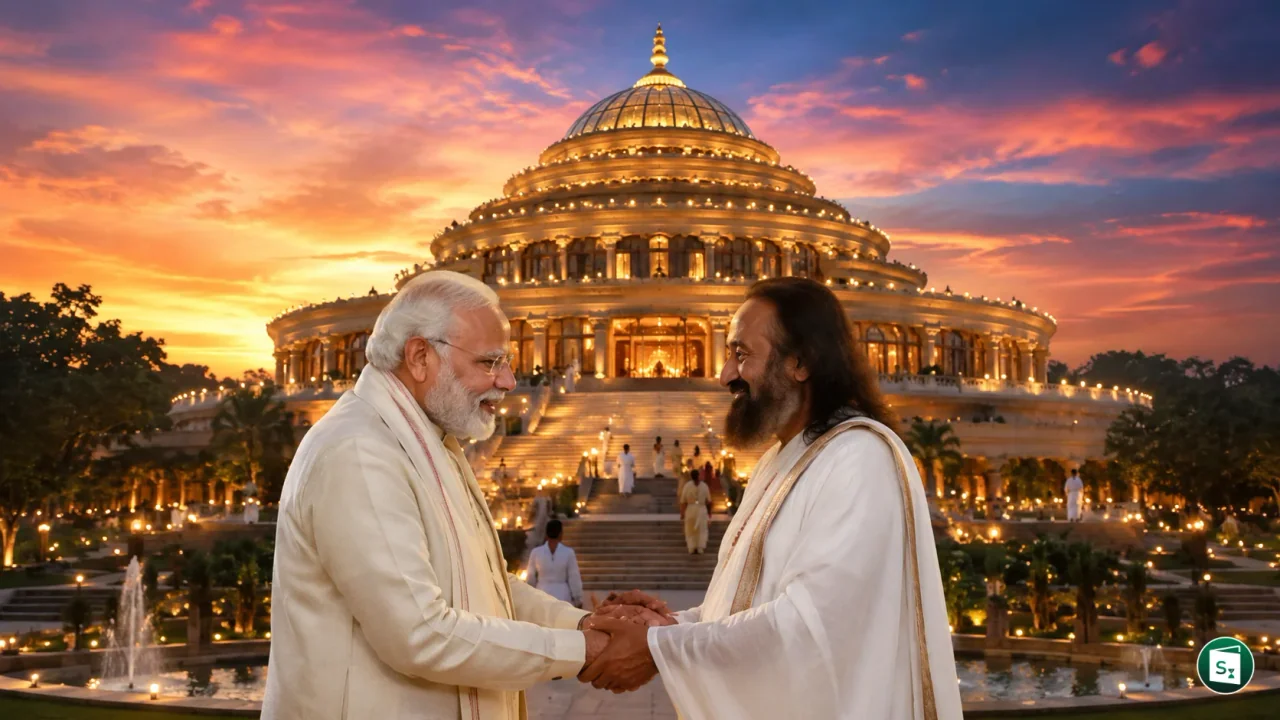
Prime Minister Narendra Modi visited the Art of Living International Centre in Bengaluru on May 10, 2026, to participate in the organization’s 45th anniversary and the 70th birthday of its founder, Gurudev Sri Sri Ravi Shankar. During this visit, the Prime Minister inaugurated the Dhyan Mandir, a newly constructed, lotus-shaped meditation hall designed to host massive spiritual gatherings and collective meditation. This event highlights the growing intersection of India’s cultural heritage, mental well-being initiatives, and grassroots social service on the global stage.
The Dhyan Mandir: Design, Capacity, and Architecture
The newly inaugurated Dhyan Mandir stands as a key architectural landmark at the Art of Living International Centre on Kanakapura Road in Bengaluru. Officially opened by the Prime Minister, this lotus-shaped meditation pavilion is designed to function as a modern, high-vibration space for meditation, yoga, and quiet introspection. Its construction complements the existing spiritual infrastructure of the ashram, which includes the famous five-tiered Vishalakshi Mantap built in 2003.
Spanning a total built-up area of 1.06 lakh square feet, the structure ranks among the largest meditation facilities in the region. A defining element of its sustainable design is a 65,000 square feet roof garden, which helps regulate indoor temperatures naturally. The main hall has the capacity to accommodate up to 20,000 practitioners at a time, facilitating massive collective chanting and group meditation sessions aimed at fostering global harmony.
Launch of Nationwide Service Initiatives
Alongside the inauguration of the meditation hall, the event marked the launch of several nationwide service projects. These initiatives, driven by the foundation’s volunteer network, target key development sectors such as agriculture, health, and environmental sustainability. Many of these projects align directly with national policies, including the central government’s Mission LiFE (Lifestyle for Environment) framework.
| Focus Area | Key Objectives and Planned Interventions |
|---|---|
| Mental Well-being | Promotion of yoga, meditation, and stress-relief programs to build emotional resilience. |
| Rural Development | Upgradation of infrastructure, vocational training, and capacity building in rural communities. |
| Environmental Conservation | Advocacy for natural farming, water conservation, reducing chemical fertilizers, and eliminating single-use plastics. |
| Social Transformation | Year-long projects targeting prison reform, tribal empowerment, primary education, and healthcare access. |
The Prime Minister’s Address: Outer Technology and Inner Software of Peace
During his address, the Prime Minister emphasized the role of public participation in national development, stating that no government program can achieve complete success without active societal involvement. He highlighted the Swachh Bharat Mission as a prime example of public participation transforming a government campaign into a mass movement. The Prime Minister noted that achieving a Viksit Bharat, or a developed India, requires a young generation that is not only skilled but also mentally calm, socially responsible, and committed to the spirit of selfless service, which he described as a core value of Indian culture.
Reflecting on the location of the event, the Prime Minister highlighted Bengaluru’s unique dual identity as a leading global technology hub and a prominent center of spiritual consciousness. He remarked that while the city provides technical software to the global industry, institutions like the Art of Living provide the world with the software of inner peace and mental wellness. The Prime Minister also expressed his appreciation for the foundation’s environmental efforts, particularly in promoting natural farming and water conservation under the Mission LiFE initiative.
The Art of Living Foundation: History, Growth, and Sudarshan Kriya
The Art of Living Foundation was founded in 1981 by spiritual leader Sri Sri Ravi Shankar as a volunteer-based, non-profit humanitarian and educational organization. The foundation’s programs are built around the Sudarshan Kriya, a rhythmic breathing technique conceptualized by its founder in 1982 after a ten-day period of silence in Shimoga, Karnataka. This breathing practice is designed to harmonize the natural rhythms of the body and mind, helping individuals reduce stress and improve mental well-being.
After its establishment in India, the organization expanded rapidly. It held its first international course in Switzerland in 1983 and was registered in Germany and the United States in 1989. The primary global hub, the Art of Living International Centre, was set up on Kanakapura Road in Bengaluru in 1986. The campus features iconic structures such as the Vishalakshi Mantap, a five-tiered meditation hall built in 2003, and the newly inaugurated Dhyan Mandir, reinforcing Bengaluru’s position as a focal point for global spiritual tourism.
Key Takeaways
- Prime Minister Narendra Modi inaugurated the newly constructed Dhyan Mandir on May 10, 2026, at the Art of Living International Centre in Bengaluru.
- The Dhyan Mandir is a lotus-shaped meditation hall covering an area of 1.06 lakh square feet with a capacity to accommodate up to 20,000 people.
- The inauguration coincided with the 45th anniversary of the Art of Living Foundation and the 70th birthday of its founder, Gurudev Sri Sri Ravi Shankar.
- The Art of Living Foundation was established in 1981, with its primary breathing technique, Sudarshan Kriya, conceptualized in 1982 in Shimoga, Karnataka.
- The foundation’s newly launched service projects align with the central government’s Mission LiFE initiative, promoting environmental conservation and natural farming.