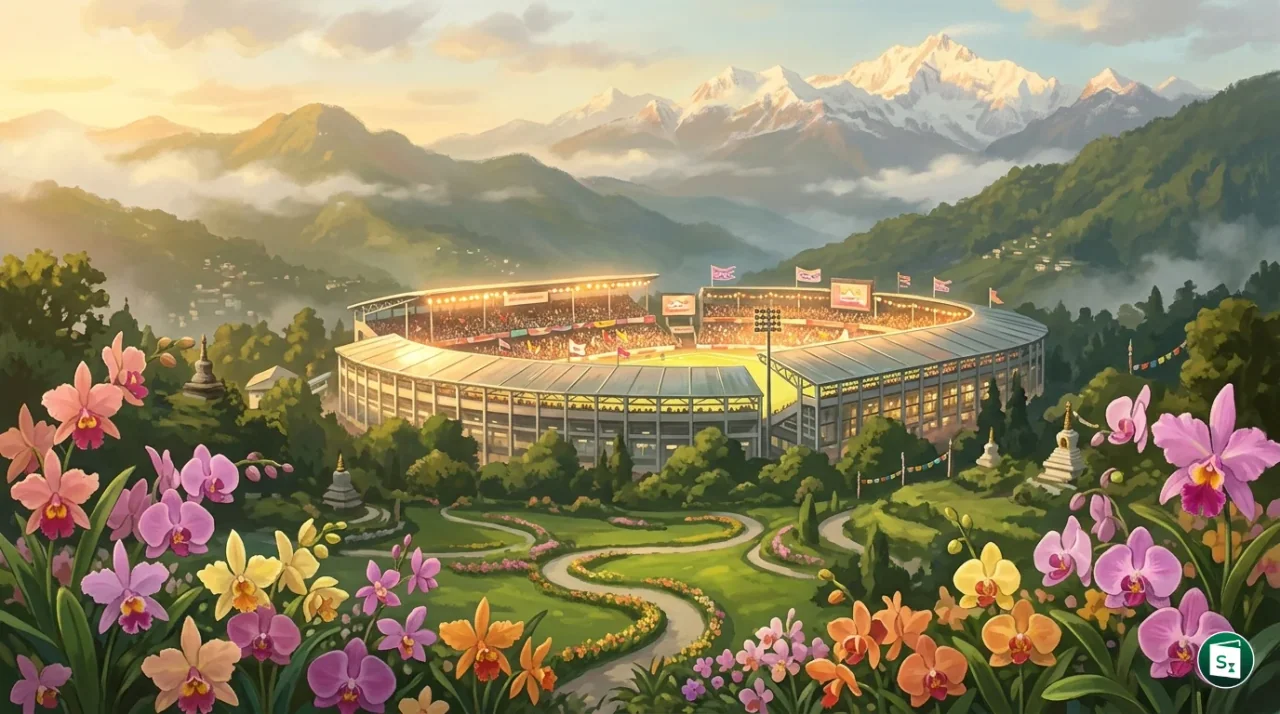
Prime Minister Narendra Modi visited Gangtok on May 7, 2026, to attend the closing ceremony of the Golden Jubilee celebrations marking 50 years of Sikkim’s statehood. During the visit, he inaugurated and laid the foundation stones for over 30 development projects worth more than ₹4,000 crore at Paljor Stadium. The Prime Minister also unveiled a world-class Orchid Experience Centre at the Swarnajayanti Maitri Manjari Park to showcase the state’s rich floral heritage.
Celebrating 50 Years of Sikkim’s Statehood
The year 2026 marks the Golden Jubilee of Sikkim’s journey as a constituent state of India. Sikkim officially became the 22nd state of the Indian Union on May 16, 1975. This historic transition was the result of a popular movement and a referendum held on April 14, 1975, where an overwhelming majority of the electorate voted to abolish the monarchy and integrate with India.
The legal integration was formalised through the Constitution (Thirty-sixth Amendment) Act, 1975. This amendment repealed the previous “associate state” status granted under the 35th Amendment and elevated Sikkim to full statehood. It also inserted Article 371F into the Constitution, providing special provisions to protect the unique social, cultural, and political identity of the state, as well as its traditional land rights. During the ceremony at Paljor Stadium, the Prime Minister highlighted how Sikkim has evolved over five decades into a model of sustainable development and peace in the Himalayan region.
Infrastructure Boost: Projects Worth ₹4,000 Crore
The Prime Minister’s visit included the inauguration and foundation laying of more than 30 development projects aimed at enhancing the quality of life and economic potential of Sikkim. These projects, with a combined valuation exceeding ₹4,000 crore, focus on key sectors including healthcare, education, connectivity, and power.
One of the major highlights is the foundation stone for a 100-bedded Ayurveda hospital in Namchi, which is expected to bolster the state’s traditional medicine infrastructure and health tourism. The developmental push aligns with the central government’s vision of the Northeast as India’s “Ashtalakshmi”, where each of the eight states contributes significantly to national prosperity.
| Sector | Focus Area | Significance |
|---|---|---|
| Healthcare | Ayurveda Hospital in Namchi | Strengthening traditional medicine and wellness tourism |
| Connectivity | Road and Railway Infrastructure | Improving accessibility to remote Himalayan regions |
| Tourism | Orchid Experience Centre | Showcasing floral biodiversity and boosting eco-tourism |
| Education | New Institutional Buildings | Enhancing local skill development and learning facilities |
These initiatives are part of a broader strategy to ensure that Sikkim remains a frontrunner in the “Act East” policy, serving as a gateway to Southeast Asia through improved trade and people-to-people links.
Swarnajayanti Maitri Manjari Park: A Tribute to Floral Heritage
A major highlight of the visit was the unveiling of the Swarnajayanti Maitri Manjari Park in Gangtok, developed to commemorate the 50th year of statehood. The park features a 26-foot-tall copper monument symbolising unity and compassion. Central to the park is a world-class Orchid Experience Centre, a climate-controlled facility designed to preserve and showcase the immense floral biodiversity of the Eastern Himalayas.
The centre houses over 100 species of orchids, including the indigenous Dendrobium nobile, which is the official state flower of Sikkim. The facility uses highly automated systems to regulate temperature, humidity, and carbon dioxide levels, creating an ideal environment for rare and exotic varieties. Notable among the collection is a rare variety named Cymbidium NaMo, named in honour of the Prime Minister.
Sikkim’s Global Status as an Orchid Hub
Sikkim is a global hotspot for biodiversity, hosting more than 500 orchid species within its varied micro-climatic zones. The state’s orchid industry is primarily driven by the Cymbidium genus, which is highly valued in the international cut-flower market. To support this sector, the National Research Centre for Orchids (NRCO) was established in 1996 at Pakyong, Sikkim. This institution plays a critical role in developing tissue culture techniques and training local farmers to improve commercial productivity.
The declaration of East Sikkim as an Agri-Export Zone (AEZ) for orchids further underscores the economic significance of this sector. By combining traditional knowledge with modern technology at centres like the Swarnajayanti Maitri Manjari Park, the state aims to position itself as a premier global destination for orchid conservation and ecotourism.
Key Takeaways
- Sikkim celebrated its Golden Jubilee marking 50 years of statehood on May 7, 2026.
- Sikkim officially integrated with India as the 22nd state on May 16, 1975.
- The integration was formalised through the Constitution (Thirty-sixth Amendment) Act, 1975, which also inserted Article 371F for special provisions.
- Prime Minister Modi launched more than 30 development projects worth over ₹4,000 crore during the visit.
- A 100-bedded Ayurveda hospital is being established in Namchi to boost traditional healthcare.
- The Swarnajayanti Maitri Manjari Park in Gangtok features a world-class Orchid Experience Centre with over 100 species.
- The official state flower of Sikkim is Dendrobium nobile, an orchid species found in the Himalayan region.
- The National Research Centre for Orchids (NRCO), established in 1996, is located in Pakyong, Sikkim.