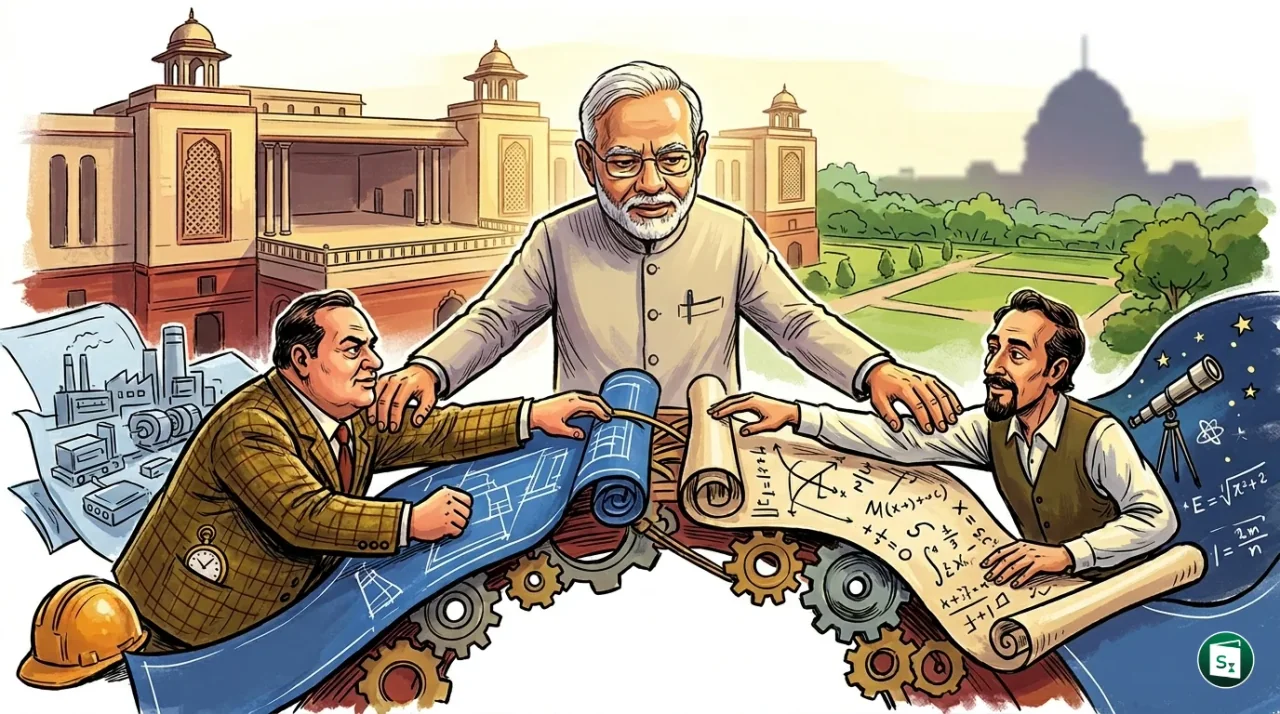
The Office of the Principal Scientific Adviser to the Government of India signed a Memorandum of Understanding with the Federation of Indian Chambers of Commerce and Industry on May 7, 2026, to revitalize the national research and development ecosystem. Formalized at Kartavya Bhavan in New Delhi, the agreement focuses on bridging the structural gap between academic research and industrial application. This collaboration aims to accelerate technology diffusion and enhance India’s position as a global co-creator of high-tech innovations.
Bridging the Gap: The Core Objectives of the MoU
The primary objective of this partnership is to create a structured coordination framework that connects all stakeholders in India’s Research and Development (R&D) landscape. By fostering a closer relationship between industry and academia, the initiative seeks to move away from purely academic pursuits toward translational research that leads to commercial products. The collaboration aims to provide a platform for policy dialogue, helping industries, including Micro, Small, and Medium Enterprises (MSMEs), to contribute more effectively to the national innovation pipeline.
The partnership also focuses on technology diffusion, which involves the rapid adoption and scaling of new technologies across various sectors. The Office of the Principal Scientific Adviser (PSA), established in 1999, acts as the nodal body for advising the Prime Minister and the Cabinet on matters related to science and technology. Currently led by Professor Ajay Kumar Sood, the office plays a central role in shaping the country’s strategic research priorities.
Focus on Translational Research and Deep-Tech
The collaboration identifies several high-tech priority areas that are critical for India’s future growth. These include solar energy, green batteries, advanced materials, and deep-tech manufacturing. By co-creating problem statements aligned with national priorities, the Federation of Indian Chambers of Commerce and Industry (FICCI) and the PSA Office aim to ensure that research efforts are directly integrated with industry needs.
Founded in 1927, FICCI is India’s largest and oldest apex business organization. It has a long history of influencing policy and fostering industrial growth. Under the leadership of Anant Goenka, who serves as the President for the 2025-26 term, FICCI continues to bridge the gap between the private sector and the government. This MoU empowers FICCI members to leverage government-backed initiatives like the Manthan platform, which was launched in August 2022 to facilitate large-scale collaboration between the demand side (industry) and the supply side (academia and startups).
Strategic Alignment with National R&D Goals
This MoU is strategically aligned with India’s goal of becoming a developed nation, or Viksit Bharat, by 2047. A key component of this vision is to increase the Gross Expenditure on Research and Development (GERD), which currently stands at approximately 0.64% of GDP. The government aims to shift the funding balance, which is presently skewed toward the public sector, to a 50-50 contribution model between the government and the private sector.
To achieve this, the government has established the Anusandhan National Research Foundation (ANRF) as the apex body for research in the country. The ANRF is mandated to facilitate collaborations between academia, industry, and government. The government has also set up a ₹1 lakh crore Research, Development, and Innovation (RDI) Fund to provide long-term capital for high-risk, high-impact innovations in sunrise sectors. This partnership between the PSA Office and FICCI will serve as a vital link in deploying these resources effectively.
Strengthening the Industry-Academia Ecosystem
A major focus of the collaboration is to build the capacity of Indian researchers and startups. The initiative will assist them in navigating complex intellectual property (IP) rights, regulatory frameworks, and investor readiness. By co-creating problem statements, the industry can provide researchers with real-world challenges, ensuring that the research output is both relevant and scalable.
This structured engagement is expected to improve the Technology Readiness Level (TRL) of Indian innovations, moving them from laboratory prototypes to market-ready products. The collaboration also highlights the importance of deep-tech manufacturing, where advanced technologies are used to solve complex engineering and scientific problems. By fostering an environment where innovation is driven by market demand, India can transition from being a consumer of global technologies to a global leader in high-tech exports.
The table below summarizes the key institutions and their roles in this new R&D ecosystem:
| Organization | Established | Role in Collaboration |
|---|---|---|
| Office of the PSA | 1999 | Advisory and national coordination |
| FICCI | 1927 | Industry representation and demand-side challenges |
| ANRF | 2023 | Apex funding and research coordination body |
| Manthan Platform | 2022 | Digital collaboration ecosystem |
Key Takeaways
- The Office of the Principal Scientific Adviser (PSA) and FICCI signed an MoU on May 7, 2026, to strengthen India’s national R&D ecosystem through industry-academia synergy.
- Formalized at Kartavya Bhavan in New Delhi, the agreement focuses on translational research and the commercialization of academic innovations.
- Strategic focus areas identified under the collaboration include solar energy, green batteries, advanced materials, and deep-tech manufacturing.
- The partnership aims to align with the Anusandhan National Research Foundation (ANRF) and leverage the ₹1 lakh crore Research, Development, and Innovation (RDI) Fund.
- FICCI, established in 1927, is currently led by President Anant Goenka and serves as the primary industry partner for this initiative.
- The collaboration will utilize the Manthan platform, launched in August 2022, to bridge the gap between industrial demand and scientific research supply.