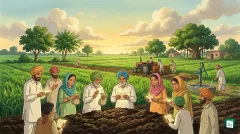
The Punjab government has officially launched the Meri Rasoi Yojna, a welfare initiative designed to distribute free kitchen grocery kits to 40 lakh economically weaker families across the state. Introduced in the Bhalwan village of Sangrur district, the scheme is aligned with the provisions of the National Food Security Act, 2013. Under this program, beneficiary households will receive essential food items on a quarterly basis to alleviate household expenditures and improve family nutrition.
Overview of the Meri Rasoi Yojna
The state government initiated the Meri Rasoi Yojna, translating to ‘My Kitchen Scheme’, as a primary nutrition safety net. Punjab Chief Minister Bhagwant Singh Mann officially inaugurated the welfare program at Bhalwan village in the Sangrur district. Under this initiative, the state distributes free kitchen utility kits to eligible households every three months. The program aims to shield vulnerable populations from food grain price spikes and localized economic challenges.
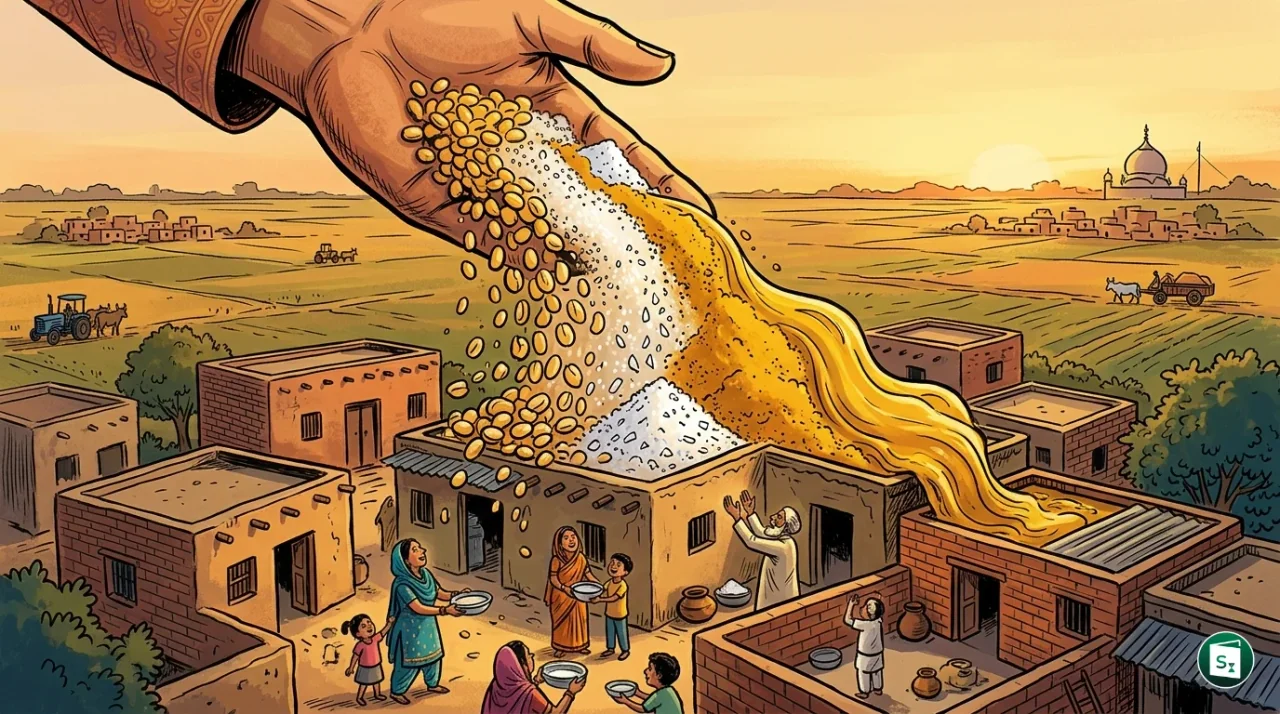
Each kit contains a curated selection of essential commodities designed to meet basic culinary and dietary requirements. Rather than just offering raw wheat or rice, the distribution includes pulses, cooking oil, and condiments to complete a household kitchen.
| Grocery Item | Quantity per Kit | Dietary Significance |
|---|---|---|
| Moong-chana dal (pulses) | 2 kg | Rich source of plant-based protein |
| Sugar | 2 kg | Primary source of food energy |
| Iodised salt | 1 kg | Essential for cognitive health and thyroid function |
| Turmeric powder | 200 g | Traditional spice with anti-inflammatory properties |
| Mustard oil | 1 litre | Standard cooking medium rich in healthy fats |
The distribution follows a strict quarterly timeline, ensuring that every registered household receives four kits annually. This periodic frequency aligns with local farming and labor income cycles, providing stability during transitional months when work or agricultural earnings may fluctuate.
Target Beneficiaries and Implementation Mechanism
The initiative aims to support approximately 40 lakh families residing in Punjab. The primary target group comprises households registered under the national food security program or those holding state-issued blue ration cards. The blue ration card designation is reserved for households with an annual income of up to ₹60,000. By targeting these specific segments, the government intends to direct resources to the most financially vulnerable households.
To support this massive logistics operation, the state government has earmarked a dedicated budget of ₹950 crore. The Punjab State Cooperative Supply and Marketing Federation Limited, commonly known as MARKFED, acts as the nodal agency responsible for the procurement and packaging of the food items. This cooperative manages the supply chain, ensuring that the grains, oil, and spices meet strict quality benchmarks before they are sealed in the official kits.
Once packaged, the kits are handed over to the state’s Department of Food, Civil Supplies and Consumer Affairs. Distribution takes place through a network of local fair price shops, also known as ration depots. To prevent pilferage, the distribution process uses electronic Point of Sale, or ePOS, machines. Beneficiaries must authenticate their identity using Aadhaar-linked biometric scans, which helps eliminate ghost cards and ensures the kits reach the intended recipients.
Linkage with the National Food Security Act, 2013
The state government designed the new kitchen kit program to complement the statutory provisions of the National Food Security Act, 2013. The Parliament of India enacted this legislation to transition food security from a welfare-based benefit to a legal right. The legislation covers up to 75 percent of the rural population and 50 percent of the urban population across India, securing food access for nearly two-thirds of the country.
Under the central act, states identify eligible beneficiaries under two main categories. Members of Priority Households receive five kilograms of foodgrains per person each month. Meanwhile, households under the Antyodaya Anna Yojana program, which represents the poorest segment of society, receive thirty-five kilograms of foodgrains per month. The central government subsidizes these grains, charging three rupees per kilogram for rice, two rupees per kilogram for wheat, and one rupee per kilogram for coarse grains.
Although the federal act guarantees raw grains, it does not provide cooking oils or spices. The state government created the new scheme to resolve this limitation. By supplying mustard oil, salt, sugar, and turmeric, the program provides the necessary items to prepare meals from the subsidized grains. This combination of central grain allocations and state cooking kits creates a more complete nutritional net.
Historical Context: Evolution of Food Security Schemes in Punjab
Punjab has a long history of state-sponsored food security initiatives designed to shield low-income groups from economic shocks. The state government first introduced a major subsidized food grains program, known as the Atta-Dal Scheme, on August 15, 2007. The program initially distributed wheat at one rupee per kilogram and pulses at twenty rupees per kilogram to families living below the poverty line. In 2013, the state government restructured and integrated the program with the newly enacted federal food security framework, broadening the distribution network to cover millions of additional residents.
To modernize the distribution network, the state government rolled out the Smart Ration Card Scheme in September 2020. This reform replaced traditional paper cards with chip-enabled smart cards. The digitalization of cards enabled ration portability, giving beneficiaries the freedom to collect their grain quotas from any fair price shop in the state rather than being bound to a single local depot. It also integrated mandatory biometric verification, which significantly curtailed corruption and eliminated duplicate beneficiary records.
The newly launched program represents the next phase of this policy evolution. While previous schemes focused primarily on staple cereals like wheat, the current administration has expanded the scope of food assistance. By integrating a wider basket of nutritional supplements including oil, dal, and spices, the state transitions from a basic caloric safety net to a comprehensive kitchen support system.
Key Takeaways
- The Meri Rasoi Yojna was launched by the Punjab government in Bhalwan village, Sangrur district, to provide free quarterly kitchen grocery kits to economically weaker families.
- The scheme targets approximately 40 lakh families who are registered under the National Food Security Act, 2013, or hold state blue ration cards with an annual income of up to ₹60,000.
- The cooperative MARKFED, registered in 1954 and headquartered in Chandigarh, acts as the nodal agency for procuring and packaging the food items.
- The National Food Security Act, 2013 provides statutory backing to food security, covering up to 75 percent of the rural population and 50 percent of the urban population across India.
- The Atta-Dal Scheme was originally launched in Punjab on August 15, 2007, to provide highly subsidized wheat and pulses to low-income households.