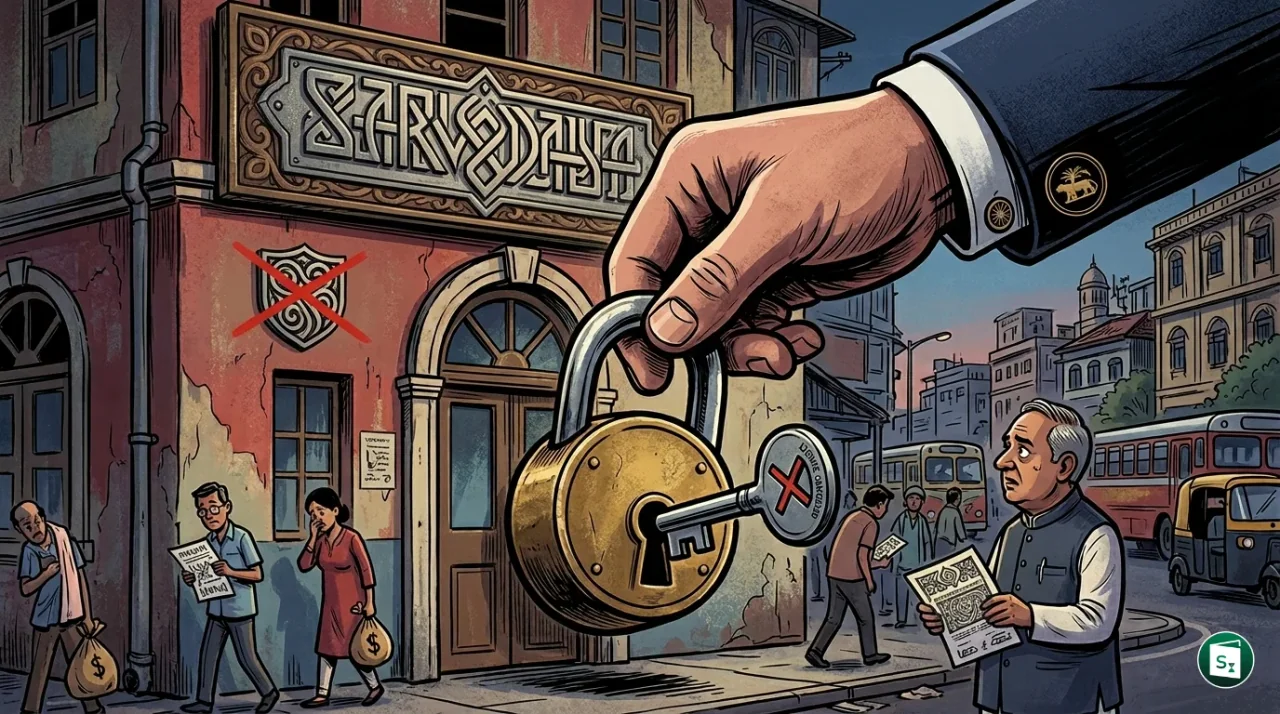
The Reserve Bank of India (RBI) cancelled the banking licence of Mumbai-based Sarvodaya Co-operative Bank Limited, effective from the close of business on May 12, 2026. The regulatory authority took this decisive step under the Banking Regulation Act, 1949, citing the cooperative bank’s inadequate capital reserves and extremely weak earning prospects. While the action immediately halts all standard banking operations, a robust deposit insurance framework ensures that almost all individual depositors will recover their funds without financial loss.
Why Did the RBI Cancel Sarvodaya Co-operative Bank’s Licence?
The central bank’s decision to revoke the banking licence of Sarvodaya Co-operative Bank stems from a severe deterioration in the institution’s financial health. During its regular supervisory assessments, the regulator observed that the bank failed to maintain a minimum capital base and possessed highly discouraging earning prospects. Without sufficient capital reserves, a bank cannot absorb operational losses or support credit growth, rendering its business model unsustainable.
In its official order, the banking regulator stated that the cooperative bank failed to comply with several key statutory requirements. Specifically, the bank was unable to meet the provisions of the Banking Regulation Act, 1949, which demand that every operating bank maintain adequate assets to protect its depositors. Allowing the bank to continue its operations would have further eroded its asset quality, placing public savings at high risk.
Ultimately, the primary trigger for the cancellation was depositor protection. The regulator concluded that the bank’s current financial position made it impossible to repay its depositors in full. In such scenarios, extending the bank’s operational life is considered highly prejudicial to the interests of the depositors and the broader public, prompting the regulator to enforce an immediate halt to all banking activities.
Legal Foundations of the Regulatory Action
The cancellation of the banking licence was executed through specific legal powers vested in the central bank. Understanding these legal provisions is critical as they define the statutory boundaries of banking regulation in India, particularly for cooperative financial institutions.
Section 56 of the Banking Regulation Act, 1949
Originally, the Banking Regulation Act, 1949, applied only to commercial banking companies. However, in 1965, the Parliament passed the Banking Laws (Application to Co-operative Societies) Act, which introduced Section 56 into the primary statute. Effective from March 1, 1966, this landmark amendment extended the regulatory and supervisory powers of the central bank to cooperative societies engaged in the business of banking.
Under Section 56, the provisions of the Act apply to cooperative banks with specific modifications. While cooperative banks remain registered under the respective cooperative societies acts of their state governments, their actual banking operations, such as credit guidelines, capital requirements, and licensing, are governed directly by the central bank. This section acts as the primary legal gateway that brings urban and state cooperative banks under the regulatory umbrella of the central bank.
Section 22 of the Banking Regulation Act, 1949
Section 22 mandates that no cooperative society or banking company can conduct banking operations in India without obtaining a formal banking licence from the central bank. The licence is granted only when the applicant satisfies strict criteria outlined in Section 22(3), which include having adequate capital and ensuring that banking affairs will not be conducted in a manner harmful to depositors.
Under Section 22(4), the central bank holds the explicit authority to cancel an active banking licence. This power is invoked if a bank fails to comply with the primary licensing conditions, ceases its banking operations, or deteriorates financially to a point where it can no longer safeguard the interests of its depositors. In the case of Sarvodaya Co-operative Bank, the central bank exercised its powers under Section 22(4) because the bank fell short of these core statutory conditions.
Impact on Operations and Depositor Compensation
The cancellation of the banking licence has immediate and far-reaching consequences for both the bank’s management and its depositors. It triggers a transition from active operations to liquidation, invoking the national safety net for bank depositors.
Cessation of Banking Activities
With the licence cancellation becoming effective from the close of business on May 12, 2026, Sarvodaya Co-operative Bank is strictly prohibited from conducting any standard banking business. Under the regulatory directive, the bank must immediately halt the acceptance of fresh deposits from the public, stop the repayment of existing deposits to account holders, and cease extending any new loans or advances. In short, the bank cannot carry out any transaction that falls under the statutory definition of banking.
Following the operational halt, the central bank initiated the formal process of closing the institution. It requested the Commissioner for Cooperation and Registrar of Cooperative Societies, Maharashtra, to issue an official order for the winding up of the bank and to appoint a competent liquidator. The liquidator will be responsible for consolidating the bank’s assets, settling outstanding liabilities, and overseeing the payout process.
Deposit Insurance via the DICGC
To safeguard the interest of retail savers, the central bank leverages the protection mechanism of the Deposit Insurance and Credit Guarantee Corporation (DICGC). The DICGC is a crucial safety net for the Indian banking sector.
| Feature | Details |
|---|---|
| Parent Organization | Wholly-owned subsidiary of the Reserve Bank of India (RBI) |
| Establishment Year | 1978 (formed by merging Deposit Insurance Corporation and Credit Guarantee Corporation of India) |
| Governing Statute | Deposit Insurance and Credit Guarantee Corporation Act, 1961 |
| Headquarters | Mumbai, Maharashtra |
| Coverage Limit | Up to ₹5 lakh per depositor for both principal and interest |
Under the DICGC rules, upon liquidation of the bank, every depositor is entitled to receive an insurance claim amount of up to ₹5 lakh covering their combined deposits (savings, current, and fixed deposits) held in the same capacity and right. According to the financial data submitted by Sarvodaya Co-operative Bank, approximately 98.36% of the depositors are eligible to receive the full amount of their deposits from the DICGC. This high coverage percentage ensures that almost the entire depositor base will be protected from any direct capital loss, with the liquidator and the DICGC handling the recovery and payout.
The Broader Supervision of Urban Co-operative Banks in India
The action against Sarvodaya Co-operative Bank is part of a larger, systemic drive by the central bank to strengthen the cooperative banking sector. Primary (Urban) Co-operative Banks play a crucial role in India’s financial ecosystem by catering to small businesses, retail traders, and middle-class households in semi-urban and urban areas. However, because they are structured as cooperative societies, they have historically operated under a unique regulatory environment that presents distinct administrative challenges.
For decades, cooperative banks in India operated under a dual control framework. Under this system, the administrative aspects (such as registration, management elections, audit, and administrative winding up) were controlled by the Registrar of Co-operative Societies (RCS) of the respective state government, or the Central Registrar of Co-operative Societies for multi-state banks. On the other hand, the actual banking-related functions (such as licensing, interest rate structures, reserve ratios, and branch expansion) were regulated by the central bank. This separation of authority often created regulatory gaps, making it difficult to enforce swift corrective measures in financially stressed banks.
To resolve these governance issues and protect depositor interests, the Union Parliament passed a crucial amendment to the Banking Regulation Act in 2020. This reform significantly enhanced the central bank’s supervisory authority over cooperative banks. It granted the central bank the power to supersede the board of directors of cooperative banks in consultation with state cooperative registrars, restructuring their management and enforcing professional standards. By closing down non-viable institutions and closely monitoring others, the regulator aims to restore public confidence in the cooperative banking landscape and prevent localized financial distress from spreading to the wider financial market.
Key Takeaways
- The Reserve Bank of India (RBI) cancelled the banking licence of Mumbai-based Sarvodaya Co-operative Bank Limited, effective from May 12, 2026.
- The regulatory cancellation was executed under Section 22(4) and Section 56 of the Banking Regulation Act, 1949, due to the bank’s inadequate capital and poor earning prospects.
- The central bank requested the Commissioner for Cooperation and Registrar of Cooperative Societies, Maharashtra, to issue a winding-up order and appoint a liquidator for the bank.
- The Deposit Insurance and Credit Guarantee Corporation (DICGC), established in 1978 under a 1961 Act, secures bank deposits up to a statutory limit of ₹5 lakh per depositor.
- Approximately 98.36% of the depositors of Sarvodaya Co-operative Bank are eligible to receive their full deposit amounts from the DICGC.
- The dual regulation of cooperative banks was revised by the Banking Regulation (Amendment) Act, 2020, which granted the central bank greater governance powers over cooperative societies.