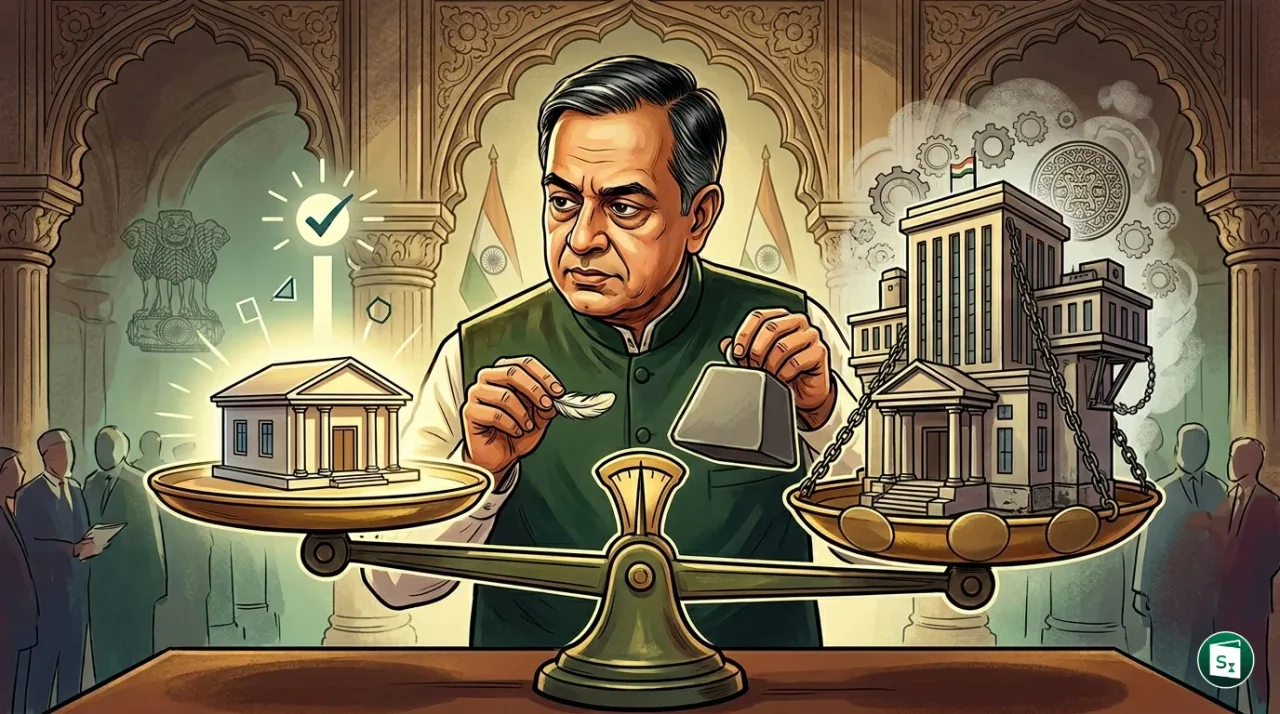
The Reserve Bank of India (RBI) has issued the final RBI (Non-Banking Financial Companies – Registration, Exemptions and Framework for Scale Based Regulation) Amendment Directions, 2026. These new regulations introduce a simplified framework for small, low-risk entities by exempting certain Non-Banking Financial Companies (NBFCs) from the mandatory registration process. Starting from July 1, 2026, the move aims to reduce the regulatory burden on companies that do not access public funds or interact directly with customers.
RBI Introduces New Classification and Registration Exemptions for NBFCs
The latest directions by the central bank represent a significant shift in how non-banking financial entities are regulated in India. By focusing on the risk profile rather than just the business model, the RBI is creating a more conducive environment for small-scale financial operations. The Reserve Bank of India, established on April 1, 1935, under the Reserve Bank of India Act, 1934, serves as the apex monetary authority and regulator of the country’s financial system. It was nationalized in 1949 and is headquartered in Mumbai.
Under the new 2026 directions, the regulator has redefined the categorization of NBFCs to better align with the Scale Based Regulation (SBR) framework. This framework, which was originally introduced in October 2021, categorizes entities into four layers based on their size, activities, and riskiness. The primary objective of the latest amendment is to provide a “light-touch” regulatory approach for entities that pose minimal risk to the broader financial system and the depositing public.
Categorization of NBFCs: Type I vs Type II
The amended guidelines introduce a clear distinction between entities based on their funding sources and customer interaction. This classification helps the regulator apply varying levels of oversight depending on the potential for systemic impact.
| Category | Description |
|---|---|
| Type I NBFC | A company that does not accept public funds, has no direct customer interface, and holds a Certificate of Registration from the RBI. |
| Type II NBFC | All other registered NBFCs that do not qualify as Type I, typically involving those with public funds or customer interactions. |
| Unregistered Type I NBFC | Small entities that meet the Type I criteria and have an asset size below ₹1,000 crore, allowing them to operate without formal registration. |
A Type I NBFC is defined as an entity that does not access public funds, including public deposits, bank borrowings, or market instruments like commercial papers. Furthermore, these entities do not have a customer interface, meaning they do not directly interact with or provide services to individual retail customers.
Eligibility for Registration Exemption
The most significant change introduced by the 2026 guidelines is the exemption from registration for specific entities. NBFCs that qualify as Unregistered Type I are no longer required to obtain a Certificate of Registration from the central bank. To be eligible for this exemption, an entity must satisfy three concurrent conditions:
- The company must not raise or use public funds as part of its business model.
- The company must not have any customer interface or direct consumer-facing operations.
- The total asset size of the entity must be less than ₹1,000 crore, as per its latest audited balance sheet.
Entities meeting these criteria are exempt from Section 45-IA of the Reserve Bank of India Act, 1934, which mandates registration. Additionally, they are exempt from Section 45-IC, which requires the creation of a statutory reserve fund. This exemption significantly reduces the administrative and compliance burden for small investment firms or group holding companies that operate primarily with their own capital.
Voluntary Deregistration and Compliance Requirements
Existing NBFCs that currently hold a Certificate of Registration but meet the new criteria for Unregistered Type I status have the option to voluntarily surrender their license. The RBI has set a deadline of December 31, 2026, for such entities to submit their deregistration applications. Once deregistered, these companies will be classified as exempt entities but must still follow specific compliance norms to maintain their status.
To ensure that exempt entities do not drift away from the stipulated criteria, the RBI has mandated several ongoing requirements. Boards of these companies must pass an annual resolution within one month of the start of every financial year, confirming that the company continues to have no public funds and no customer interface. Additionally, these entities must clearly disclose their exempt status in the notes to their audited financial statements. If an entity’s asset size crosses the ₹1,000 crore mark or if it begins accessing public funds, it must immediately apply for registration as a Type II NBFC.
The Rationale Behind the Light-Touch Regulatory Framework
The introduction of the 2026 guidelines is rooted in the principle of proportionality. The RBI recognizes that small, closely held companies that use their own funds to invest in other businesses or manage family wealth do not pose the same level of risk as large, public-facing financial institutions. By exempting these low-risk entities from the stringent registration and reporting requirements, the regulator is promoting ease of doing business and optimizing its own supervisory resources.
This “light-touch” approach allows the RBI to focus its oversight on systemically important NBFCs, which are those that could impact the stability of the financial system if they fail. For small players, the removal of the registration requirement simplifies their corporate structure and reduces legal costs. However, the regulator maintains its power to inspect any such entity if there is a suspicion of fraudulent activity or if the company begins to exhibit characteristics of a public-interest entity.
Understanding Scale Based Regulation (SBR) for NBFCs
The 2026 directions are an extension of the Scale Based Regulation (SBR) framework that the RBI fully implemented in October 2022. This framework was designed to address the growing complexity of the NBFC sector by creating a tiered regulatory structure. The SBR framework divides NBFCs into four distinct layers:
- Base Layer: Includes non-deposit-taking NBFCs with assets below ₹1,000 crore, along with specific types like Peer-to-Peer (P2P) lenders and Account Aggregators.
- Middle Layer: Comprises all deposit-taking NBFCs and non-deposit-taking entities with assets of ₹1,000 crore or more.
- Upper Layer: Consists of those NBFCs that are specifically identified by the RBI as warranting enhanced regulatory requirement based on a set of parameters and scoring methodology.
- Top Layer: A layer that is kept empty by default but can be populated if the RBI feels that a specific entity in the Upper Layer poses an extreme systemic risk.
The latest amendment specifically addresses entities that would typically fall into the Base Layer but, due to their lack of public funding and customer interaction, can now be granted complete exemption from registration. This further refines the SBR philosophy of “higher the risk, tighter the regulation.”
Key Takeaways
- The RBI issued the final NBFC Amendment Directions, 2026, which introduce registration exemptions for low-risk entities.
- Entities with an asset size of less than ₹1,000 crore that do not use public funds or have a customer interface are exempt from registration.
- These exempt entities are classified as Unregistered Type I NBFCs and do not need to follow Section 45-IA of the RBI Act, 1934.
- Existing companies meeting the criteria can voluntarily surrender their Certificate of Registration by December 31, 2026.
- The Scale Based Regulation (SBR) framework, implemented in October 2022, serves as the foundation for these tiered regulatory changes.
- Exempt companies must pass an annual board resolution confirming their compliance with the non-public fund and no-customer interface criteria.