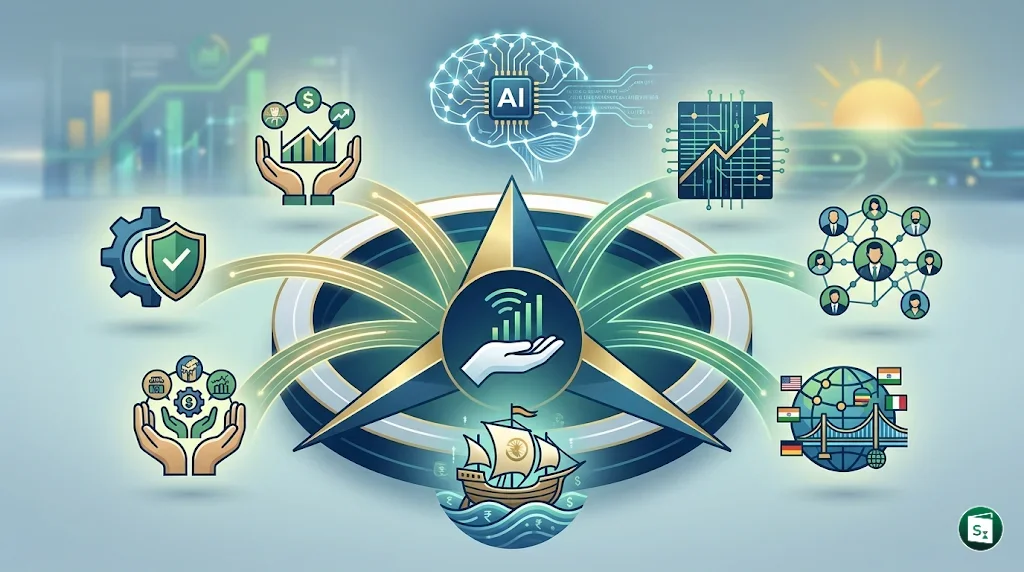
The Reserve Bank of India officially launched its next medium-term strategy framework, Utkarsh 2029, covering the three-year period from April 2026 to March 2029. This blueprint outlines 49 specific deliverables aimed at elevating the central bank to a world-class status while navigating the evolving global financial landscape. The framework places a heavy emphasis on technological innovation, inclusive finance, and the modernization of core banking operations.
The Six Strategic Pillars of Utkarsh 2029
The roadmap defines six strategic pillars to steer the central bank’s objectives. These pillars include robust regulations, which focus on rationalizing rules to minimize compliance hurdles for banks and other entities. The goal of customer centricity and inclusive finance is to ensure that financial services reach the underserved while maintaining high service standards.
Additionally, the framework aims to develop competitive financial markets and integrate effective technology into the core of the bank’s operations. To support these goals, the RBI is building a future-ready organization through staff upskilling and seeking global integration by expanding the international reach of India’s payment networks. This comprehensive approach is designed to ensure stability and growth in a rapidly changing financial environment.
Project Sa-Mudra: A New Era for Currency Management
Utkarsh 2029 introduces Project Sa-Mudra, a transformative initiative dedicated to modernizing the management of India’s physical currency. This project seeks to integrate automation and advanced robotics into the counting, sorting, and tracking of banknotes and coins. By digitizing these processes, the RBI aims to improve the efficiency of currency distribution and enhance the overall security and integrity of the cash supply chain.
The initiative represents a shift toward a more high-tech approach to currency operations. It focuses on reducing manual intervention and streamlining the handling of cash across the country. This modernization is essential for maintaining public trust in the physical currency system while the bank simultaneously pursues digital payment innovations.
Driving Financial Inclusion with ULI and CBDC
The strategy framework places significant emphasis on scaling the Unified Lending Interface (ULI), which is envisioned as a foundational Digital Public Infrastructure (DPI) for credit. ULI facilitates ‘frictionless credit’ by providing a common platform where lenders can access diverse data sources, such as land records and tax data, with the consent of the borrower. This system is particularly aimed at enhancing credit access for underserved groups, including small farmers and Micro, Small, and Medium Enterprises (MSMEs).
Simultaneously, the RBI is expanding the scope of its Central Bank Digital Currency (CBDC), also known as the Digital Rupee. A major goal of the 2029 framework is to leverage CBDC for more efficient cross-border payments. By using digital currency, the bank intends to create faster and cheaper transaction channels that bypass traditional correspondent banking layers. This expansion is expected to bolster India’s position in the global digital economy and simplify international trade settlements.
Innovation through Indigenous AI and LLMs
A key highlight of Utkarsh 2029 is the development of an indigenous Artificial Intelligence (AI) tool. Unlike generic models, this tool will be based on a purpose-built Large Language Model (LLM) specifically designed for the RBI’s internal operations and supervisory functions. The use of a customized LLM will help the bank automate complex data analysis, improve regulatory oversight, and enhance decision-making processes.
This move aligns with the broader goal of building a technologically superior and self-reliant central bank. By developing its own AI capabilities, the RBI can ensure better data privacy and tailor the technology to the unique requirements of the Indian financial system. This initiative is a critical component of the ‘Effective Technology’ pillar, positioning the bank at the forefront of AI adoption in central banking.
Evolution of RBI’s Strategic Frameworks
The Utkarsh series represents the RBI’s commitment to long-term strategic planning. The journey began with the original Utkarsh 2022 roadmap, which focused on improving institutional trust and strengthening the supervisory framework. This was followed by Utkarsh 2.0, implemented between January 2023 and December 2025, which successfully integrated several digital initiatives into the banking sector.
Established in 1935 under the Reserve Bank of India Act, 1934, the RBI has evolved from a traditional central bank into a modern financial regulator. Headquartered in Mumbai, the bank plays a pivotal role in maintaining price stability, managing the country’s foreign exchange reserves, and regulating the payment and settlement systems. Utkarsh 2029 marks another milestone in this evolution, ensuring the bank remains agile in an era of digital and global challenges.
Key Takeaways
- Utkarsh 2029 is the RBI’s three-year medium-term strategy framework spanning from April 2026 to March 2029.
- The framework introduces Project Sa-Mudra to automate and modernize the management of physical currency in India.
- The Unified Lending Interface (ULI) will be scaled up as a digital infrastructure to ensure frictionless credit for MSMEs and rural borrowers.
- The RBI plans to develop an indigenous AI tool based on a purpose-built Large Language Model (LLM) for its internal operations.
- Central Bank Digital Currency (CBDC) expansion is a priority for enabling faster and more efficient cross-border payment systems.
- The strategy framework is built upon six strategic pillars and includes a total of 49 specific deliverables.