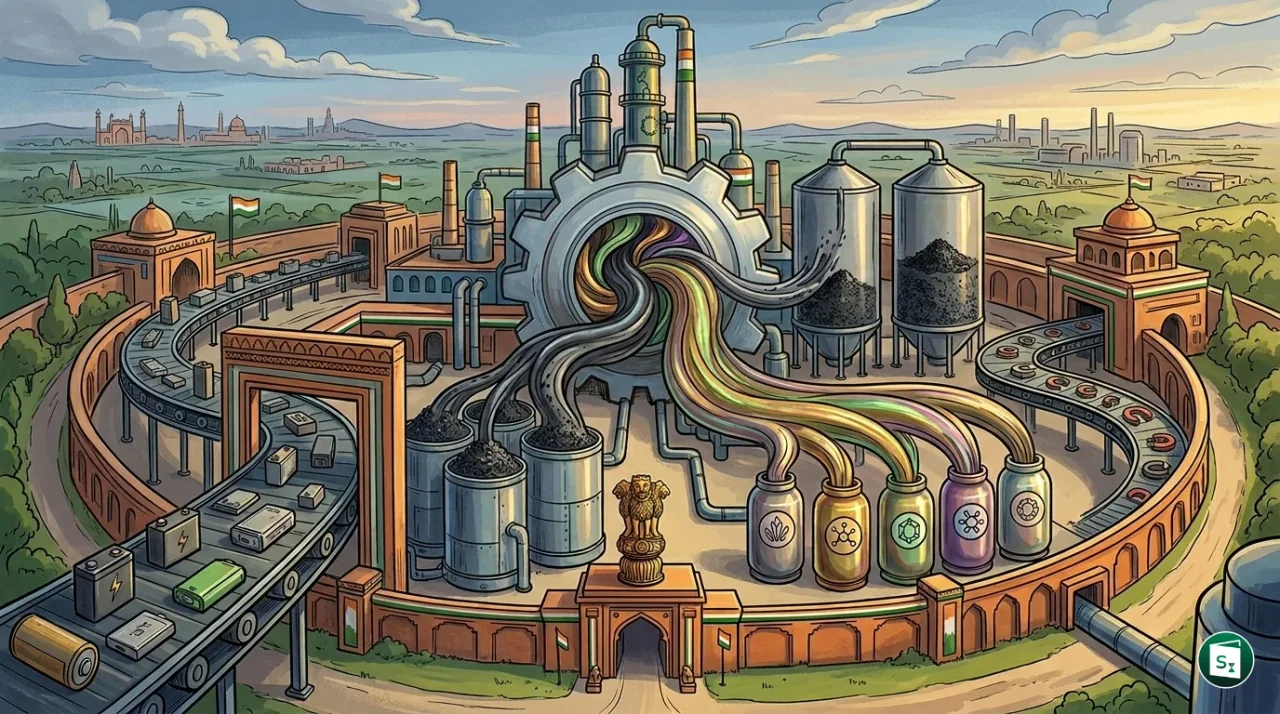
Rocklink India Private Limited has commissioned India’s first integrated recycling facility for lithium-ion batteries and rare earth magnets at Sikandrabad in Uttar Pradesh. Located in the Bulandshahr district, the plant represents a significant milestone in India’s quest for critical mineral security and a self-reliant electronics manufacturing ecosystem. The facility is designed to recover high-value materials from electronic waste, supporting the country’s transition toward electric mobility and sustainable energy.
India’s First Integrated Recycling Facility
The new recycling plant is situated in the UPSIDC Industrial Area of Sikandrabad, located in the Bulandshahr district of Uttar Pradesh. It is the first facility in the country to integrate the recycling of lithium-ion (Li-ion) batteries and rare earth magnets under one roof. Rocklink India is a subsidiary of the Germany-based Rocklink Group, a global leader in specialized recycling technologies for technical waste.
The establishment of this plant aligns with India’s Critical Minerals Mission, which aims to secure the supply of minerals essential for advanced technologies. By localizing the recycling process, the facility reduces India’s dependence on imports for high-value materials like lithium, cobalt, and rare earth elements. These materials are vital for manufacturing everything from smartphones and laptops to electric vehicle (EV) motors and wind turbines.
Strategic Recovery of Critical Minerals
The Sikandrabad facility boasts an initial processing capacity of 10,000 tonnes per annum (TPA) for lithium-ion batteries. This process is expected to yield approximately 5,000 to 6,000 tonnes of black mass annually. Black mass is a high-value mixture containing concentrated amounts of precious metals such as lithium, cobalt, nickel, and manganese, which are recovered from the electrodes of used batteries.
These metals are among the 30 critical minerals identified by the Ministry of Mines as essential for India’s national security and economic growth. The recycling process ensures that these finite resources are reintroduced into the production cycle, supporting the domestic manufacturing of new battery cells. This is particularly crucial for India’s growing EV market, which relies heavily on stable access to these battery-grade materials.
Advanced Processing of Rare Earth Magnets
In addition to battery recycling, the plant processes rare earth magnets at a rate of 60 tonnes per month (TPM). The facility uses semi-automated systems to dismantle and process various permanent magnet alloys, including:
- NdFeB (Neodymium-Iron-Boron)
- SmCo (Samarium-Cobalt)
- AlNiCo (Aluminium-Nickel-Cobalt)
These magnets are indispensable in modern defense systems, electronics, and precision-guided weaponry. To further enhance its capabilities, Rocklink India plans to implement a rare earth chloride unit with a capacity of 1,500 TPA by late 2026. This unit will allow for more advanced refining of rare earth materials, further strengthening the domestic supply chain for these strategic elements.
Strengthening India’s Circular Economy and Net Zero Goals
The facility utilizes Rocklink’s proprietary “R2” recycling technology, which is designed to manage hazardous emissions while achieving metal recovery rates of over 98% for materials like aluminium, copper, and iron. This high efficiency is critical for minimizing the environmental footprint of electronic waste. The company has also introduced its “Magcycle” reverse logistics model in India, which focuses on the efficient collection and transportation of magnet scrap from various sources.
By promoting a circular economy, where waste materials are continuously reused, the facility supports India’s ambitious goal of achieving Net Zero emissions by 2070. Reducing the need for primary mining not only conserves natural resources but also significantly lowers the carbon intensity associated with mineral extraction and processing. The plant also plans to expand into battery refurbishment in the future, extending the life cycle of existing battery packs before they require full recycling.
The Regulatory Framework: Battery Waste Management Rules 2022
The operations at the Sikandrabad plant are governed by the Battery Waste Management Rules, 2022, which replaced the earlier 2001 regulations. These rules introduced the concept of Extended Producer Responsibility (EPR), making manufacturers and importers legally responsible for the collection and recycling of waste batteries. This regulatory push has created a formal market for recycling companies like Rocklink India, ensuring that hazardous battery waste is handled by authorized entities.
The Central Pollution Control Board (CPCB), headquartered in New Delhi and established in 1974 under the Water (Prevention and Control of Pollution) Act, monitors the implementation of these rules. Under the EPR framework, producers must meet specific recycling targets, and the use of domestically recycled materials in new batteries will become mandatory starting from 2027 to 2028. This integrated approach ensures that India builds a robust and environmentally responsible ecosystem for battery and magnet waste.
Key Takeaways
- Rocklink India commissioned the country’s first integrated lithium-ion battery and rare earth magnet recycling facility in Sikandrabad, Uttar Pradesh.
- The plant has an annual processing capacity of 10,000 tonnes for lithium-ion batteries, yielding up to 6,000 tonnes of black mass.
- The facility processes rare earth magnets at a rate of 60 tonnes per month, including alloys like NdFeB and SmCo.
- A rare earth chloride unit with a capacity of 1,500 TPA is scheduled to be operational by the end of 2026.
- The recycling operations are governed by the Battery Waste Management Rules, 2022, which mandate Extended Producer Responsibility (EPR).
- The facility uses the proprietary “R2” technology, achieving over 98% metal recovery for aluminium, copper, and iron.
- CPCB, established in 1974, is the nodal body responsible for monitoring waste management regulations in India.