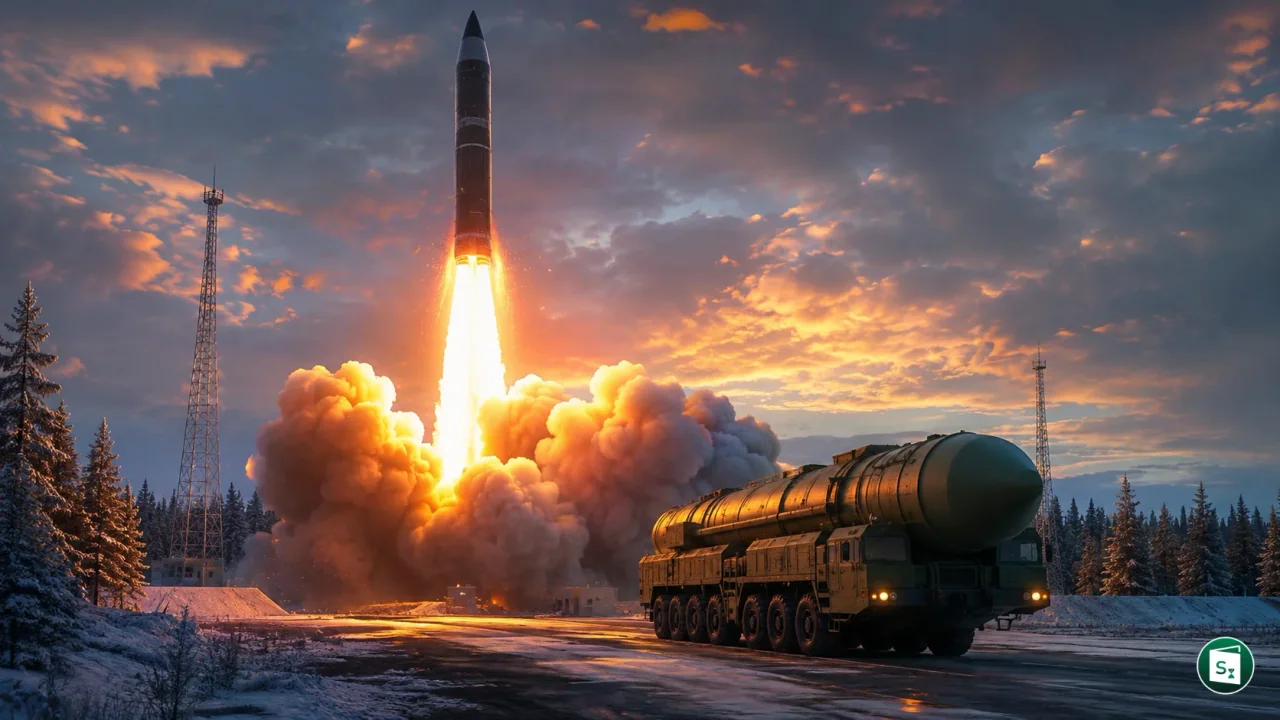
Russia successfully conducted a test launch of its next-generation RS-28 Sarmat intercontinental ballistic missile on 12 May 2026 from the Plesetsk Cosmodrome in northern Russia. The heavy, liquid-fueled missile, known to the North Atlantic Treaty Organisation as Satan II, successfully struck its target at the Kura Test Range on the Kamchatka Peninsula. This launch marks a significant step in the modernization of Russia’s strategic nuclear arsenal, as the system prepares to replace the Soviet-era R-36M2 Voyevoda missiles.
Development and Operational Overview of the RS-28 Sarmat
The RS-28 Sarmat is a next-generation, silo-based, liquid-fueled heavy intercontinental ballistic missile developed to form the core of Russia’s land-based nuclear deterrent. It is operated by the Strategic Rocket Forces of the Russian Federation, a dedicated military branch established on 17 December 1959 and currently commanded by Colonel General Sergey Karakayev. The development of the Sarmat is part of a broader effort to modernize the country’s strategic forces, replacing the aging Soviet-era missile systems that have reached the end of their operational service lives.
The recent test launch was conducted from the Plesetsk Cosmodrome, which was established in 1957 near the town of Mirny in the Arkhangelsk Oblast. Plesetsk serves as the northernmost spaceport in the world and functions as a primary testing facility for Russian strategic missiles. The missile traveled across the Russian landmass to strike its designated target area at the Kura Test Range, located in a remote region of the Kamchatka Krai in the Russian Far East. Operational since 1955, the Kura range is administratively managed by the Plesetsk Cosmodrome and is the primary destination for testing the accuracy and impact characteristics of long-range missiles.
Following the successful test, military planners intend to deploy the first operational regiment of the Sarmat system by the end of 2026. This initial deployment is scheduled for the 62nd Missile Division based in Uzhur, Krasnoyarsk Krai, where modified missile silos are being prepared to house the new weapon system.
Technical Specifications and Capabilities
The RS-28 Sarmat is a three-stage, liquid-fueled super-heavy intercontinental ballistic missile designed to carry a massive payload over global distances. Unlike earlier liquid-fueled systems that required fueling immediately prior to launch due to corrosive propellants, the Sarmat utilizes stable, hydrazine-based propellants. This technology allows the missile to be pre-fueled and stored in a ready-to-launch state inside its silo for decades, combining the high performance of liquid fuel with the rapid response times of solid-fueled missiles.
The physical dimensions of the missile highlight its super-heavy classification. It measures approximately 35.5 metres in length and 3.0 metres in diameter, with a total launch weight of about 208 tonnes. The missile possesses a maximum operational range of up to 18,000 kilometres, allowing it to target almost any location on Earth. It has a payload capacity or throw weight of approximately 10 tonnes, which can be configured with various warhead payloads.
A key capability of the Sarmat is its payload versatility. The missile can carry a payload consisting of 10 to 15 Multiple Independently Targetable Reentry Vehicles (MIRVs), allowing a single missile to target multiple distant locations simultaneously. Additionally, the payload bay is designed to carry the Avangard hypersonic glide vehicle, which can travel at speeds of Mach 20 to Mach 27 and execute rapid, unpredictable mid-flight maneuvers to bypass tracking and interception systems.
The table below compares the technical specifications of the RS-28 Sarmat with its predecessor, the R-36M2 Voyevoda:
| Feature | RS-28 Sarmat | R-36M2 Voyevoda |
|---|---|---|
| Launch Weight | ~208 tonnes | ~211 tonnes |
| Length | ~35.5 metres | ~34.3 metres |
| Diameter | 3.0 metres | 3.0 metres |
| Operational Range | Up to 18,000 kilometres | 11,000 to 16,000 kilometres |
| Payload Capacity | ~10 tonnes | ~8.8 tonnes |
| Warhead Configuration | MIRVs, Hypersonic Glide Vehicles (HGVs), or decoys | MIRVs (up to 10) or single heavy warhead |
| Propulsion System | Three-stage, liquid-fueled | Two-stage and bus, liquid-fueled |
Key Advancements Over the Legacy Voyevoda System
The RS-28 Sarmat introduces several critical technological upgrades over the R-36M2 Voyevoda, enhancing both its operational survivability and its ability to penetrate missile defense networks.
First, the Sarmat is designed with a significantly shortened boost phase. The boost phase is the initial flight segment when the rocket motors are firing and the missile is ascending. By accelerating rapidly and completing this phase much faster than its predecessor, the Sarmat reduces the time that space-based infrared early-warning satellites have to detect the massive heat signature of its engines. This makes it far more difficult for adversaries to calculate its trajectory early in flight.
Second, the structural and chemical engineering of the propellant system has been modernized. While the Soviet-era Voyevoda required highly complex maintenance and fueling protocols to prevent corrosive damage from its liquid propellants, the Sarmat utilizes stable liquid fuels sealed in advanced composite-material tanks. This allows the missile to remain in a state of constant combat readiness for its entire operational lifespan without requiring frequent defueling or dangerous maintenance operations.
Finally, the Sarmat incorporates a highly advanced suite of penetration aids. Rather than relying solely on traditional ballistic trajectories, the Sarmat is designed to deploy multiple decoy systems alongside active warheads. When combined with the Avangard hypersonic glide vehicle, this payload configuration allows the missile to maneuver dynamically in the upper atmosphere, neutralizing the effectiveness of existing mid-course interceptors.
Strategic Implications and Global Defense Impact
The deployment of the RS-28 Sarmat introduces significant shifts in global nuclear deterrence and missile defense planning. A primary strategic capability of the missile is its capacity to execute polar trajectories. Traditional early-warning and missile defense architectures, particularly those established by the United States and its allies, are heavily oriented toward the Arctic to detect incoming threats traveling over the North Pole. Because of its extended range and power, the Sarmat can fly suborbital routes over the South Pole, approaching targets from the south and exploiting major coverage gaps in existing radar arrays.
Western defense analysts and military planners have closely tracked the missile’s development under the NATO designation Satan II. The system is seen as a core component of Russia’s effort to maintain strategic parity with the West, especially in light of developing global missile defense shields. While Russia has faced numerous developmental hurdles, including a high-profile test silo explosion in September 2024 and a launch failure in November 2025, this successful flight test validates the design and signals the impending transition of Russia’s Strategic Rocket Forces to this next-generation heavy ICBM platform.
Key Takeaways
- Russia successfully test-fired its next-generation RS-28 Sarmat intercontinental ballistic missile from the Plesetsk Cosmodrome on 12 May 2026.
- The missile, designated Satan II by NATO, is a liquid-fueled heavy ICBM designed to replace the Soviet-era R-36M2 Voyevoda system.
- The Strategic Rocket Forces of the Russian Federation, established in 1959, operates Russia’s land-based nuclear missile systems under Commander Colonel General Sergey Karakayev.
- The RS-28 Sarmat has a launch weight of 208 tonnes, a payload capacity of 10 tonnes, and an operational range of up to 18,000 kilometres.
- The missile can carry 10 to 15 Multiple Independently Targetable Reentry Vehicles (MIRVs) or the maneuverable Avangard hypersonic glide vehicle, which flies at speeds between Mach 20 and Mach 27.
- Test launches are conducted from Plesetsk in northern Russia to the Kura Test Range in the Kamchatka Krai, which has served as an impact test site since 1955.