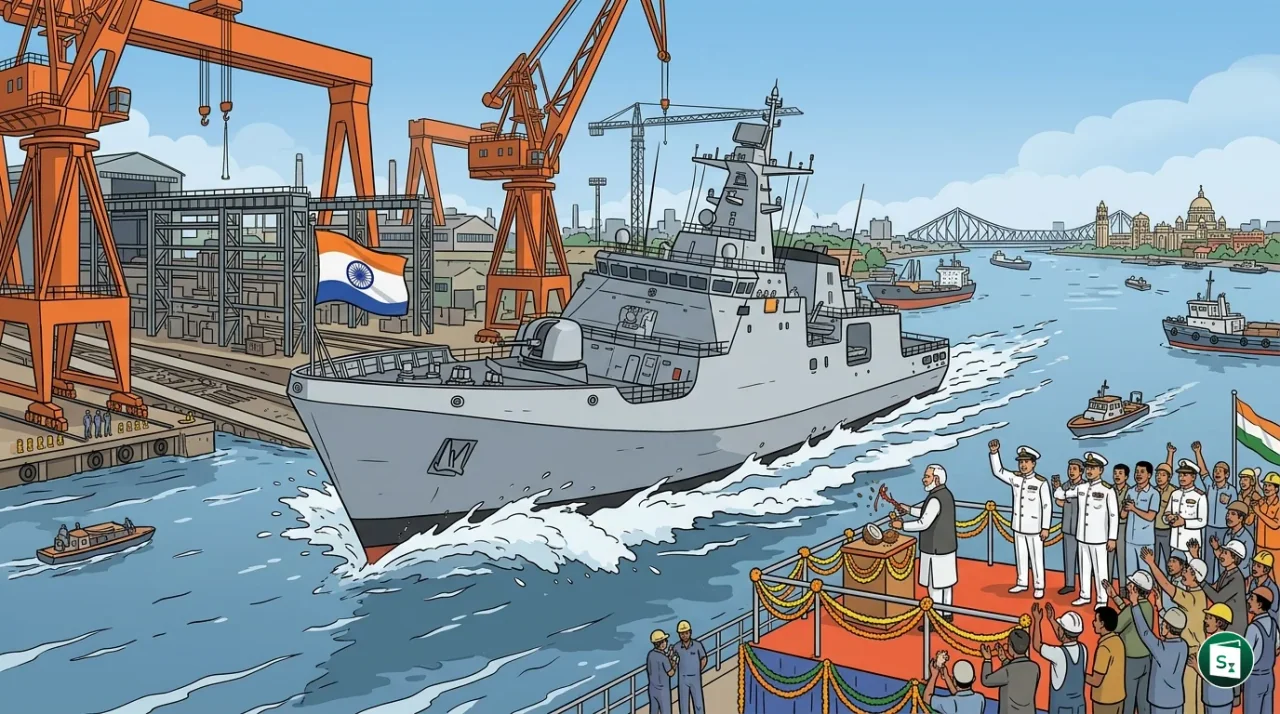
The Indian Navy achieved a significant milestone in its indigenous shipbuilding programme with the launch of Sanghmitra, the first Next Generation Offshore Patrol Vessel (NGOPV), at the Garden Reach Shipbuilders and Engineers (GRSE) facility in Kolkata on May 20, 2026. This vessel is the first of eleven high-tech patrol ships being constructed to bolster India’s maritime surveillance and multi-domain operational capabilities in the Indian Ocean Region. The launch underscores the nation’s progress toward achieving self-reliance in defence manufacturing through the collaborative efforts of domestic shipyards and indigenous design.
A New Milestone in Maritime Surveillance: The Launch of ‘Sanghmitra’
The ceremonial launch of Sanghmitra (Yard 3039) was conducted in the presence of Vice Admiral Sanjay Vatsayan, the Vice Chief of Naval Staff, who served as the Chief Guest. In accordance with maritime tradition, the vessel was launched by Smt. Sarita Vatsayan following the chanting of invocations from the Atharva Veda. The name Sanghmitra, which translates to friend of the community, is inspired by the daughter of Emperor Ashoka, symbolizing India’s historical legacy of spreading messages of peace and cooperation across the seas.
The ship’s crest is equally symbolic, featuring the Ursa Major constellation (Saptarishi) and a red-and-white lighthouse. These elements represent guidance, vigilance, and the vessel’s role as a beacon of security in the maritime domain. This launch is particularly significant as it is the first vessel of the NGOPV class to be launched by GRSE, marking the beginning of a new era in the Indian Navy’s patrol capabilities.
Understanding the NGOPV Project
The Next Generation Offshore Patrol Vessel (NGOPV) project is a major initiative by the Ministry of Defence to modernize India’s maritime surveillance infrastructure. The contract for 11 vessels was signed on March 30, 2023, with a total project value of approximately ₹9,781 crore. This project is being executed under the Buy (Indian-IDDM) category, which stands for Indian Designed, Developed and Manufactured, ensuring a very high percentage of indigenous content.
Role of GRSE and Goa Shipyard
The construction of these eleven vessels is shared between two of India’s premier public sector shipyards. Goa Shipyard Limited (GSL), headquartered in Vasco da Gama and established in 1957, is the lead shipyard for the project and is responsible for the design and construction of seven vessels. Garden Reach Shipbuilders and Engineers (GRSE), based in Kolkata and established in 1884, is constructing the remaining four vessels.
GRSE, which was nationalized in 1960 and currently holds Miniratna Category I status, has a long history of building complex warships for the Indian Navy. The launch of Sanghmitra follows the launch of the first NGOPV by GSL, named Shachi, which took place on March 31, 2026.
Technical Specifications and Capabilities
The NGOPVs are significantly more advanced and capable than the older classes of offshore patrol vessels currently in service. These ships are designed to operate for extended periods in both coastal and deep-sea environments.
| Feature | Specification |
|---|---|
| Displacement | Approximately 3,000 tonnes |
| Length | 113 metres |
| Width | 14.6 metres |
| Maximum Speed | 23 knots |
| Endurance | 8,500 nautical miles at 14 knots |
| Draught | 4 metres |
The shallow draught of only 4 metres is a critical design feature, as it allows the vessels to operate effectively in shallow coastal waters and littoral zones where larger warships might struggle to navigate. Each vessel is designed to accommodate a crew of approximately 24 officers and more than 100 sailors.
Strategic Significance for India’s Maritime Security
The induction of the NGOPV class is a critical component of India’s maritime strategy in the Indian Ocean Region. These vessels are designed to bridge the gap between heavy destroyers and smaller patrol boats, providing a versatile platform for a wide range of security and humanitarian tasks.
Enhancing Multi-Domain Operations
The NGOPVs are equipped to handle a variety of missions that are essential for maintaining the security of India’s Exclusive Economic Zone (EEZ). Their primary roles include:
- Maritime Surveillance and Interdiction: Monitoring ship movements and intercepting suspicious vessels to prevent smuggling and illegal activities.
- Protection of Offshore Assets: Safeguarding vital national infrastructure, such as offshore oil rigs and underwater pipelines, from asymmetric threats.
- Anti-Piracy and Anti-Poaching: Ensuring the safety of commercial shipping lanes and protecting marine resources from unauthorized exploitation.
- Humanitarian Assistance and Disaster Relief (HADR): Providing a rapid response platform for search and rescue operations during natural disasters.
These vessels also support India’s broader geopolitical vision of Security and Growth for All in the Region (SAGAR), which aims to foster cooperation and security among Indian Ocean nations.
Focus on Indigenous Manufacturing (Aatmanirbhar Bharat)
A standout feature of the NGOPV project is its commitment to the Aatmanirbhar Bharat (Self-Reliant India) initiative. The vessels have been indigenously designed by the Indian Navy’s in-house Warship Design Bureau. The project involves a high degree of domestic value addition, with most of the machinery, equipment, weaponry, and sensors being sourced from Indian manufacturers, including numerous Micro, Small and Medium Enterprises (MSMEs).
By keeping the design and construction within domestic shipyards, the project not only enhances national security but also creates thousands of jobs and stimulates the local industrial ecosystem. This self-reliance ensures that the Indian Navy has complete control over the lifecycle of its fleet, from design and construction to maintenance and future upgrades.
The Way Forward
With the launch of Sanghmitra, the Indian Navy is on track to significantly expand its operational reach and surveillance capabilities. The delivery of the first set of NGOPVs is expected to begin in late 2026, marking the start of a phased induction process. This project is a vital part of the Navy’s long-term plan to maintain a fleet of at least 175 ships and submarines by 2035, ensuring India’s status as a dominant maritime power in the Indo-Pacific.
As these vessels enter active service, they will allow larger destroyers and frigates to focus on high-end combat missions, while the NGOPVs handle the critical day-to-day tasks of patrolling, interdiction, and humanitarian assistance. The success of the NGOPV project serves as a blueprint for future indigenous warship programmes, demonstrating India’s capability to design and build world-class naval assets within the country.
Key Takeaways
- Sanghmitra (Yard 3039) is the first Next Generation Offshore Patrol Vessel (NGOPV) launched by Garden Reach Shipbuilders and Engineers (GRSE) for the Indian Navy.
- The NGOPV project involves the construction of 11 vessels at a total cost of approximately ₹9,781 crore, with 7 built by Goa Shipyard Limited (GSL) and 4 by GRSE.
- These vessels are built under the Buy (Indian-IDDM) category and were indigenously designed by the Navy’s Warship Design Bureau.
- Each vessel features a displacement of 3,000 tonnes, a length of 113 metres, and a maximum speed of 23 knots.
- The ships are designed with a shallow draught of 4 metres to enable operations in both deep-sea and shallow littoral waters.
- GRSE, established in 1884 and headquartered in Kolkata, is a Miniratna Category I shipyard under the Ministry of Defence.