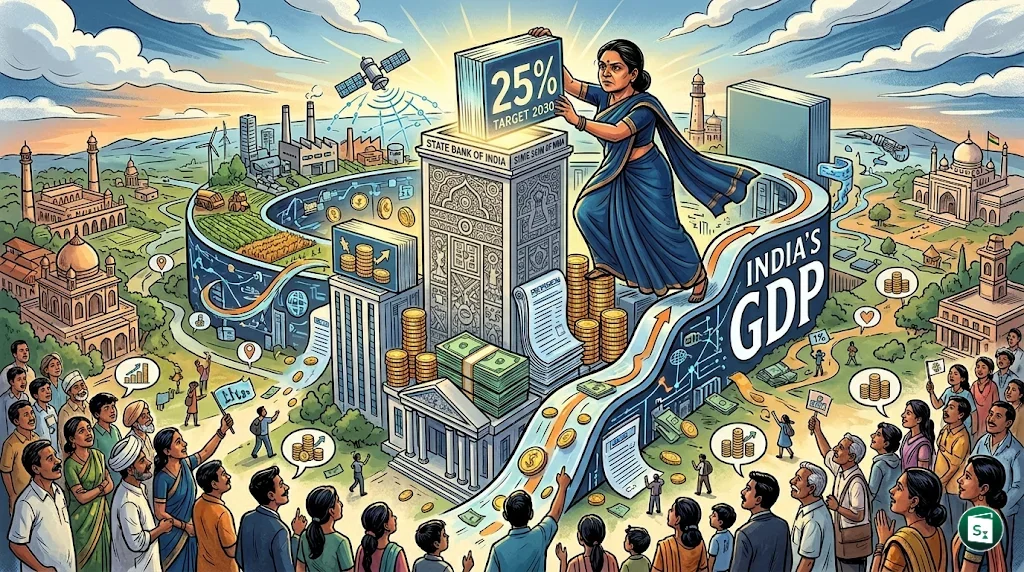
State Bank of India (SBI) has announced an ambitious strategic roadmap to expand its balance sheet to 25% of India’s Gross Domestic Product (GDP) by the year 2030. Up from its current share of approximately 20%, the move highlights the lender’s push to aggressively align its growth with the expanding Indian economy. To achieve this, the bank is rolling out a localized expansion model, treating each of India’s roughly 800 districts as an individual growth unit to systematically capture greater market share.
Decoding SBI’s 2030 Vision
As India positions itself to become the world’s third-largest economy, its banking sector requires massive capital expansion to support ongoing infrastructure, corporate, and retail demands. SBI, functioning as the country’s largest public sector lender, is aiming to outpace the broader economic growth to deepen its financial footprint.
By stretching its balance sheet to cover a quarter of the national GDP, SBI is not just looking at corporate lending but is also planning to balance its portfolio across the agriculture, retail, and Micro, Small, and Medium Enterprises (MSME) segments. The strategy relies heavily on digital activation, leveraging platforms like YONO to onboard customers and activate dormant deposit accounts.
Current Financial Standing
As of December 31, 2025, SBI’s total balance sheet stood at a staggering ₹71.62 lakh crore. The bank’s overall business at the end of the third quarter of FY26 crossed the ₹100 lakh crore mark, driven by robust deposit mobilization and credit off-take.
| Metric (As of Dec 2025) | Amount |
|---|---|
| Total Balance Sheet | ₹71.62 lakh crore |
| Total Business | ₹103.29 lakh crore |
| Total Deposits | ₹57.01 lakh crore |
| Total Advances | ₹46.28 lakh crore |
The District-Level Growth Strategy
To realize its 2030 target, the bank’s leadership, currently headed by Chairman Challa Sreenivasulu Setty (CS Setty), has adopted a highly granular, decentralized approach. Instead of a monolithic national strategy, SBI has identified approximately 800 districts across the country as independent growth units.
During the financial year 2026-27 (FY27), the bank has set a specific short-term goal to increase its market share by exactly 1% in every single district. Bank managers and regional heads are being tasked with drawing up hyper-local strategies tailored to the economic realities of their respective districts, ensuring that credit and deposit growth reaches the grassroots level.
About State Bank of India
The State Bank of India traces its origins back to the Bank of Calcutta, founded in 1806, making it the oldest commercial bank in the Indian subcontinent. In 1921, the Presidency Banks were amalgamated to form the Imperial Bank of India. The institution was later nationalized and renamed under the State Bank of India Act, 1955.
Headquartered in Mumbai, SBI operates as a statutory body and is the largest commercial bank in India by assets, deposits, branches, and employees. It is also one of the designated Domestic Systemically Important Banks (D-SIBs) recognized by the Reserve Bank of India (RBI).
Key Takeaways
- State Bank of India (SBI) aims to expand its total balance sheet to 25% of India’s GDP by the year 2030.
- The bank’s current balance sheet equates to approximately 20% of the national GDP.
- As of December 2025, SBI’s total balance sheet was recorded at a massive ₹71.62 lakh crore.
- Chairman CS Setty has introduced a decentralized strategy treating each of India’s 800 districts as an individual growth unit.
- SBI has set a target to increase its local market share by 1% across every district during the financial year 2026-27.
- The bank was nationalized and constituted in its current form through the State Bank of India Act, 1955, and is headquartered in Mumbai.