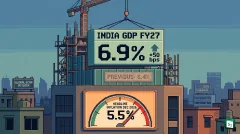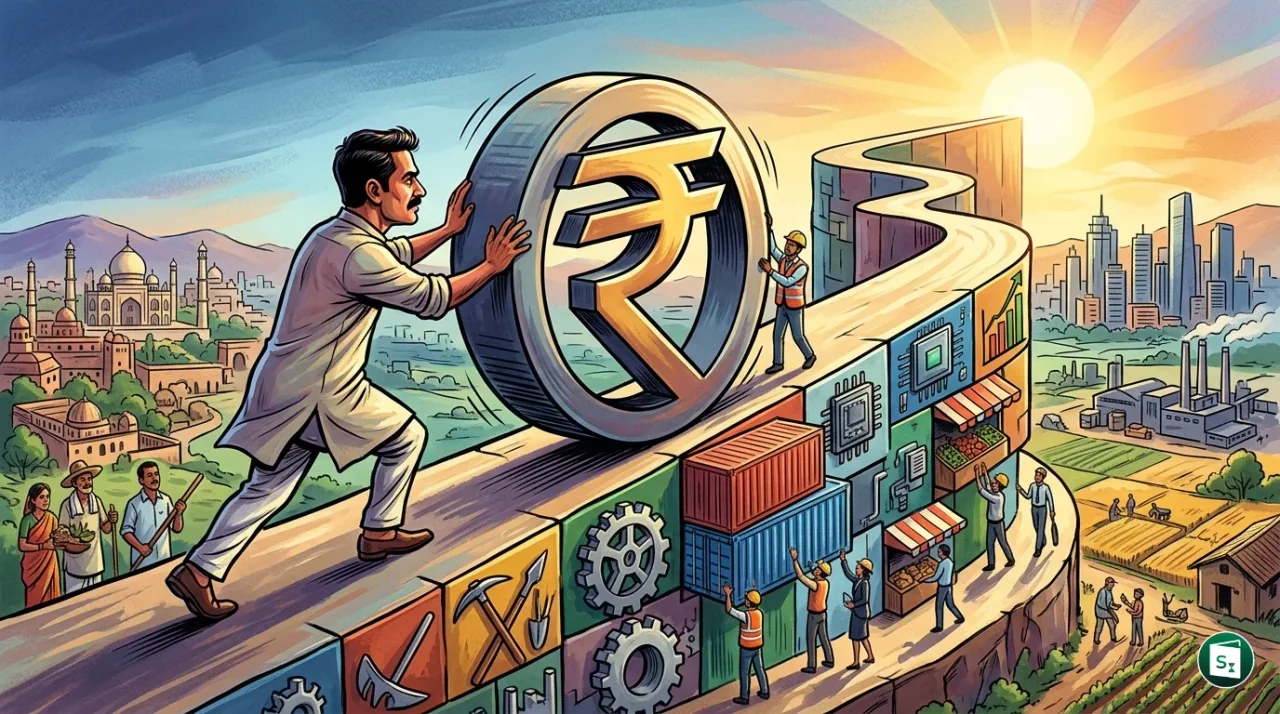
SBI Research has projected India’s real Gross Domestic Product (GDP) growth at 6.6% for the fiscal year 2026-27. This estimate, released in the latest Ecowrap report, signals a shift towards economic normalization following a high-growth phase in the preceding year. While domestic demand remains a primary driver, the report underscores the need for structural safeguards against mounting global geopolitical risks and currency volatility.
SBI Research GDP Projections for FY27
The SBI Research report, authored by the group’s Chief Economic Adviser, provides a detailed quarterly roadmap for India’s economic performance in the current fiscal year. The real GDP growth, which measures economic output adjusted for inflation, is expected to remain steady but moderate compared to the estimated 7.5% growth recorded in the previous fiscal year.
The quarterly projections for FY27 are as follows:
| Period | Growth Projection |
|---|---|
| Quarter 1 (April to June) | 6.8% |
| Quarter 2 (July to September) | 6.6% |
| Second Half (October to March) | 6.5% |
This trend suggests that the Indian economy is entering a phase of stable growth. The slight dip in the second half of the year reflects broader global uncertainties and the high-base effect from the robust performance in 2025. According to the Ecowrap report, maintaining this 6.6% trajectory would be a significant achievement given the prevailing international economic environment.
Drivers of the Indian Economy
The resilience of the Indian economy is primarily anchored in strong domestic consumption. Both rural and urban demand have shown remarkable consistency, providing a buffer against external shocks. Rural consumption, in particular, has been supported by improved agricultural output and government social spending, while urban demand continues to be fueled by the services sector and rising disposable incomes.
Another critical driver is the sustained credit growth across various sectors. Banks and financial institutions have reported robust demand for loans from both corporate and retail segments. This credit expansion indicates healthy private investment and consumer confidence. The State Bank of India (SBI), which was established in 1955 and is headquartered in Mumbai, plays a pivotal role in this credit landscape as the country’s largest public sector lender. Through its research wing, SBI provides these forecasts to help policymakers and investors navigate the evolving financial terrain.
External Risks and the Balance of Payments Challenge
Despite strong domestic fundamentals, the report highlights significant external vulnerabilities. The most prominent risk is the volatility in global energy markets. With Brent crude oil prices hovering above $100 per barrel due to ongoing conflicts in West Asia, India’s import bill remains under pressure. As a major importer of crude oil, high prices directly impact India’s Current Account Deficit (CAD) and inflationary pressures.
The Indian Rupee has also faced depreciation, recently breaching the 95-mark against the US Dollar. This weakening of the currency is driven by global dollar strength and speculative forces. Such volatility poses a challenge to the Balance of Payments (BoP), which is the record of all economic transactions between residents of a country and the rest of the world. A sustained BoP imbalance could erode foreign exchange reserves and dampen international investor sentiment. The report warns that if these external macro clouds persist, they could hinder the speed of India’s economic recovery.
Strategic Recommendations: Strengthening External Buffers
To counter these external pressures, SBI Research has proposed a comprehensive package of structural measures. A key recommendation is the issuance of resurgent Indian Diaspora Bonds. These bonds are designed to attract investment from the Indian diaspora living abroad, thereby providing a stable source of foreign currency. Similar instruments, such as the Resurgent India Bonds (RIB) in 1998 and India Millennium Deposits (IMD) in 2000, were successfully used in the past to shore up foreign exchange reserves during times of economic stress.
Beyond financial instruments, the report advocates for long-term structural shifts to reduce dependency on imports. These include:
- Import Substitution: Encouraging domestic manufacturing to reduce the reliance on foreign goods, particularly in essential sectors.
- Export Competitiveness: Enhancing the quality and cost-effectiveness of Indian exports to capture a larger share of the global market.
- Global Value Chain Integration: Systematically aligning Indian industries with global supply chains to ensure more resilient economic ties.
By focusing on these areas, India can build stronger external buffers that protect the domestic economy from future global shocks. According to the report, these measures are essential to maintain the country’s growth momentum in an increasingly fragmented global economy.
The Road to a Five Trillion Dollar Economy
The report also provides a sobering assessment of India’s goal to become a $5 trillion economy. While the country is on a steady growth path in local currency terms, the depreciation of the rupee has a direct impact on the GDP when measured in US dollars. A weaker rupee means that India’s economic output appears smaller on the global stage, potentially delaying the achievement of the $5 trillion milestone.
SBI Research estimates that if the rupee continues to face significant pressure, the target, originally envisioned for earlier in the decade, may now be realized by FY30. This makes the stability of the exchange rate as crucial as the underlying growth rate. The National Statistical Office (NSO), which operates under the Ministry of Statistics and Programme Implementation (MoSPI), will continue to provide the official data that tracks this progress. For now, the focus remains on ensuring that the 6.6% growth projected for FY27 remains inclusive and sustainable across all sectors.
Key Takeaways
- SBI Research has estimated India’s real GDP growth for the fiscal year 2026-27 (FY27) at 6.6%.
- The quarterly growth projections for FY27 are 6.8% for Q1, 6.6% for Q2, and 6.5% for the second half of the year.
- The Ecowrap report identifies strong domestic consumption and robust credit growth as the primary drivers of economic resilience.
- External risks include high Brent crude oil prices (above $100 per barrel) and the depreciation of the Indian Rupee beyond the 95-mark against the US Dollar.
- To strengthen external buffers, the report recommends issuing resurgent Indian Diaspora Bonds, similar to those used in 1998 and 2000.
- The achievement of the $5 trillion economy target could be pushed to FY30 if significant currency volatility persists.
- The State Bank of India (SBI), which publishes the report, was established in 1955 and is headquartered in Mumbai.