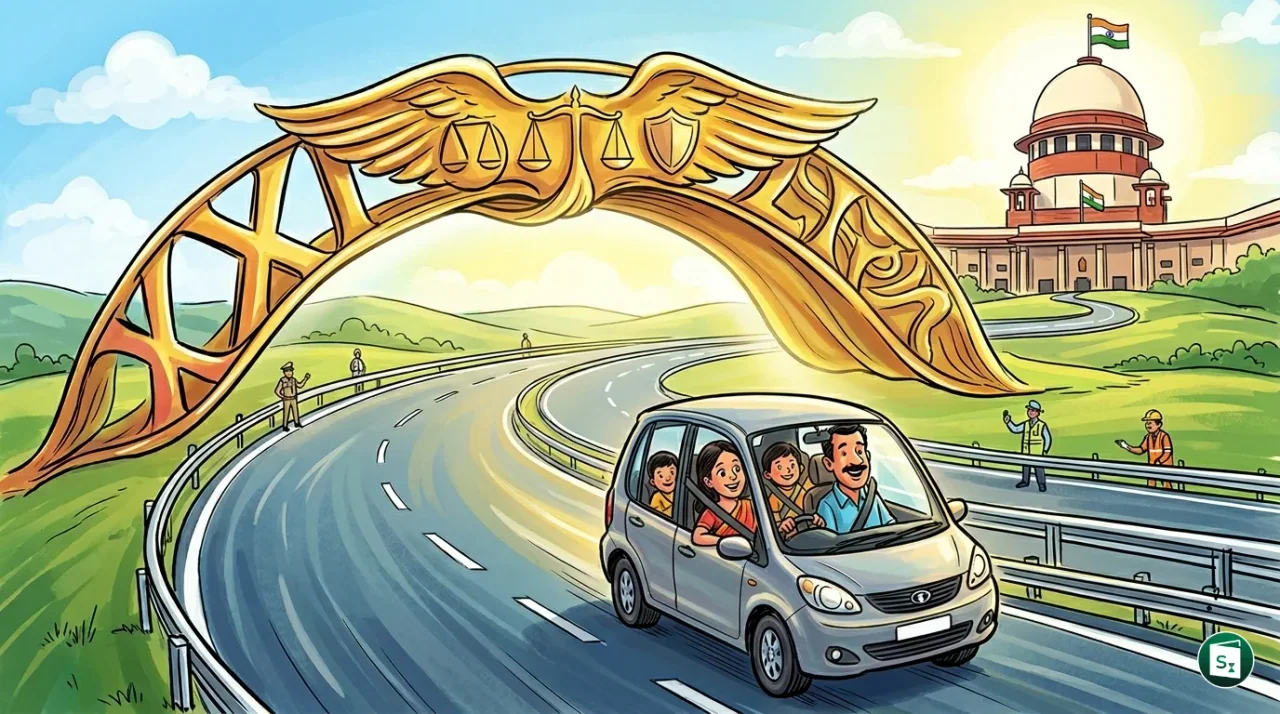
The Supreme Court of India has formally recognized the Right to Safe Road Travel as an essential component of the Right to Life under Article 21 of the Constitution. This landmark ruling emphasizes that the state has a positive obligation to ensure safety on highways and expressways to protect the lives of citizens. The judgment stems from a suo motu case titled In Re: Phalodi Accident, which addressed systemic safety failures following a series of fatal road mishaps.
Recognition of Road Safety as a Fundamental Right
The Supreme Court bench, comprising Justices J.K. Maheshwari and Atul S. Chandurkar, observed that Article 21 is not just a protection against the illegal deprivation of life. Instead, it imposes a duty on the State to create a safe environment where citizens can travel without fear of preventable harm. The Court noted that the high number of fatalities on Indian highways often results from administrative negligence rather than just driver error.
By elevating road safety to a fundamental right, the judiciary has provided a legal basis for citizens to hold authorities accountable for poor road conditions, illegal encroachments, and inadequate safety measures. This paradigm shift means that the State cannot cite financial constraints as an excuse for failing to provide basic safety infrastructure. The ruling clarifies that the sanctity of human life is paramount and must be protected through active governance.
The “In Re: Phalodi Accident” Case: Background and Scope
The case was initiated suo motu by the Supreme Court after two devastating accidents in November 2025. One occurred on the Bharatmala Expressway in Phalodi, Rajasthan, and another in the Rangareddy district of Telangana. These incidents, which resulted in the loss of 34 lives, were identified by the Court as symptoms of broader systemic issues rather than isolated events.
The Court’s inquiry revealed that many highways suffer from illegal roadside structures, improper parking of heavy vehicles, and a lack of quick-response medical teams. The In Re: Phalodi Accident judgment sought to address these gaps by moving beyond the specific accidents to create a national framework for highway safety. It emphasized that road safety is a shared responsibility between the National Highways Authority of India (NHAI), the Ministry of Road Transport and Highways (MoRTH), and state governments.
Key Directives for Highway Safety and Enforcement
To implement the Right to Safe Road Travel, the Supreme Court issued several binding directives aimed at clearing highways of hazards. A primary focus is the removal of unauthorized commercial structures. The Court ordered a complete ban on any new dhabas, eateries, or shops within the Right of Way (ROW) of National Highways. Existing unauthorized structures must be demolished or removed by District Magistrates within a strict 60-day window.
Additionally, the judgment addresses the issue of dangerous parking. Heavy and commercial vehicles are now strictly prohibited from parking on highway carriageways or paved shoulders. Such vehicles must use designated bays, lay-byes, or official wayside amenities. Furthermore, no department or local body can grant licenses or No Objection Certificates (NOCs) for new roadside establishments without prior safety clearance from the NHAI or the relevant Public Works Department (PWD).
Institutional Reforms: The District Highway Safety Task Force
To ensure continuous monitoring and enforcement, the Supreme Court mandated the creation of a District Highway Safety Task Force in every district across India. This task force will be responsible for identifying safety hazards and ensuring that highway protocols are strictly followed. It will work in coordination with the police, transport departments, and the NHAI to maintain a hazard-free environment.
The Task Force’s primary duties include conducting regular audits of highway stretches, overseeing the removal of encroachments, and ensuring that parking violations are penalized. By decentralizing enforcement to the district level, the Court aims to create a more responsive system that can address local issues quickly. This institutional reform is designed to move away from ad-hoc responses and toward a permanent, structured approach to road safety management.
Infrastructure and Emergency Response Mandates
The ruling also sets specific standards for medical and recovery assistance on National Highways. The NHAI has been directed to ensure that ambulances and recovery cranes are available at intervals not exceeding 75 kilometres on all National Highways. This mandate aims to minimize the ‘Golden Hour’ response time for accident victims, significantly increasing their chances of survival.
Beyond emergency response, the Court emphasized the need for better engineering and infrastructure planning. This includes the regular maintenance of road signs, proper lighting at intersections, and the creation of safe pedestrian crossings where highways pass through populated areas. The judgment underscores that ‘safety’ is not a one-time achievement but a continuous obligation that must be integrated into the design, construction, and operation phases of all road projects.
Significance for India’s Road Safety Landscape
This judgment is expected to have far-reaching implications for road governance in India, a country that accounts for a significant share of global road fatalities. By linking road safety directly to the Right to Life, the Supreme Court has empowered citizens to seek judicial intervention if the State fails to provide safe infrastructure. It shifts the burden of proof from the victim to the implementing agency, requiring authorities to prove they took all necessary precautions.
The directives also target the ‘highway economy’—the proliferation of dhabas and commercial hubs that often prioritize business over safety. By enforcing a strict Right of Way, the Court aims to restore the intended function of highways as fast and safe transit corridors. In the long term, this legal precedent could lead to more stringent accountability for road contractors and government officials, potentially reducing the human cost of road travel across the country.
Key Takeaways
- The Supreme Court has declared the Right to Safe Road Travel as an integral part of the Right to Life under Article 21.
- The judgment was delivered in the case of In Re: Phalodi Accident, following fatal mishaps in Rajasthan and Telangana.
- A mandatory District Highway Safety Task Force must be established in every district to enforce safety protocols.
- There is an immediate ban on new unauthorized commercial structures within the Right of Way (ROW) of National Highways.
- The NHAI must ensure that ambulances and recovery cranes are available every 75 kilometres on highways.
- Heavy vehicles are strictly prohibited from parking on highway carriageways or paved shoulders except at designated amenities.