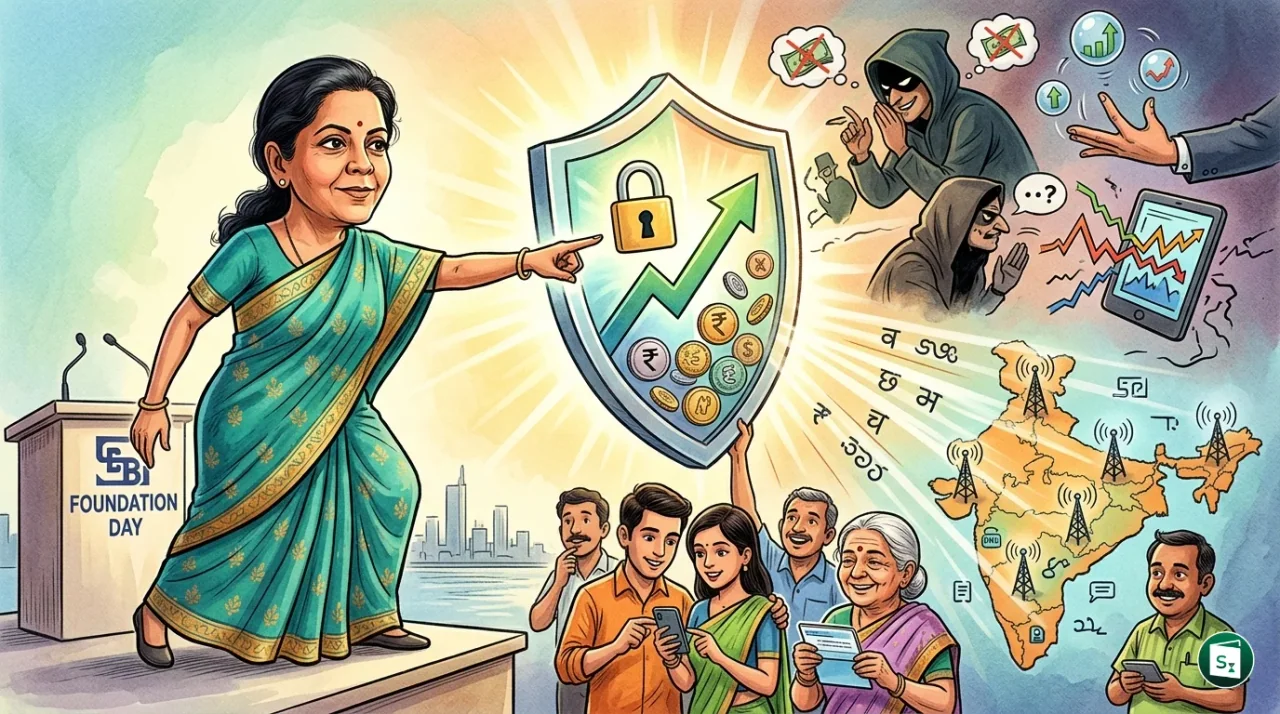
Union Finance Minister Nirmala Sitharaman launched Mission Jagrook, a nationwide investor awareness initiative, at the 38th Foundation Day of the Securities and Exchange Board of India (SEBI) in Mumbai on May 2, 2026. The initiative is designed to protect retail investors from financial fraud, deepfakes, and manipulative content disseminated by unregistered financial influencers. This launch underscores the government’s commitment to balancing rapid market growth with robust investor safeguarding mechanisms.
What is Mission Jagrook?
Mission Jagrook is a multi-dimensional investor awareness campaign conceptualized to address the evolving complexities of the modern financial landscape. The initiative focuses on enhancing financial literacy across diverse demographic segments, ensuring that the benefits of India’s robust market performance are protected by informed decision-making.
The mission prioritizes the protection of first-time and retail investors who are increasingly entering the capital markets through digital channels. It emphasizes the need for a collaborative approach between regulators, market intermediaries, and the public to create a resilient investment ecosystem. By leveraging technology and regional connectivity, Mission Jagrook aims to bridge the information gap that often leaves retail participants vulnerable to exploitation.
Addressing Modern Threats: AI and Deepfakes
One of the central pillars of Mission Jagrook is the mitigation of risks arising from advanced technologies such as Artificial Intelligence (AI) and deepfakes. Finance Minister Sitharaman highlighted that malicious actors are increasingly using AI-generated content to impersonate trusted public figures and provide misleading investment advice. These deepfake videos often promise unrealistic returns, luring unsuspecting investors into fraudulent schemes.
The campaign also targets the growing menace of unregistered financial influencers, commonly known as fin-fluencers. Many such entities monetize the trust of retail investors by promoting manipulative financial content without the necessary regulatory oversight. SEBI has been urged to proactively monitor these digital platforms and take decisive action against unlicensed entities that exploit the enthusiasm of new market participants.
Verification via the “SEBI Check” Tool
To provide a practical safeguard against payment-related frauds, the government highlighted the SEBI Check tool. This digital utility allows investors to verify the registration details and payment credentials of market intermediaries before initiating any financial transaction. By using this tool, investors can cross-verify whether the platform or advisor they are dealing with is officially recognized by the regulator.
The tool is particularly effective in identifying cloned apps and fraudulent payment links that mimic legitimate brokerage platforms. In an era where digital transactions are the norm, such verification mechanisms are essential to prevent the unauthorized transfer of funds to untraceable accounts. SEBI has been directed to integrate this tool more deeply into its mobile applications and web portals for ease of access.
Expanding Outreach in Regional Languages
A key component of Mission Jagrook is its emphasis on regional languages. The Finance Minister noted that for investor protection to be truly effective, it must reach the last mile of the population in a language they understand best. Consequently, SEBI has been tasked with scaling up its awareness campaigns beyond English and Hindi, targeting major regional languages across India.
This linguistic expansion is coupled with an increased presence on digital platforms. Since a vast majority of new-age investors consume information through social media and mobile apps, Mission Jagrook will leverage these channels to disseminate bite-sized, educational content. The goal is to create a culture of vigilance where investors are encouraged to ‘check before they invest,’ thereby reducing the success rate of predatory financial advertisements.
About the Securities and Exchange Board of India (SEBI)
The Securities and Exchange Board of India (SEBI) is the principal regulatory body for the securities market in India. It was established on April 12, 1988, initially as a non-statutory body. However, it was granted statutory powers on January 30, 1992, through the SEBI Act, 1992, enacted by the Parliament of India. SEBI is headquartered in Mumbai, with regional offices in New Delhi, Kolkata, Chennai, and Ahmedabad.
The primary functions of SEBI include protecting the interests of investors in securities and promoting the development and regulation of the securities market. As of early 2026, the chairperson of SEBI is Tuhin Kanta Pandey, who oversees the board’s efforts to maintain market integrity and transparency. SEBI operates under the administrative control of the Ministry of Finance, Government of India.
| Key Fact | Detail |
|---|---|
| Establishment | April 12, 1988 |
| Statutory Status | January 30, 1992 |
| Headquarters | Mumbai |
| Chairperson (2026) | Tuhin Kanta Pandey |
| Nodal Ministry | Ministry of Finance |
Key Takeaways
- Mission Jagrook was launched by Union Finance Minister Nirmala Sitharaman on May 2, 2026, during SEBI’s 38th Foundation Day.
- The primary objective of the mission is to protect retail investors from digital fraud, deepfakes, and manipulative content from unregistered financial influencers.
- The campaign emphasizes expanding investor awareness outreach across digital platforms and in regional languages.
- The SEBI Check tool was highlighted as a mechanism for investors to verify the credentials and payment details of registered market intermediaries.
- SEBI was established in 1988 and became a statutory body in 1992 with its headquarters in Mumbai.
- As of May 2026, Tuhin Kanta Pandey serves as the Chairperson of SEBI.