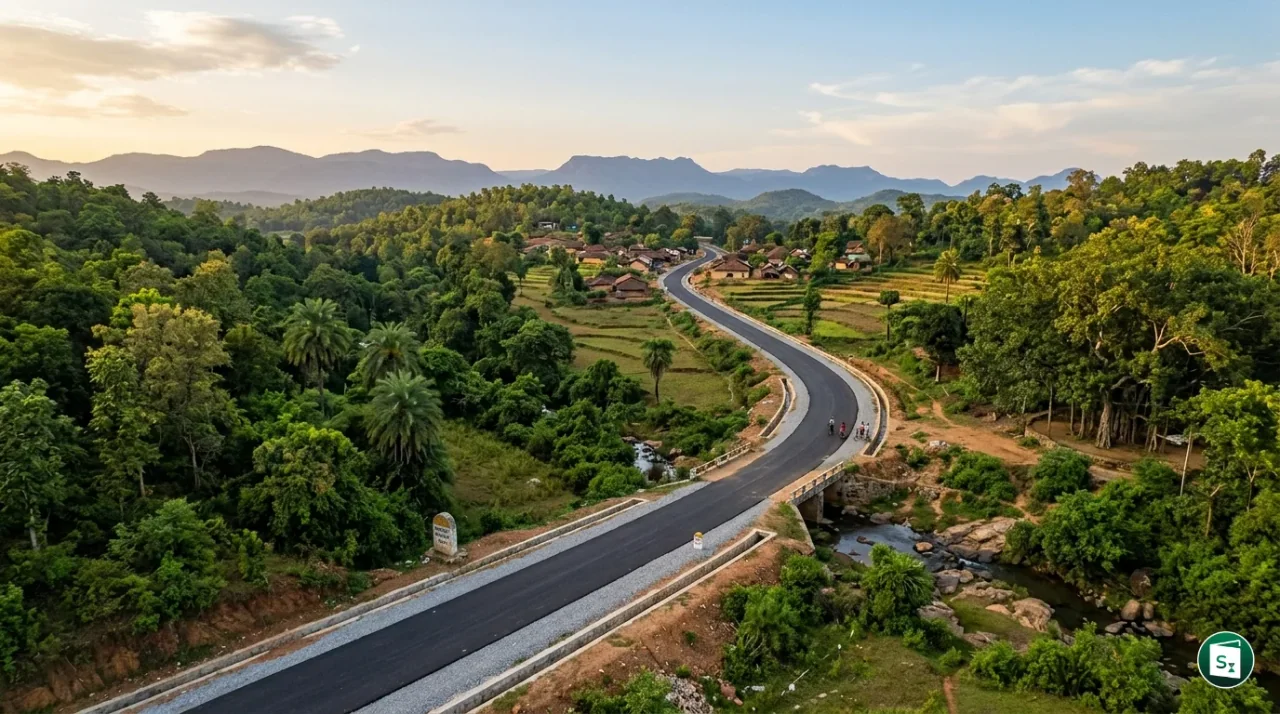
Union Minister Shivraj Singh Chouhan inaugurated the fourth phase of the Pradhan Mantri Gram Sadak Yojana (PMGSY-IV) in Rayagada, Odisha, marking a major expansion of rural infrastructure in the state. With an initial outlay of ₹1,700 crore, the project aims to connect 898 previously isolated habitations across eight districts with all-weather roads for the first time. This initiative reflects the government’s commitment to enhancing last-mile connectivity and socio-economic integration in India’s most underserved regions.
Launch of PMGSY-IV in Rayagada
The launch event took place in Rayagada district, a region characterized by its challenging hilly terrain and significant tribal population. Union Minister for Rural Development Shivraj Singh Chouhan handed over the formal approval letter for the fourth phase to Odisha Chief Minister Mohan Charan Majhi. This event signifies the beginning of a massive infrastructure push in the state, specifically targeting habitations that have remained isolated despite the implementation of previous phases of the scheme.
Project Details and Coverage in Odisha
The initial sanctioned works under PMGSY-IV in Odisha involve 827 road projects with a combined length of 1,701.84 km. These projects are specifically designed to provide all-weather road access to 898 habitations for the very first time. The development is spread across eight key districts, primarily in the southern and western parts of the state.
| Feature | Details |
|---|---|
| Total Estimated Cost | ₹1,698.04 crore |
| Road Projects Sanctioned | 827 |
| Total Road Length | 1,701.84 km |
| New Habitations Connected | 898 |
| Number of Districts | 8 |
The eight districts identified for this phase include Kandhamal, Keonjhar, Khordha, Koraput, Malkangiri, Nabarangpur, Rayagada, and Sambalpur. These regions are often underserved due to geographical constraints and have been prioritized to ensure that the benefits of rural development reach the most remote clusters.
Understanding the Fourth Phase of PMGSY
The Pradhan Mantri Gram Sadak Yojana - Phase IV was approved by the Union Cabinet in 2024 to continue the mission of rural connectivity. While previous phases successfully connected larger habitations, Phase IV focuses on the remaining eligible unconnected habitations. This phase aims to bridge the final gap in rural road infrastructure, ensuring that even the smallest clusters of population have reliable access to markets, schools, and healthcare facilities.
A key feature of PMGSY-IV is its emphasis on providing all-weather roads. Unlike seasonal tracks, these roads are designed to withstand heavy rainfall and other climatic conditions. This is particularly vital for states like Odisha, which often face accessibility challenges during the monsoon season. By ensuring year-round connectivity, the scheme facilitates the movement of agricultural produce and improves the delivery of emergency medical services.
Historical Context: 25 Years of PMGSY
The Pradhan Mantri Gram Sadak Yojana was launched on December 25, 2000, by then Prime Minister Atal Bihari Vajpayee. As the scheme enters its silver jubilee year in 2025-26, it has fundamentally transformed the landscape of rural India. Over the last two and a half decades, the program has evolved through several stages, each addressing a specific requirement in the national rural road network.
| Phase | Launch Year | Primary Focus |
|---|---|---|
| Phase I | 2000 | Initial connectivity to large unconnected habitations. |
| Phase II | 2013 | Upgradation of existing roads to improve durability. |
| Phase III | 2019 | Connecting habitations to schools, hospitals, and markets. |
| Phase IV | 2024 | Connecting the final remaining remote habitations. |
The success of the initiative is largely attributed to its systematic approach to planning and rigorous quality monitoring. By providing reliable access to larger economic centers, the program has played a crucial role in reducing rural poverty and enhancing social mobility across the country.
Funding Structure and Institutional Framework
The implementation of PMGSY-IV follows a model of cooperative federalism. For general category states such as Odisha, the financial responsibility is shared between the Central Government and the State Government in a 60:40 ratio. In contrast, for North-Eastern and Himalayan states, the funding pattern is adjusted to 90:10 to account for the unique geographic and fiscal challenges faced by those regions.
At the national level, the Ministry of Rural Development serves as the nodal ministry for the program. Technical and management support is provided by the National Rural Infrastructure Development Agency (NRIDA). Established in 2002, the NRIDA assists in the planning, monitoring, and quality assurance of rural road projects nationwide. In Odisha, the Rural Development Department of the state government is responsible for the direct execution and long-term maintenance of the sanctioned road networks.
Key Takeaways
- Union Minister Shivraj Singh Chouhan launched the fourth phase of the Pradhan Mantri Gram Sadak Yojana (PMGSY-IV) in Rayagada, Odisha.
- The initiative involves an initial outlay of ₹1,700 crore to connect 898 previously isolated habitations with all-weather roads.
- A total of 827 road projects spanning 1,701.84 km have been sanctioned for eight districts in Odisha during this phase.
- The financial responsibility for the scheme is shared between the Central Government and general category states like Odisha in a 60:40 ratio.
- The PMGSY program was first launched on December 25, 2000, and is currently celebrating its silver jubilee year in 2025-26.
- The National Rural Infrastructure Development Agency (NRIDA), established in 2002, provides essential technical support for rural road implementation.