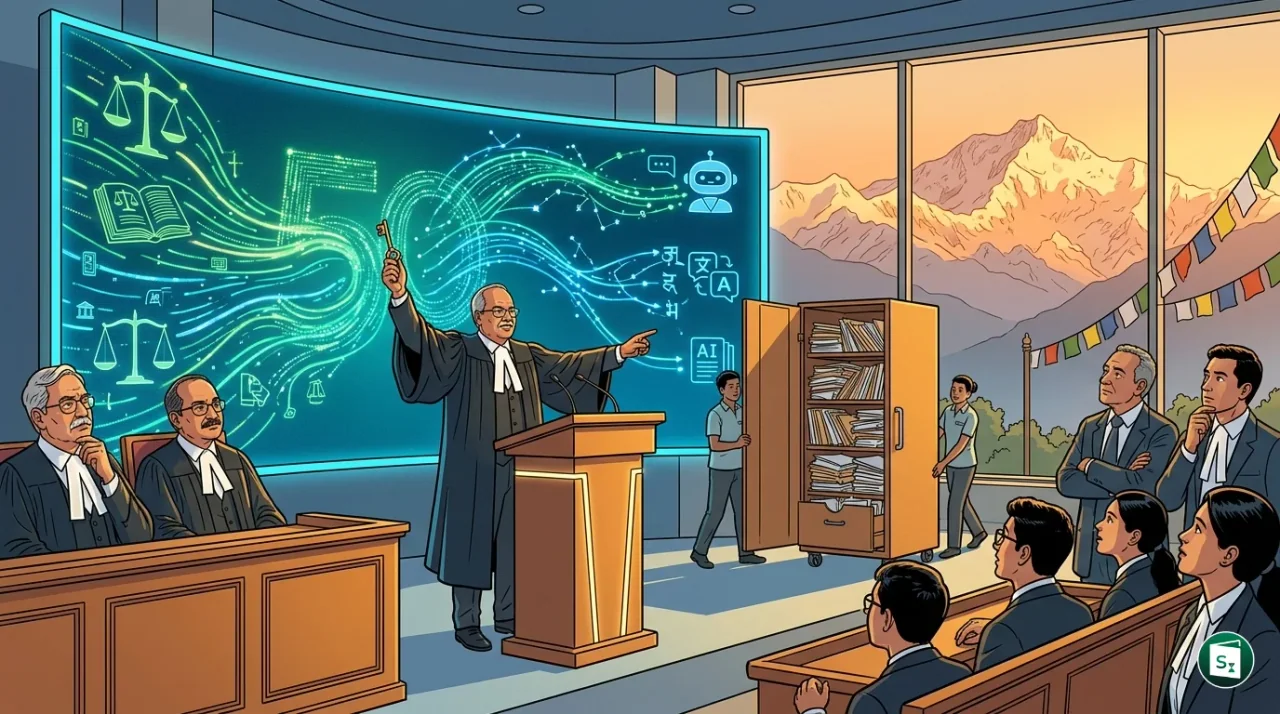
Sikkim has become the first state in India to achieve a fully paperless judiciary, marking a significant milestone in the country’s digital justice mission. The announcement was made by the Chief Justice of India, Surya Kant, during a two-day national conclave on technology and judicial education in Gangtok. This transition incorporates advanced artificial intelligence tools to enhance efficiency and transparency within the judicial framework.
A Milestone in Judicial Digitization
The transition to a digital judiciary in Sikkim involves the complete end-to-end digitization of court processes. This includes the implementation of e-filing for new cases, the maintenance of digital case records, and the conduct of virtual hearings. The initiative is part of the broader e-Courts Mission Mode Project, which aims to make the justice system more accessible and transparent. By eliminating physical paperwork, the judiciary can significantly reduce delays associated with document handling and storage.
The declaration of Sikkim as India’s first paperless state judiciary was made at the National Conclave on Technology and Judicial Education. This event brought together legal experts and judicial officers to discuss the future of digital integration in Indian courts. The conclave emphasized that while technology is a powerful tool, it must serve to assist rather than replace human judicial reasoning.
Integration of Artificial Intelligence: SUPACE and SUVAS
A key highlight of Sikkim’s digital transition is the integration of specialized artificial intelligence tools designed to assist judicial officers. The Supreme Court Portal for Assistance in Court’s Efficiency (SUPACE) serves as a robust legal research tool. It helps judges and legal researchers manage vast volumes of case data by automating the extraction of relevant facts and legal precedents. SUPACE acts as a force multiplier, allowing judicial officers to focus on complex legal reasoning by handling time-consuming administrative tasks.
Another critical tool is the Supreme Court Vidhik Anuvaad Software (SUVAS), a machine-learning-based translation platform. SUVAS is designed to translate judgments and legal documents from English into various Indian regional languages and vice-versa. This tool is instrumental in overcoming language barriers, ensuring that litigants can understand judicial rulings in their native tongues. By making legal information more accessible, SUVAS plays a vital role in democratizing the justice delivery system.
Significance of the 50th Anniversary of Statehood
The achievement of becoming a fully paperless judiciary coincides with the 50th anniversary of Sikkim’s statehood. Sikkim became the 22nd state of India on May 16, 1975. The golden jubilee celebrations, which spanned from 2025 to 2026, highlighted the state’s journey from a Himalayan kingdom to a modern, democratic entity within the Indian Union. This milestone reflects Sikkim’s commitment to modernization and its role as a pioneer in adopting sustainable and efficient governance models.
During the anniversary celebrations, the Prime Minister and other national leaders praised Sikkim for its contributions to the nation, particularly in organic farming and eco-tourism. The digital transformation of the judiciary adds a new dimension to the state’s achievements, showcasing its readiness to lead in the digital era while preserving its unique cultural and geographical identity.
Impact on Justice Delivery in Mountainous Regions
The transition to a digital system is particularly significant for Sikkim due to its challenging mountainous terrain. Geographical distances and difficult weather conditions often pose hurdles to physical document transport and court appearances. By adopting a paperless model and enabling virtual hearings, the judiciary has made justice more accessible to citizens living in remote areas.
The use of technology reduces the need for litigants and lawyers to travel long distances to reach court premises in Gangtok or other district headquarters. This not only saves time and financial resources but also ensures that the judicial process continues uninterrupted by the state’s rugged topography. The move aligns with the Digital India vision of leveraging technology to bridge geographical divides and ensure inclusive development.
The e-Courts Mission Mode Project: A Broader Vision
The digitization of Sikkim’s judiciary is a flagship outcome of the e-Courts Mission Mode Project, which is currently in its Phase III. This national initiative, overseen by the e-Committee of the Supreme Court of India, aims to transform the Indian judiciary into a digital-first system. Phase III focuses on the integration of advanced technologies like AI, blockchain, and cloud computing to enhance the efficiency of court management and the speed of case disposal.
The project is a collaborative effort between the Central Government and the Supreme Court, with the goal of creating a transparent and paperless judicial environment across all states and Union Territories. Sikkim’s success serves as a blueprint for other states, demonstrating that even regions with complex geographical challenges can lead the way in technological adoption. The expansion of these initiatives is expected to drastically reduce the pendency of cases in the Indian judicial system.
Key Takeaways
- Sikkim has become the first state in India to implement a fully paperless state judiciary, integrating end-to-end digital processes.
- The declaration was made by the Chief Justice of India, Surya Kant, during a national conclave held in Gangtok in May 2026.
- The digital transition utilizes SUPACE, an AI tool for legal research, and SUVAS, a machine-learning software for language translation.
- The milestone coincides with the 50th anniversary of Sikkim’s statehood, which began on May 16, 1975.
- This initiative is a part of the e-Courts Mission Mode Project Phase III, aimed at modernizing the Indian judicial system through technology.
- The paperless model enhances accessibility and transparency, particularly addressing the challenges of Sikkim’s mountainous terrain.